

You got your surgery date and your surgeon’s office sent over the pre-op instructions. There’s a list of things to stop taking. Maybe it’s one page. Maybe it’s three bullet points. Either way, nobody explained why any of it matters, and now you’re wondering if your daily fish oil capsule is actually a big deal or just boilerplate. It is a big deal. Here’s the honest version of what’s on that list and why it exists.
Quick Answer
Almost everything on a pre-op stop list exists because of two mechanisms: bleeding risk and anesthesia interaction. NSAIDs, common supplements, and alcohol all affect one or both. Prescription medications are a separate conversation, one that requires your prescribing doctor, not just your surgeon. Give your surgical team a complete list of everything you take, including supplements and vitamins.
Looking for a quick answer? Jump to the FAQ below.
Why the Stop List Exists
Liposuction involves significant tissue manipulation. Blood vessels are disrupted. The body responds with inflammation, fluid shifts, and the clotting cascade. If the clotting cascade is compromised going in, the procedure becomes harder for the surgeon, bruising is more extensive, and healing takes longer.
The anesthesia piece is separate but equally real. Certain substances affect how anesthetic agents are metabolized, how blood pressure responds during sedation, and how long sedation lasts. An unpredictable anesthetic event is the opposite of what anyone in that operating room wants.
This is why the list is not arbitrary. Every item on it has a mechanism. Understanding that mechanism is what makes people actually follow the instructions instead of quietly deciding their turmeric supplement is probably fine.
What’s Normal
- Mild bruising and swelling after lipo, even with full pre-op compliance
- Some discomfort and tightness in treated areas for 1-3 weeks
- Light oozing from incision sites in the first 24-48 hours
- Feeling more fatigued than expected in the first week
When to Call
- Heavy or increasing bleeding from incision sites, especially after day 2
- Fever above 101°F (38.3°C) in the first week
- Sudden increase in swelling, redness, or warmth in one area
- Shortness of breath or chest tightness at any point post-surgery
Over-the-Counter Medications: The Common Culprits
Aspirin, ibuprofen (Advil, Motrin), and naproxen (Aleve) are the three most likely items on your stop list. All three are NSAIDs. They inhibit platelet aggregation, which means your blood’s clotting ability is reduced while they are in your system. Standard surgical guidance is to stop these 1-2 weeks before surgery, though your surgeon will specify the exact timeframe.
Acetaminophen (Tylenol, paracetamol) is different. It does not inhibit platelet aggregation. Most surgical teams consider it acceptable for pain management in the pre-operative period, which matters because patients stopping NSAIDs sometimes need an alternative. Confirm with your surgeon before using it, but it is generally the safe swap.
If you are taking low-dose aspirin for cardiovascular reasons, that is a prescription-level decision. Do not stop it without talking to the cardiologist or physician who prescribed it. The surgeon needs to be in that conversation too.
Supplements: The Ones Patients Forget to Mention
This is the section most patients get wrong. “Natural” does not mean neutral. Several common supplements have documented blood-thinning or anesthesia interaction effects that are clinically relevant before surgery.
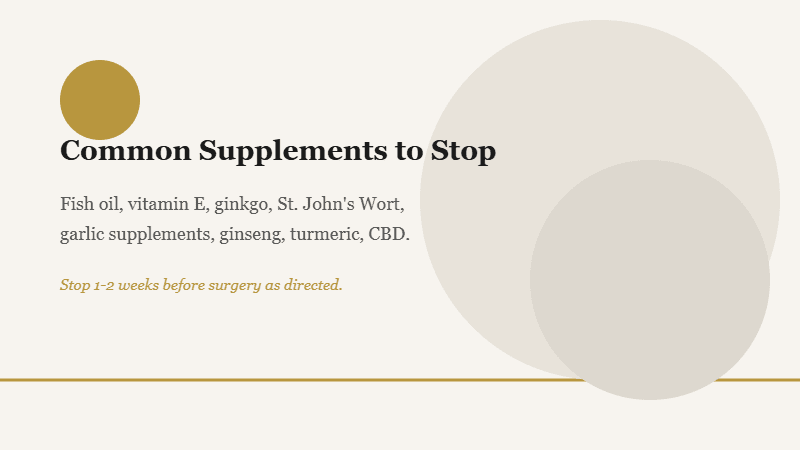
Fish oil and omega-3 supplements are the most commonly missed. They thin the blood, meaningfully enough that most plastic surgeons put them on the stop list. Vitamin E above the standard recommended daily amount has a similar effect. Garlic supplements (not garlic in food, but concentrated supplement form), ginkgo biloba, ginseng, and turmeric or curcumin supplements all have documented blood-thinning properties. CBD oil also appears on many pre-op lists due to potential interactions with anesthesia and liver metabolism.
St. John’s Wort deserves a specific mention. It is the most pharmacologically active supplement on this list. It induces CYP450 enzymes, which are responsible for metabolizing many anesthetic agents. That means the anesthesia can be processed faster or unpredictably when St. John’s Wort is in your system, making dosing harder to control. Stop it at least 1-2 weeks before surgery, ideally longer.
The practical rule: declare everything. Give your surgical team a complete list of every supplement, vitamin, and herbal product you take. They cannot make a sound decision based on partial information.
| Timeframe Before Surgery | What to Stop |
|---|---|
| 4 weeks out | Smoking (ideally; minimum 2 weeks) |
| 2 weeks out | St. John’s Wort, fish oil, vitamin E, garlic supplements, ginkgo biloba, ginseng, turmeric/curcumin, CBD oil |
| 1-2 weeks out | Aspirin, ibuprofen, naproxen, all other NSAIDs (confirm exact date with surgeon) |
| 1-2 weeks out | Alcohol (impairs liver function and wound healing) |
| 48 hours out | Confirm medication list with surgical team; nothing new |
| Day of | Follow fasting instructions exactly; take only surgeon-approved medications |
Alcohol and Smoking: The Two People Minimize
Alcohol is a vasodilator, it affects liver function, and it impairs wound healing. For lipo specifically, it also increases bleeding during and after the procedure. Most surgeons ask patients to stop drinking 1-2 weeks before surgery. This is one instruction that gets quietly ignored more than almost any other.
Smoking has the most significant pre-operative impact of anything on this list. Nicotine and the other components of smoke restrict microvascular blood flow, which is exactly what healing tissue depends on. Poor blood flow to healing tissue increases the risk of infection, delays recovery, and can compromise the final result in ways that are difficult to reverse. The standard recommendation in plastic surgery is to stop smoking 4 weeks before surgery. Even reducing significantly is better than continuing. This is the one pre-op instruction with the highest stakes, and it is worth taking seriously even if nothing else on this list changes your habits.
Prescription Medications: Not the Patient’s Call
Here is what the generic pre-op list usually does not say clearly enough: never stop a prescription anticoagulant without coordinating between your prescribing doctor and your surgeon. Warfarin, rivaroxaban (Xarelto), apixaban (Eliquis), and others cannot simply be paused before an elective procedure. The withdrawal or bridging plan requires clinical judgment. Making that decision unilaterally is more dangerous than the bleeding risk it is meant to address.
Certain antidepressants, particularly SSRIs, also appear on some pre-op consideration lists because of mild platelet effects and potential anesthesia interactions. Again, the decision to adjust or hold these belongs to the prescribing psychiatrist or doctor, not to the patient reading a forum at midnight before surgery.
The GLP-1 category (semaglutide, tirzepatide, and similar medications) has added a newer wrinkle to pre-operative planning. These medications slow gastric emptying, which has direct implications for anesthesia safety and fasting. Some anesthesiologists request that patients pause GLP-1 medications for a defined period before surgery due to aspiration risk. This is a decision made by the prescribing physician and the anesthesiologist together. Inform your surgical team that you are on one of these medications as early as possible in the process.
What to Take Post-Op for Bruising
Arnica is the one supplement that works in the other direction. It does not thin the blood, so stopping it pre-operatively is not the concern. Most patients use arnica in recovery to help reduce bruising visibility and speed resolution. If you want to prepare for recovery before surgery day, look into arnica before your procedure and have it ready for the week after. Details on what the evidence actually supports are in the arnica for bruising guide.
For bruising management
Topical arnica is the standard first line for procedure bruising. Boiron Arnicare gel is the one we recommend; apply around the area, never on broken skin.
For everything else recovery-related, including compression garments and what to eat after lipo, see the faja sizing guide and the post-lipo nutrition guide. Compression is a mandatory part of lipo recovery and the sizing decisions matter more than most patients expect before they are sitting in swelling trying to figure it out.
FAQ
How long before liposuction should I stop taking ibuprofen?
The standard guidance is 1-2 weeks before surgery, though your surgeon will give you a specific date based on your procedure. Ibuprofen, aspirin, and naproxen all inhibit platelet aggregation and increase bleeding risk. If you need pain relief in the pre-op period, acetaminophen is generally acceptable but confirm with your surgeon first.
Do I really need to stop fish oil before liposuction?
Yes. Fish oil and omega-3 supplements have documented blood-thinning effects. They appear on most plastic surgeons’ pre-operative stop lists for this reason. Stop them 1-2 weeks before surgery as directed. The same applies to vitamin E above standard daily amounts, garlic supplements, ginkgo biloba, and turmeric or curcumin supplements.
Can I stop my blood pressure or antidepressant medication before surgery?
No, not without medical guidance. Prescription medications, including blood thinners, antidepressants, and blood pressure medications, require coordination between your prescribing doctor and your surgical team before any changes are made. Some medications have withdrawal risks that are more dangerous than the risks they are meant to address. This is not a decision to make on your own.
The other side of pre-surgical preparation is what to eat. The pre-surgery nutrition guide covers how to build your healing reserves in the month before surgery, and why crash-dieting before a body contouring procedure is counterproductive.
This article is for educational purposes only and is not a substitute for professional medical advice. Always follow your injector’s or surgeon’s specific aftercare instructions.