

The compression garment you wear immediately after liposuction is not the garment you will wear at week six. Switching at the wrong time stretches incision sites, destabilizes seroma formation, and actively worsens fibrosis. Switching too late leaves you in a garment that has lost the structural integrity needed to shape actively remodeling tissue. Here is the clinical logic behind the two-stage protocol and how to execute the transition correctly.
Looking for a quick answer? Jump to the FAQ below.
The short answer
Most patients switch from Stage 1 to Stage 2 between weeks 4 and 6, when swelling has stabilized and the faja no longer feels snug within an hour of putting it on. Don’t switch by the calendar. Switch by fit.
The Structural Difference Between Stage 1 and Stage 2 Garments
Stage 1 and Stage 2 fajas are not just different levels of tightness. They are structurally and mechanically different garments designed for different phases of tissue healing.
Chin liposuction uses a different garment type entirely: a compression chin strap rather than a faja. The compression logic is the same: counteracting gravity and supporting tissue retraction during healing. If you are recovering from chin lipo specifically, the chin liposuction recovery guide covers the chin strap protocol in full.
Stage 1 Faja: Acute Phase Compression
A Stage 1 faja is engineered for the first two to four weeks post-operation. Its key structural features are front hook-and-eye closures for adjustable compression, high-grade elastic panels that provide rigid, uniform pressure across the surgical zone, open crotch design for bathroom access without removing the garment, and boning or semi-rigid panels at the sides and back to prevent the garment from rolling or shifting during the most swollen phase of recovery.
The compression level of a Stage 1 garment is high, typically equivalent to Class III medical compression (40 mmHg or greater at the treated zone). This level of pressure serves three functions in the acute phase. It limits additional fluid accumulation in the interstitial tissue. It supports the cannula channels, the tunnels left by the liposuction instrument, while the surrounding tissue collapses inward. And it counteracts the outward pressure of post-surgical edema to maintain the contour that was surgically created.
Stage 1 garments are intentionally sized for your pre-operative or day-of-surgery measurements. They are meant to feel tight immediately post-op and to accommodate significant swelling without becoming so loose they lose compression efficacy.
Recommended: Stage 1 Faja
For the first weeks you want a full-body stage 1 with flat seams and an open crotch, nothing decorative. This full-body stage 1 faja is the one we point sizing questions to.
Stage 2 Faja: Remodeling Phase Compression
A Stage 2 faja is engineered for weeks four through twelve post-operation, during active tissue remodeling. Its structural features differ substantially. Stage 2 garments use a zipper closure rather than hook-and-eye, allowing more precise compression adjustment as the body shrinks. The fabric is typically a finer-weave, higher-elasticity material that conforms tightly to the new contours of the body rather than imposing rigid structure. Most Stage 2 garments have higher built-in abdomen boards or internal shaping panels to encourage smooth skin attachment to underlying tissue.
The compression level of a Stage 2 garment is moderate to firm, equivalent to Class II compression (30 to 40 mmHg). This is intentionally lower than Stage 1 because excessive pressure during the fibrosis phase can actually worsen fibrosis by creating ischemia in the tissue and disrupting the lymphatic massage schedule that supports drainage of inflammatory debris. The goal shifts from containment to contouring.
Stage 2 garments are sized for your post-swelling measurements, typically your measurements taken between weeks three and four post-op. They should fit snugly but not require straining to close the zipper. If you need to hold your breath to zip, the garment is too small.
Recommended: Stage 2 Faja
When your surgeon clears the switch, look for hook-and-eye rows plus a zipper so the faja tightens as swelling drops. The Sonryse stage 2 is our standing pick for exactly that closure system. If you’re comparing specific stage 2 brands beyond just this pick, the closure and bust design differences are worth a closer look.
This is normal
- Faja feels looser in the morning than at night
- Mild redness along compression lines after removal
- Needing to tighten closures as swelling reduces week by week
Call your provider if
- Numbness or tingling that doesn’t resolve within an hour of removal
- Skin breakdown or open areas under the garment
- Swelling suddenly increases after it had been reducing
The Exact Day and Week Threshold for Switching
The standard transition window is between day 21 and day 30 post-operation. Most plastic surgeons clear patients to switch at the four-week post-op appointment. There are four clinical indicators that determine readiness, and all four should be met before switching. The American Society of Plastic Surgeons’ published guidance runs along the same lines: board-certified plastic surgeon Dr. Josef Hadeed advises that compression garments are usually worn around the clock for a minimum of six weeks, followed by part-time wear if needed for several months, while Dr. Roy Kim notes that stage 1 garments are typically worn 24/7 for the first one to two weeks after surgery.
Indicator 1: Incision Sites Are Closed
All liposuction port sites should be fully epithelialized, meaning the surface skin has closed and no moisture, crust, or scabbing is actively present. Open skin under a Stage 2 zipper closure creates a significant infection risk and allows bacteria to enter the healing tissue. If any port site is still weeping or crusted, delay the switch regardless of the week.
Indicator 2: Acute Swelling Has Plateaued
You should notice that your circumferential measurements are stable across two to three consecutive days. If your measurements are still decreasing daily by more than a centimeter, you are still in the acute fluid-clearance phase. Wait until measurements plateau before ordering a Stage 2 garment, because a garment sized during active shrinkage will be too large within the week.
Indicator 3: No Active Seroma
If your surgeon has identified and is treating a seroma, do not switch to a Stage 2 garment until the seroma has resolved. Seromas require the rigid, even compression of a Stage 1 garment to prevent reaccumulation after aspiration. A Stage 2 garment’s more flexible fabric does not provide adequate counter-pressure against seroma reformation.
Indicator 4: Surgeon Clearance
Your four-week post-op appointment is the appropriate time to confirm readiness. Do not switch garments based solely on elapsed time. Some patients with larger volume liposuction, multiple zones treated simultaneously, or underlying healing challenges require an extended Stage 1 period of five to six weeks. Your surgeon’s physical assessment of your tissue takes priority over any general timeline. For more on planning ahead, see the full guide on how many garments you actually need for a full recovery.
| Week | Stage | Notes |
|---|---|---|
| Week 1–2 | Stage 1 only | 24/7 wear, remove only to shower |
| Week 3–4 | Stage 1 only | Swelling still active, do not switch yet |
| Week 4–6 | Assess for switch | Check fit after washing, measure if unsure |
| Week 6+ | Stage 2 | Full compression, hook-and-eye closure, shaping focus |
| Week 12+ | Stage 2 or graduated compression | Follow surgeon guidance |
The Risks of Switching Too Early
Switching to a Stage 2 faja before the tissue is ready carries concrete clinical risks that directly affect your final result.
Seroma Formation and Reaccumulation
The cannula channels created by liposuction are spaces that fill with fluid as the surrounding tissue collapses inward. During the first three weeks, these channels are actively closing under the constant pressure of the Stage 1 garment. Switching to a less rigid garment before this process completes allows the channels to expand again, creating seroma-prone spaces that may require surgical aspiration.
Contour Irregularities
The tissue is extremely pliable during the first three weeks. Without the structural support of a Stage 1 garment, the healing fascia can develop adhesions in undesirable patterns, creating visible divots, ridges, or uneven contours that are difficult to correct non-surgically. The Stage 1 garment acts as a physical mold during this window. Removing it prematurely removes the mold before the tissue has solidified into its intended shape.
Accelerated Fibrosis
A Stage 2 garment that is too large for the current stage of recovery creates localized pressure differentials. Areas under the zipper tracks or garment seams experience high pressure, while adjacent areas have inadequate compression. These pressure gradients create exactly the type of uneven mechanical stress that drives fibrosis formation in the poorly supported zones. The result is textured, lumpy skin in specific lines and bands corresponding to the garment’s structural weak points.
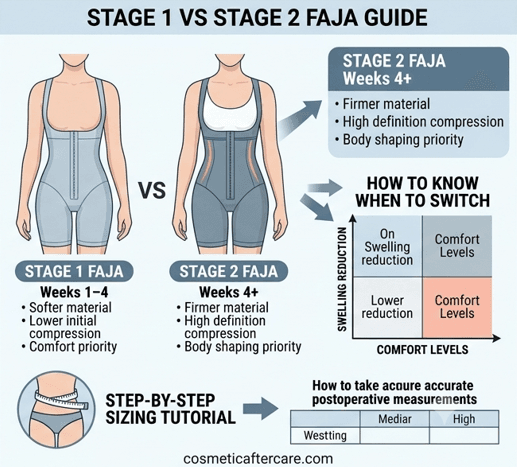
How to Measure Your Shrinking Waistline to Order the Correct Stage 2 Size
Sizing a Stage 2 faja requires a different protocol than sizing a standard garment. Your measurements will change week by week, and the garment must fit the body you have at the moment of ordering, not the body you had before surgery or the body you expect to have in another two weeks.
What You Need
You need a soft tape measure, a notebook or phone to record measurements, and a mirror. Take measurements in the morning after waking and before eating or drinking, as measurements taken later in the day are artificially increased by food volume and gravitational fluid pooling. Remove your Stage 1 garment for five minutes before measuring to allow the tissue to decompress slightly and give a more accurate reading of your actual circumference.
Measurement Points
Take the tape measure and record all of the following measurements while standing upright, with your weight distributed evenly on both feet, not holding your breath. First measure your waist at the narrowest point of your torso, typically two to three inches above the navel. Second measure your navel circumference, directly at the level of your belly button. Third measure your upper abdomen, approximately three inches above the navel. Fourth measure your hips at the widest point, typically seven to nine inches below the navel across the fullest part of the glutes. Fifth measure your upper thighs if you had inner or outer thigh liposuction, at the fullest point of each thigh with one inch of separation between your feet.
Record each measurement to the nearest quarter inch or half centimeter. Take each measurement twice and use the average of the two readings. Swelling creates a slight asymmetry between measurements taken moments apart, and averaging removes that variance.
How to Apply Your Measurements to Faja Sizing Charts
Colombian faja brands, which dominate the post-op compression market, use their own size charts that do not correspond to standard clothing sizes. The measurement that drives the size is almost always the waist circumference, not the hip or bust. Find the brand’s specific size chart before ordering. Most quality Stage 2 brands provide a chart correlating waist circumference in both inches and centimeters to their proprietary size designations, which typically run from XS through 5XL or use number designations like 32 through 52.
If your measurements fall on the border between two sizes, choose the smaller size for a Stage 2 faja. The garment is designed to have a firm compression fit, not a comfortable wear fit. A slightly smaller garment that requires moderate effort to zip correctly provides therapeutic compression. A garment that slides on easily is too large to provide the contouring pressure the tissue needs.
Account for Continued Shrinkage
Between week four, when you are sizing, and week eight to twelve, when you will finish needing the Stage 2 garment, most patients lose an additional one to three inches of circumference as residual swelling resolves and fibrosis softens. This means a garment sized perfectly at week four will feel slightly looser by week ten. This is expected and acceptable. Do not size down aggressively to account for projected shrinkage. The garment needs to fit well now, during the period of maximum therapeutic benefit.
Some patients purchase two Stage 2 garments: one sized for weeks four through seven, and a second sized one size down for weeks eight through twelve. This approach maximizes compression efficacy throughout the full remodeling phase and is particularly worthwhile for patients with larger volume procedures or multiple zones treated. Having two garments also allows daily washing of the garment in use without going uncompressed during drying time.
Recommended: Stage 2 Faja (Sizing Kit Pick)
If you are ordering two garments to cover the full remodeling window, choose one with hook-and-eye rows plus a zipper so each stays adjustable as swelling drops. The Sonryse stage 2 is our standing pick for exactly that closure system, ordered one size down for the second garment.
When the Stage 2 Faja Is No Longer Needed
Most surgeons discontinue compression garment use between weeks ten and fourteen post-op for standard liposuction cases — for a full breakdown, see the guide on how long to wear your faja at each stage of recovery. The tissue has remodeled sufficiently that external compression is no longer therapeutic and may begin to impede normal lymphatic function. Your discharge from garment use should be surgeon-directed, based on palpation of the tissue at your follow-up appointment, not based on elapsed time alone. Patients who discontinue the Stage 2 faja before tissue is fully stable risk late contour irregularities as the remaining inflammatory edema redistributes without compression guidance.
Frequently Asked Questions
How do I know if my Stage 1 faja is still working?
Three things to check: compression loss, garment rolling, and closure fit. If you can pinch the fabric away from your body and it no longer snaps back firmly, the compression panels have fatigued. If the garment rolls down from the waist or up from the hem during normal movement, the structural boning has softened and it’s no longer holding its shape. And if the hooks or clasps that once needed effort to close now feel loose — or if you’ve had to move to a tighter set of hooks — the garment has stretched beyond its therapeutic range. Any one of these signs means it’s time to assess whether you’re ready to transition.
Can I switch to Stage 2 early if my swelling goes down fast?
Fast swelling resolution is a great sign, but it doesn’t automatically mean you’re ready to switch. The real green light is measurement stability — your circumferential measurements need to be consistent across two to three consecutive days before your tissue is genuinely ready for the contouring pressure of a Stage 2 garment. A measurement that’s still dropping by even a centimeter per day means fluid is still actively clearing, and a Stage 2 faja at that point won’t fit correctly by the time the swelling finishes resolving. Most importantly, your surgeon needs to sign off. They’ll check incision closure and tissue feel at your follow-up, and their assessment takes priority over how your swelling looks from the outside.
What if I can’t afford two fajas?
Be honest with yourself here: if you have to choose, prioritise the Stage 1 garment. The acute recovery window is when compression matters most for seroma prevention and incision support. A Stage 1 faja that fits correctly and holds compression is not optional — it directly affects your healing. For the Stage 2 transition, the workaround is to time your purchase strategically: wait until your measurements have fully stabilised (usually around week four), buy a single well-fitted Stage 2 garment, and wash it on a rotating schedule. Two fajas make the washing schedule easier, but one correctly-fitted garment worn consistently is better than two poorly-fitted ones. Don’t sacrifice Stage 1 quality to buy Stage 2 early. For the fuller shopping list and timing across every garment and tool a lipo patient actually needs, see our complete lipo recovery kit guide.
For patients recovering from male breast reduction, the same compression staging logic applies to the chest vest after gynecomastia surgery — the same principles of transitioning between compression levels apply when moving from a firmer post-surgical vest to lighter maintenance wear.
The compression protocol described here applies equally to VASER liposuction patients. Because VASER carries a higher risk of seroma and involves different tissue disruption than standard lipo, consistent garment wear matters at least as much as with any other procedure. The VASER liposuction recovery guide explains what is different about VASER recovery and why the garment schedule is identical to standard lipo regardless.
This article is for educational purposes only and is not a substitute for professional medical advice. Always follow your injector’s or surgeon’s specific aftercare instructions.