
You asked your surgeon how long you’d need to wear your faja. They said “about eight weeks.” You nodded, went home, and immediately went down a rabbit hole of forum posts where half the people said four weeks and the other half said six months. Here’s the honest version: “eight weeks” is a starting point, not a finish line, and it tells you almost nothing useful about the three or four transitions that actually matter between now and the day you stop wearing it.
Why the Single Number Answer Is Almost Useless
The amount removed, how many areas were treated, your body’s natural swelling pattern, and how disciplined you are about wearing the garment in the first place all affect how long your recovery compression phase lasts. A patient who had a small amount removed from one flank area and a patient who had lipo 360 with a significant volume removed are not on the same timeline, even if their surgeons both said “eight weeks.”
What actually helps you is understanding the transition points: when to switch from stage 1 to stage 2, when to go from full-time wear to part-time, and when to wean off entirely. Those milestones tell you far more than the total week count.
Stage 1: What 23 Hours a Day Actually Means
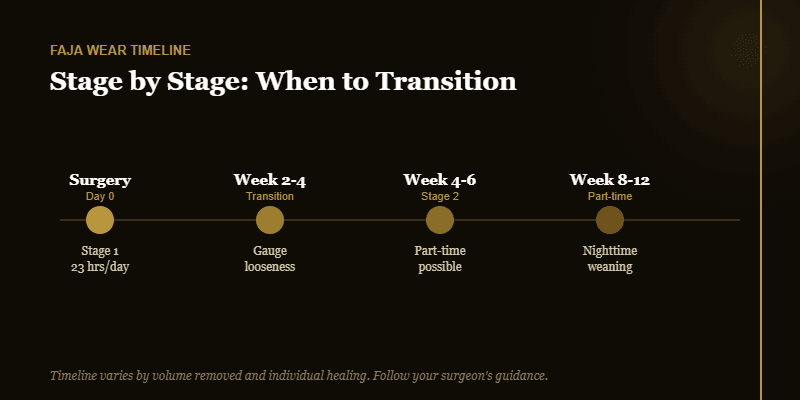
Stage 1 compression is typically worn for the first two to four weeks after surgery, though some surgeons extend this to six weeks depending on what was done. During this phase, many patients also use ab boards or lipo foam underneath the garment to smooth compression and reduce pressure irregularities. The standard guidance is 23 hours a day. That one hour off is not leisure time. It is for showering and washing the faja. ASPS member surgeon guidance published on plasticsurgery.org points to a similar window, describing a compression garment worn for four to eight weeks after liposuction. That guidance also puts a six-week, around-the-clock minimum on garment wear before easing into part-time use, which lines up with the full-time-to-part-time transition described below.
In practice, this means you sleep in it. You wear it to work. You wear it on the couch. The only exception most surgeons allow in the very early days is the brief period you are actually bathing and hand-washing the garment to dry. If you are still sizing or have just received your garment, the stage 1 vs stage 2 sizing guide covers what to look for and how to confirm you are in the right garment for this phase.
The first week is the hardest. Patients consistently describe day three as the day they panic, not because anything is wrong, but because the swelling peaks around that point and the faja suddenly feels brutal. That is normal. It is doing its job.
Recommended: Stage 1 Faja
For the first weeks you want a full-body stage 1 with flat seams and an open crotch, nothing decorative. This full-body stage 1 faja is the one we point sizing questions to.
The Stage 2 Transition: It’s Not a Date on the Calendar
The single most misunderstood moment in faja recovery is the transition to stage 2. People fixate on a week number, usually weeks three to six depending on what they read, but the real signal is physical, not calendrical.
Your stage 1 faja should feel noticeably loose. Not slightly more comfortable because the swelling went down a bit, but actually loose in a way that tells you the garment is no longer providing meaningful compression. The swelling pattern changes too: instead of uniform puffiness, you may notice your abdomen looks different in the morning versus the evening as fluid redistributes more freely. When those two things happen, you are ready to transition.
Stage 2 garments are lighter, easier to move in, and often have more options for coverage and style. They still provide real compression, just less extreme than stage 1. The faja sizing and switching guide goes into this in detail, including how to size yourself for stage 2 when you are still swollen and your measurements are not yet settled. The short version: size for your current swollen measurements, not your expected results.
Recommended: Stage 2 Faja
When your surgeon clears the switch, look for hook-and-eye rows plus a zipper so the faja tightens as swelling drops. The Sonryse stage 2 is our standing pick for exactly that closure system.
Part-Time Wear and Nighttime Weaning
Somewhere between weeks six and twelve for most patients, full-time wear transitions to part-time. This usually looks like wearing the faja during waking hours but taking it off at night. Your surgeon will guide the specific timing, but the body signals matter here too: if you notice increased evening swelling or a sense of heaviness in your abdomen after a day without the garment, your tissues are telling you they are not ready.
The next step is dropping to daytime-only wear, then to wearing it only when you know you will be on your feet for extended periods, like travel or long workdays. This is the weaning phase, and it is gradual by design. Tissues that have been supported continuously need time to adapt to functioning independently.
Some people wear a stage 2 garment occasionally for comfort up to six months or beyond. That is not a sign of failure or excessive swelling. Bodies that had significant volume removed sometimes just feel better with periodic support at the three to five month mark, particularly during physical activity.
Signs You Stopped Too Early
The most common self-inflicted setback in lipo recovery is weaning off the faja too fast. The signs are specific and hard to miss.
Evening swelling that was not there before is the clearest indicator. If you had a week of stable, comfortable days and then started noticing your abdomen puffing up by late afternoon after going faja-free, you moved too fast. A feeling of heaviness or pressure when upright for more than a few hours is another one. Some patients describe it as their midsection feeling “unsupported” in a way that is vaguely uncomfortable rather than painful. That sensation is accurate feedback.
Putting the faja back on is not failure. It means you are paying attention. Most surgeons would rather hear that you added another two weeks of part-time wear than learn you pushed through swelling and ended up with uneven results at the three-month mark.
When Longer Is Not Better
This one gets less attention. Wearing your faja for six months when your surgeon cleared you at ten weeks is not extra dedication. Prolonged compression past the point where your tissues need it can interfere with circulation, create dependence (meaning the tissues stop self-regulating fluid because the garment has been doing it), and in rare cases contribute to skin sensitivity or contact irritation. If your surgeon says you are done and you feel structurally comfortable without the garment, trust that. The goal was always to not need it.
There is also the matter of the how many fajas you actually need question, which connects to the timeline because the right garment for each phase matters as much as the duration. The wrong stage 2 garment worn too long does less for you than the right one worn for the appropriate window.
When to Call Your Surgeon
Swelling that is noticeably asymmetrical, warm to the touch, or worsening after day five instead of slowly improving warrants a call. Fever combined with any change in swelling is always worth calling about. Skin changes, including a rash or significant redness where the faja sits, should also be reported. And if you have removed the faja and notice a firm lump, area of induration, or unusual contour change that was not there before, have it evaluated. Most of those findings turn out to be normal post-lipo changes, but they are worth confirming.
FAQ
Can I sleep without my faja in the first two weeks?
Most surgeons say no for the first few weeks. The 23-hours-a-day recommendation applies to nighttime too, because swelling does not pause when you sleep. Some patients find sleeping in a stage 1 faja uncomfortable at first, but this typically improves by the end of the first week as the initial inflammation settles.
What if my faja still feels tight at week four?
Residual tightness at week four is common with larger volume cases or multiple treatment areas. It does not necessarily mean you are behind schedule. Check whether the tightness is uniform compression or if there is one specific area that feels differently tight, which could indicate uneven swelling worth mentioning to your surgeon. Unless your surgeon has specifically indicated a transition date, follow the looseness signal rather than the calendar.
Is there a point where wearing the faja stops helping with swelling?
Yes. Once your lymphatic system has reestablished normal drainage patterns — something you can actively support with a structured lymphatic massage schedule — and your connective tissue has adapted to the new contour, the faja is providing comfort rather than therapeutic compression. For most patients this happens somewhere in the eight to twelve week range, though it varies. If the garment is not noticeably reducing any swelling or discomfort and your surgeon has cleared you, continuing out of habit is not harmful but it is not adding benefit either.
This article is for educational purposes only and is not a substitute for professional medical advice. Always follow your injector’s or surgeon’s specific aftercare instructions.