
The clinic paperwork tells you to arrive in loose clothing, don’t eat after midnight, bring your ID and your payment. What it doesn’t tell you is what the next 48 hours actually looks like, and if you haven’t prepared your home and your car ride before you go in, you’re going to be figuring it out while you’re swollen, leaking, and in more discomfort than you expected.
This list is built around the question nobody thinks to ask until they’re already home from surgery: what would I have wanted within arm’s reach right now? The things you need to pack for lipo surgery day fall into three windows: the car ride home, the first 48 hours at home, and what to hold off buying entirely until you know more about your recovery, a longer version of that last question is covered in our full lipo recovery kit breakdown.
The Car Ride Home: Plan This Before You Walk Into the Clinic
The ride home after liposuction is genuinely uncomfortable, and most patients aren’t prepared for it. You’re swollen, you’re tender at every incision site, you’re in a compression garment, and you need to stay in the car for as long as the drive takes. A few things make this substantially better.
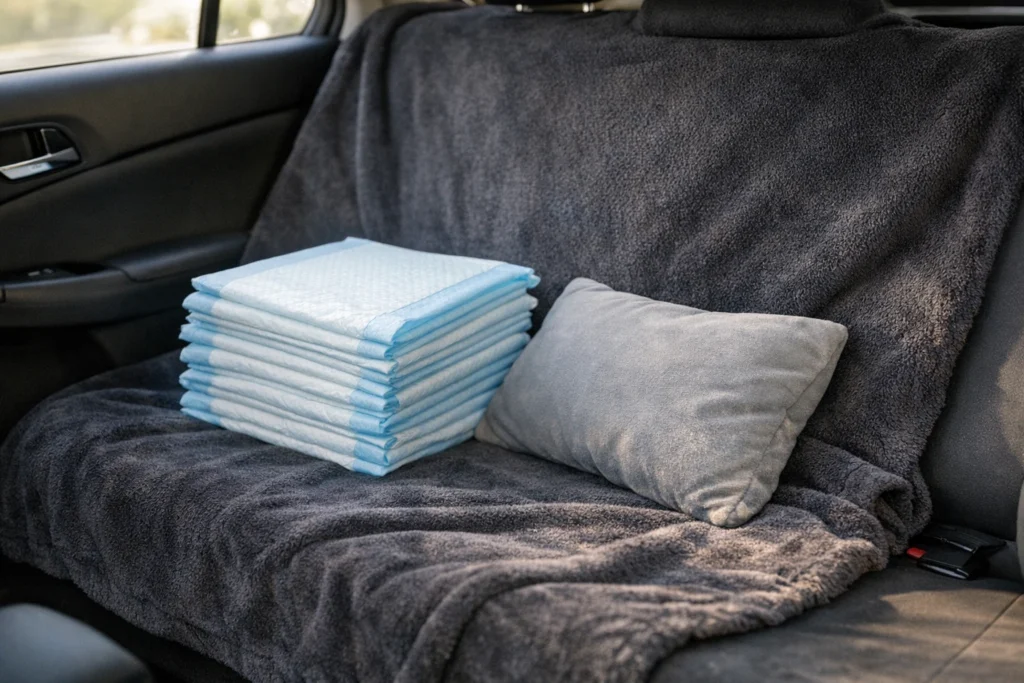
Chux pads (also called underpad or incontinence pads) are essential. Liposuction incisions are left open to allow fluid to drain, which is normal and expected but looks alarming the first time you see the volume. That fluid will seep through your garment and onto whatever you’re sitting on. Put chux pads on the car seat before you leave for the clinic. Bring extras. This is not a “might happen” situation: it will happen, and the amount surprises most people. Dark-colored clothing helps too. Your first outfit post-surgery should be disposable-quality or at minimum something you don’t care about.
For the first leaky nights
Nobody warns you how much those first nights drain. A stack of disposable underpads protects your mattress and your dignity; Medline disposable underpads are the pack we recommend.
A small pillow between the seatbelt and your abdomen matters more than it sounds. The seatbelt sits directly over the treated area. A soft pillow or folded blanket as a buffer takes the edge off every bump in the road. Have it in the car before you leave. Your driver should know this plan before they arrive.
Reclining the seat slightly reduces the pressure through the lap belt and often feels more manageable than sitting upright. On long drives home, plan for a stop if possible. Getting the door open and shifting position every 60 to 90 minutes helps.
What to Pack for Lipo Surgery Day: Your Outfit
The only rule is: front closure, oversized, nothing that requires bending over or pulling over your head.
A front-zip hoodie or a button-down shirt, two sizes larger than your normal size, is the practical choice. You’ll be putting it on over a compression garment, possibly over a foam board or padding at the surgical sites, and you won’t have the range of motion you’re used to. Anything you have to wrestle on is a problem. Slip-on shoes are non-negotiable. You cannot bend to tie laces. Elastic-waist pants or shorts, again oversized, complete the outfit.
Dark colors are worth repeating. Any leakage from incision sites won’t be visible, and you won’t be anxious about the seat situation. Save the white yoga pants for week four.
The First-48-Hours Station: Set This Up Before You Leave
This is the single highest-impact thing you can do for your own recovery: before you go to surgery, set up a recovery station within arm’s reach of wherever you’re going to sleep or rest. You will not want to get up. Movement on day one is painful and uncomfortable. Everything you might need should be accessible without standing.
What belongs in the station: a large water bottle (hydration matters more than people expect in the first 48 hours), electrolyte packets or sports drinks, your prescribed pain medication and anything else your surgeon sent you home with, your phone charger, extra chux pads for pad changes, and a small waste bag within reach for used pads. A stack of clean washcloths. Remote controls, headphones, anything you’d want during a day you’re not moving much.
Electrolytes deserve specific mention. Post-surgical fluid loss and the effects of anesthesia leave many patients dehydrated in a way that plain water doesn’t fully address. Having sodium-based electrolytes available makes a real difference in how quickly you feel functional again. A simple packet mixed into water is enough.
Patients consistently describe the first evening as better than expected if they prepared the station in advance, and worse than expected if they didn’t. The gap between those two experiences is about 20 minutes of setup work before you leave for surgery.
The Garment and Foam Situation
Your stage 1 faja should be washed and ready to wear before surgery. Your clinic may provide one to go home in, or they may have you bring your own. Ask before your surgery date. Either way, having your own clean stage 1 garment ready for when you need to rotate is the immediate priority.
If your surgeon uses foam boards or lipo foam at the surgical sites to help with even compression and swelling management, have that ready too. These go inside the faja against the treated skin and are part of the early-recovery compression setup. The abdominal boards vs lipo foam comparison is worth reading before your surgery date if you haven’t decided which you’re using. Your surgeon may have a preference, but many don’t specify, and knowing the difference helps you buy the right thing.
On the garment side, you need two stage 1 fajas from day one. The full reasoning lives in the how many fajas you need after lipo breakdown, but the short version is: you’re washing every day in the first week, air drying takes up to 24 hours, and going without compression because your only garment is wet is not an option you want to discover after surgery.
Recommended: Stage 1 Faja
For the first weeks you want a full-body stage 1 with flat seams and an open crotch, nothing decorative. This full-body stage 1 faja is the one we point sizing questions to.
What NOT to Buy Before Surgery Day
Stage 2 fajas. You don’t know your stage 2 size yet because your body hasn’t resolved the swelling that will determine it. Buying stage 2 garments before surgery is buying a size that doesn’t exist yet. Wait until three to four weeks post-op.
Most scar care products. Scar treatment doesn’t start until incisions are fully closed and the surface is intact, which typically takes three to four weeks minimum. Silicone sheets and scar serums are legitimate products for the right phase. In the first 48 hours, they’re just things taking up counter space that aren’t ready to be used yet.
The arnica question deserves an honest answer. Arnica is a common recommendation for bruising after surgery. Oral arnica (homeopathic pellets) has weak evidence at best. Topical arnica gel has some support for reducing bruising appearance. If your surgeon recommends either, follow their guidance. If they haven’t mentioned it and you’re wondering whether to add it to your pre-surgery kit, it’s a low-cost product with a plausible mechanism for bruising management, not a recovery game-changer. Adding it to your station isn’t wrong. It’s also not going to change your recovery in any meaningful way if you skip it.
Normal vs When to Call Your Surgeon
In the first 48 to 72 hours: significant fluid drainage from incision sites is normal. Swelling that peaks around day two or three is normal. Bruising that looks alarming is normal and will peak before it improves. Fatigue and feeling generally rough is expected after any procedure involving anesthesia.
Call your surgeon’s office (not just Google) if you experience: fever above 101°F, redness that is spreading outward from an incision site, an area that feels significantly warmer than surrounding tissue, unusual odor from drainage, or any sudden increase in pain that isn’t controlled by prescribed medication. These are not normal recovery experiences. They are clinical signs that need evaluation.
FAQ
Do I need to bring anything to the clinic itself?
Your clinic’s pre-op instructions will cover what they actually need: ID, payment if not already handled, any required medications you take. What this article covers is what you need for after the procedure. The clinic is handling the procedure; you’re handling the ride home and the first 48 hours. Those are two different lists.
How much drainage should I expect?
More than you expect. Liposuction incisions are intentionally left open to allow tumescent fluid and blood to drain in the first day or two. Pad saturation within a few hours is common and not a sign anything is wrong. The volume typically decreases significantly by day two or three. If drainage is still heavy at day four or five, mention it to your surgeon. Most patients are surprised by how much there is initially and then equally surprised by how quickly it stops.
Is it okay to be alone in the first 24 hours after lipo?
Most surgical guidelines specify that you need a responsible adult with you for the first 24 hours after a procedure involving anesthesia. This isn’t just about discomfort. Anesthesia can affect judgment and coordination for longer than you feel it. Having someone present to help with basic tasks, check on you, and drive if needed is a safety requirement, not a comfort preference. Arrange this before your surgery date. It’s also worth booking your first few sessions with a lymphatic massage therapist in advance — see the full post-lipo lymphatic massage schedule so you know what to expect and when to start.
Before surgery day, there is also a list of medications and supplements to stop. The pre-op supplement and medication guide covers what to stop and why, including the supplement categories most patients overlook.
This article is for educational purposes only and is not a substitute for professional medical advice. Always follow your injector’s or surgeon’s specific aftercare instructions.