
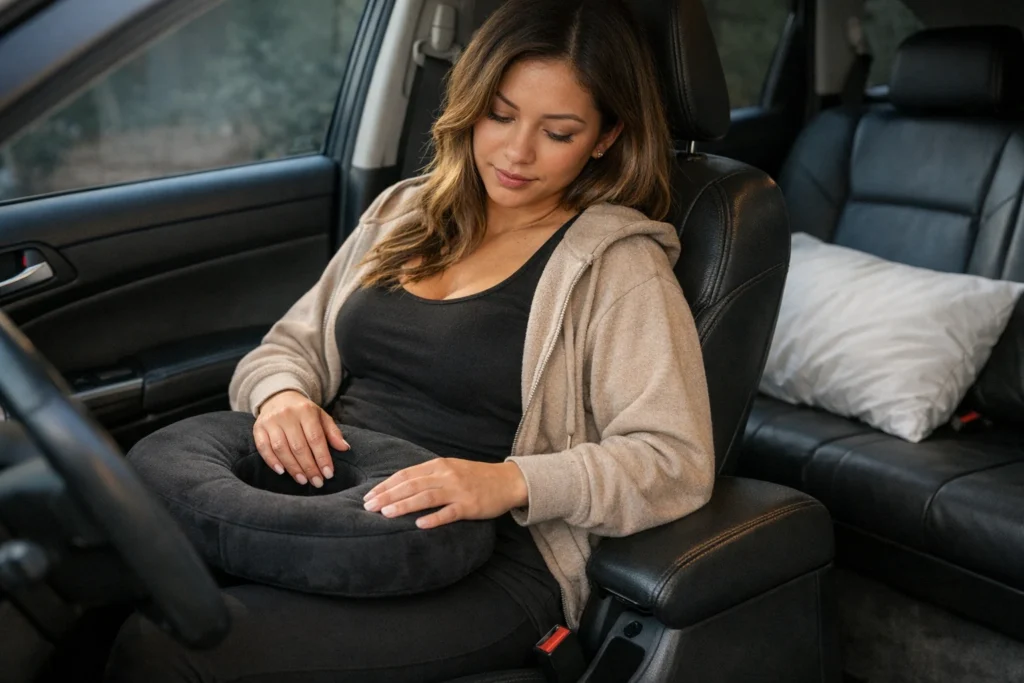
You’ve just had a BBL. You’re sitting in the car on the way home, trying to figure out how to arrange yourself on the seat without putting pressure on your newly grafted fat, and someone handed you a donut-shaped pillow. Or maybe you’re reading this pre-surgery, wondering whether the $40 to $80 “BBL pillow” is another piece of surgical-recovery marketing, or whether it actually does something.
Here’s the honest answer: the BBL pillow is one of the few procedure-specific recovery products where the mechanism is real. It’s not branded arnica. It’s not a special “BBL wrap” that’s just a compression garment with a different label. The geometry of what it does makes actual sense. That said, the specific product isn’t strictly necessary. What’s necessary is the principle.
Why Sitting Pressure Matters After a BBL
In a Brazilian Butt Lift, fat is harvested from other areas of the body, processed, and injected into the buttocks and hip area. The transferred fat cells need time to establish a blood supply in their new location. This process, sometimes called fat graft survival, happens primarily in the first few weeks after surgery.
During this window, direct sustained pressure on the grafted area compresses the fragile new tissue and can disrupt the early vascularization process. Think of it like pressing on a newly planted seedling before it roots. The result can be reduced fat survival in the areas that experienced the most pressure, which translates to uneven or diminished results. Your surgeon worked carefully to distribute fat for a specific shape. Sitting on it prematurely undermines that work in a way that no revision can fully predict or correct.
This isn’t a theoretical risk inflated by recovery product sellers. It’s a real consideration that most experienced BBL surgeons discuss in their pre-operative instructions. The commonly advised modified sitting period runs roughly two to eight weeks, though the specific timeline varies by surgeon and by the extent of your procedure. Follow what your own surgeon tells you, not a general number from the internet.
BBL Pillow vs Regular Pillow: How the Mechanics Compare
A standard pillow placed under your buttocks does not help. It does the opposite of what you want. Sitting on a pillow elevates your entire seat but still routes your body weight through the sitting bones and the soft tissue around them, which includes the grafted area. A softer surface doesn’t mean less pressure on the graft. It just means the pressure is distributed more gently across the same problematic zones.
A BBL pillow works differently. It’s designed to go under your thighs, not under your buttocks. The goal is to shift your body weight forward onto the thighs so the buttock area is essentially floating, suspended between your thighs and your lower back. The grafted tissue is no longer taking the load.
That’s the mechanism. It’s simple, it makes anatomical sense, and it’s the same reason the rolled-towel-under-thighs method works as a budget alternative. The product category is not hype. The specific brand often is.
Recommended: BBL Pillow
The only job of a BBL pillow is transferring weight to your thighs so nothing rests on the graft. The YESINDEED original does that one job without the kit padding most bundles use to inflate the box.
When a Rolled Towel or Regular Cushion Actually Works
For stationary seating at home, a firmly rolled bath towel or a firm wedge cushion under your thighs accomplishes the same mechanical goal as a purpose-made BBL pillow. The key word is firm. A soft, compressible roll will flatten under your weight and stop doing anything useful within minutes. You need something that stays at consistent height regardless of your weight.
Where improvised solutions fall short is in environments you can’t control. Car seats have a specific geometry that makes DIY arrangements awkward and often insecure. Office chairs are worse. If you’re returning to work during your recovery or have a long drive to a post-op appointment, a purpose-made BBL pillow with a non-slip base is genuinely more practical than trying to keep a towel roll positioned correctly while you’re focused on other things.
Patients consistently describe the car ride home from surgery as the first moment they realize they needed a better plan. The seatbelt adds pressure across the abdomen, the seat reclines backward (which actually helps), but any bump routes force through the seat. Having a pillow already in the car before surgery day is one of those details that seems minor until it isn’t.
What to Look For If You’re Buying One
Firmness is the most important variable. The pillow needs to maintain its height under load without significant compression. High-density foam in the 2-3 lb/cubic foot range handles this well. Soft memory foam does not. If you press down on a BBL pillow and it compresses more than half an inch under moderate pressure, it’s not doing the job.
Width matters. The pillow needs to span both thighs fully so your weight distributes evenly. Too narrow and you’re putting lateral pressure on the inner thigh area while the outer edge hangs unsupported. Look for something at least 16 to 18 inches wide.
Non-slip base. On car seats and office chairs, a pillow that slides forward every time you shift weight is a distraction and a safety issue. Rubberized or grip-textured bases solve this. It’s a small feature that makes the pillow actually usable in mobile settings.
You don’t need the most expensive option. You need one that meets these criteria. The “BBL pillow” category has a wide price range and some genuinely overpriced options that trade on the procedure name. A $30 to $60 firm foam thigh support that meets the above specs does what the $120 branded version does.
Sleeping Position Is a Separate Problem
The BBL pillow helps with sitting. Sleeping is a different challenge — for a full breakdown of positions by recovery stage, see the guide on sleeping positions after lipo 360. Most surgeons advise sleeping on your stomach for the first few weeks, which removes buttock pressure entirely but creates its own issues with neck and shoulder strain over a long recovery period. Side sleeping with a pillow between the knees can be acceptable depending on your surgeon’s specific guidance. What you want to avoid is direct back sleeping without modification. For the specifics of how the pillow works for sleeping as well as sitting, and the full week-by-week position breakdown, the dedicated guide covers this in detail.
There’s no dedicated “sleep pillow” product category that solves this elegantly. Body pillows can help with positioning, but the main thing is understanding the mechanics: keep pressure off the graft while maintaining enough comfort to actually sleep for eight hours. Stomach sleeping on a firm mattress with a thin pillow under the hips accomplishes this for most people.
Recovery after a BBL involves more moving parts than just the pillow, including lymphatic support in the weeks following surgery. If you haven’t mapped out your post-lipo lymphatic massage schedule, that’s worth doing before your surgery date. And compression garment selection matters in parallel with positioning, so the stage 1 vs stage 2 faja guide is worth reading for the compression side of your recovery plan. If your surgeon also has you using abdominal boards or lipo foam at the harvest sites, make sure you understand how to manage those in your positioning routine too.
What’s Normal and What Should You Call About
Soreness and tenderness in the harvest sites (abdomen, flanks, thighs) is normal and typically more intense than the buttock area itself in the first week. The grafted area may feel firm or dense in spots as the fat integrates. Mild asymmetry in the early weeks is normal and doesn’t reflect your final result.
Call your surgeon if you experience: significant swelling in one area that’s dramatically different from the other side, redness with warmth and fever (potential infection), any open areas or drainage at a small injection site that increases rather than decreases, or sudden sharp pain in the buttock area after a period of normal recovery. These are not positioning problems. These need evaluation.
FAQ
How long do I actually need to use a BBL pillow?
Most surgeons advise modified sitting for two to eight weeks, with the strictest restrictions in the first two to three weeks when the graft is most vulnerable. After that, brief normal sitting periods may be permitted, with gradual return to normal activity. The specific timeline depends on your surgeon’s protocol and how your recovery is progressing. No general number online should override what your surgeon tells you directly.
Can I just use a donut pillow instead?
A donut-shaped pillow with a hole for the buttocks is a common solution but has a mechanical problem: your sitting bones are positioned near the inner edge of the hole, meaning they’re still partially supported by the pillow surface rather than fully suspended. For short periods it may be workable, but a thigh-support pillow that actually floats the entire gluteal area is more mechanically sound for extended sitting during the first critical weeks.
Is a BBL pillow necessary if my surgeon didn’t specifically mention it?
If your surgeon gave you sitting restrictions but didn’t name the specific product, the principle still applies. They’re telling you to avoid direct pressure on the graft, and a BBL pillow is a tool to accomplish that restriction more practically. Ask your surgeon’s office how they recommend patients implement the modified sitting instruction. Most will confirm that thigh support is the correct approach, whether via a specific product or a firm rolled alternative.
The BBL pillow works alongside your compression garment rather than independently of it. Understanding the garment requirements that come with it, particularly the open-seat design and wearing schedule, completes the picture of sitting restriction compliance.
This article is for educational purposes only and is not a substitute for professional medical advice. Always follow your injector’s or surgeon’s specific aftercare instructions.