
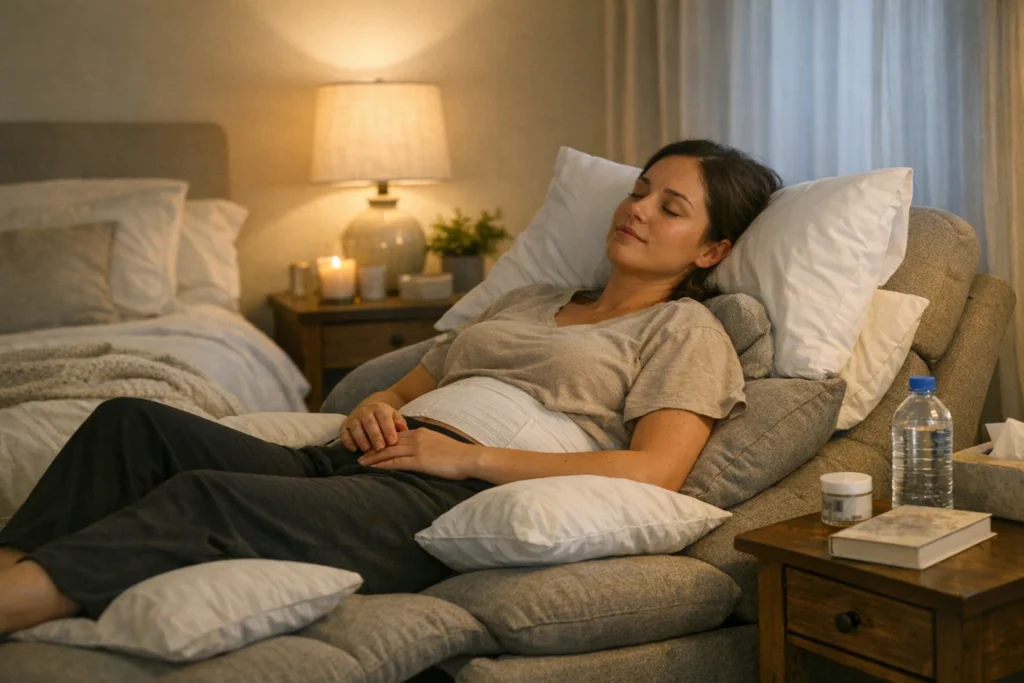
You were told to sleep on your back. Fine. But nobody explained that “sleep on your back” when your abdomen, flanks, and back were all treated is a physical puzzle with no obvious solution. Every position that feels natural involves pressure on something that was just worked on. That is the lipo 360 sleep problem, and the standard advice skips the part where you have to actually stay in that position for eight hours.
Why Elevation Matters in the First Week
Swelling after lipo 360 is managed partly by gravity. Keeping the upper body elevated, ideally at a 30 to 45 degree angle, helps fluid drain toward the lymphatic system rather than pooling at the surgical sites. It also keeps pressure off the incision sites in a way that lying completely flat does not.
For the first three to five days, most surgeons want you elevated during sleep. This is not a gentle preference. Patients who go flat too early often notice one-sided or generalized swelling that takes longer to resolve. The elevation is doing active work.
A recliner is the single best sleep solution for lipo 360 patients in the first week, and the patients who have one consistently describe the first week as more manageable than those who improvise with pillows on a flat bed. If you do not own a recliner, this is worth borrowing one or renting one for the recovery period. The alternatives work but require more upkeep.
Building the Pillow Architecture
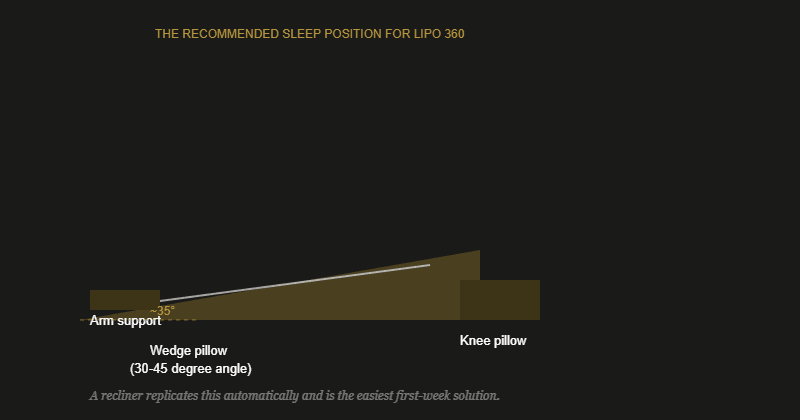
If a recliner is not available, the goal is to replicate the inclined position using a wedge pillow or stacked regular pillows. A dedicated wedge pillow, the triangular foam kind used for acid reflux, is more stable than pillows and will not collapse at 3 AM when you shift your weight. You may also be wearing abdominal boards or lipo foam under your faja — sleeping at an incline can help keep these in place. They typically run $30 to $60 and are worth it for the recovery period alone.
Place the wedge so your upper body is genuinely inclined, not just your head. A pillow under only your head creates neck strain without providing the elevation that matters for swelling. Your entire torso should be angled up.
Under your knees: a pillow or rolled blanket here takes the arch out of your lower back and makes back sleeping tolerable for longer periods. Without it, most people find that back sleeping becomes painful after an hour or two because of lumbar tension. With it, you can actually stay in position.
Arms are a problem. When lying inclined without side support, arms tend to slide or create shoulder discomfort. A pillow on each side, tucked under the arm at roughly elbow height, solves this without putting pressure on the flanks.
Getting Out of Bed Without Using Your Core
This is the thing nobody covers in the pre-op appointment, and patients figure it out painfully on day one. Sitting up from flat using your abdominal muscles after lipo 360 is not something you want to do. The tissue is traumatized and the discomfort of engaging those muscles is significant. You need a different technique. Every time.
The log roll: roll your entire body to one side as a single unit, keeping your spine aligned and not twisting at the waist. Use your arms to push yourself up to sitting while your legs swing off the edge of the bed simultaneously. The push comes from your arms, not your core. This feels awkward at first and becomes second nature by day three.
A bedside grab bar, or even a sturdy chair positioned next to the bed, gives you something to grip for the push. Patients who plan for this ahead of time do not pull their abdominal tissue on day one. Those who do not plan for it almost always do.
Coming back down: reverse the process. Lower yourself to sit on the edge using your arms, then log-roll onto your side before gently settling onto your back. Do not attempt to lower yourself straight backward to flat.
If You Also Had a BBL
Lipo 360 combined with a Brazilian Butt Lift creates a different constraint: you cannot put pressure on the transferred fat in the gluteal area for a significant period, which your surgeon will specify. This is not optional. Pressure on freshly transferred fat compromises graft survival.
The sleeping arrangement changes substantially. Some patients sleep on their stomachs if the abdomen was not treated severely, or use a specialized cushion to support the thighs while suspending the buttocks. A BBL pillow designed for post-surgical positioning is essentially mandatory for sleeping if you had fat transfer, as regular pillows do not provide the right geometry to protect the gluteal area while keeping you in a resting position.
This is a case where two surgical objectives, elevated back sleeping for lipo 360 and off-loading the buttocks for BBL, create genuinely competing requirements. Your surgeon’s specific instructions take priority over any general guidance.
Sleeping in Your Faja and the Week-Two Problem
You will be sleeping in compression for weeks. This is non-negotiable for lipo 360 recovery, and understanding which faja to use at which stage matters for both recovery quality and sleep comfort. The stage 1 vs stage 2 faja transition guide covers the compression differences in detail, but the short version is that the stage 1 is designed for the most acute swelling phase and the stage 2 for the longer maintenance phase. Stage 1 is usually worn 24 hours a day including sleep.
The midnight itch is real and documented. The combination of healing tissue and compression creates an itch that is impossible to scratch through the garment. Most patients describe it as peaking around the end of week one. Cold packs applied over the garment can help. Patients who try to remove the faja to scratch are often the same ones who wake up with the faja twisted or loose and have to reapply it in the dark, half-asleep.
Around week two, the limitation of back sleeping usually hits its worst point. The inclined position has been in use for ten to fourteen days, the lower back is protesting, and the bed feels like a problem that needs solving. This is the week most patients start asking their surgeon when side sleeping is allowed. The answer is typically several weeks in total, but follow your surgeon’s specific timeline, not an article. Some surgeons release patients to modified side sleeping with a pillow between the legs as early as two to three weeks if the flanks were treated and swelling has responded well. Others hold the back-sleeping recommendation longer.
Signs Your Sleep Position Is Causing a Problem
Waking up to find one side noticeably more swollen than the other can indicate you spent time sleeping with pressure on that side. This is not a disaster. Adjust your positioning setup and it usually equalizes over the following day or two. Persistent asymmetric swelling that does not respond to corrections over several days is worth mentioning to your surgeon at your follow-up. If you’re also finding that you look larger than before surgery, see the guide on why you look bigger after lipo — this is common and explainable.
Indent lines in the faja when you wake up are usually from the garment bunching or twisting during sleep. Check that the faja is smooth before you lie down. Some patients use medical-grade tape along the edges to prevent rolling. This matters because a bunched faja can create uneven compression that shapes the tissue incorrectly during the critical early healing window.
Significant new pain that develops specifically during or after sleeping, beyond the expected discomfort of recovery, is worth a call to your surgeon’s office. The same applies to any area that feels unusually hot or hard the morning after.
FAQ
How long do I have to sleep on my back after lipo 360?
Most surgeons recommend back sleeping for a minimum of two to four weeks, with side sleeping introduced gradually after that. The timeline depends on where you were treated, how your swelling has resolved, and your surgeon’s specific protocol. Asking this question at your one-week follow-up is entirely appropriate, and your surgeon’s answer supersedes any general timeline.
Can I sleep in a hotel bed or travel after lipo 360?
Most surgeons want you relatively local for the first two weeks for follow-up access if something needs attention. Hotel beds are typically flat, which means replicating the elevation setup requires bringing your wedge pillow with you. Car travel and particularly air travel in the first few weeks comes with additional circulatory considerations. This is a surgeon-specific conversation, not a general one.
Is it okay if I accidentally roll onto my side during sleep?
Probably. One night of side sleeping will not undo your recovery, particularly after the first week when the most acute phase has passed. The goal is consistency, not perfection. What you want to avoid is a pattern of sleeping on one side for extended periods in the early weeks, particularly if your flanks were heavily treated. The pillow architecture is about making it easier to stay in position, not about self-punishment if you move.
This article is for educational purposes only and is not a substitute for professional medical advice. Always follow your injector’s or surgeon’s specific aftercare instructions.