
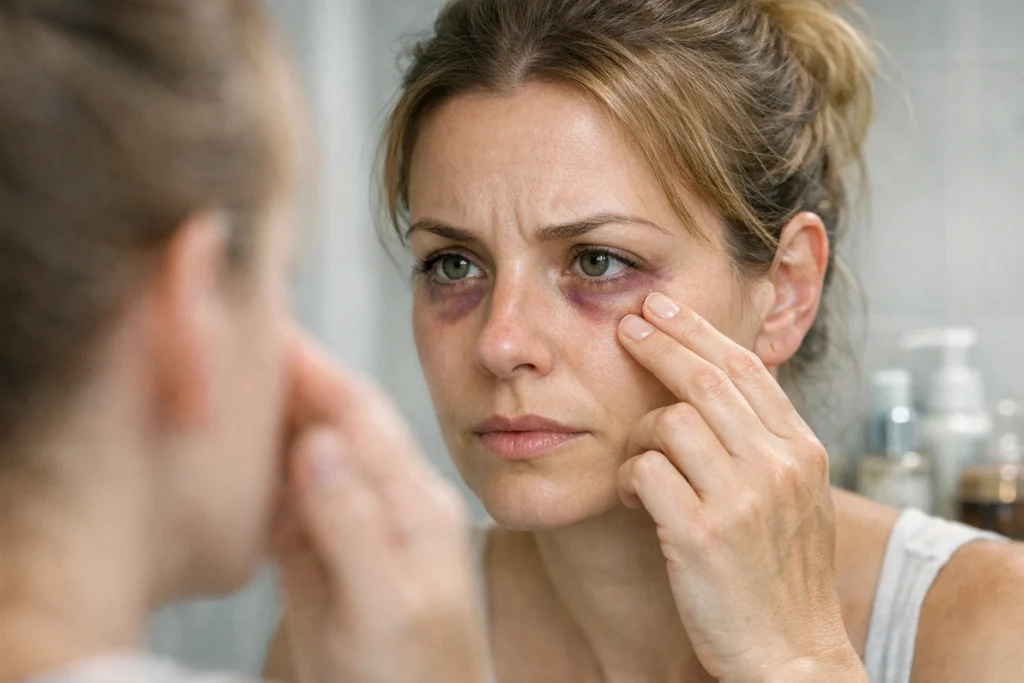
You looked at the Instagram result: smooth, bright, rested. Then you looked in the mirror four days after your tear trough appointment and saw something that looked like you had walked into a door. This is the gap nobody prepares you for, and it is entirely normal. Tear trough filler has the biggest gulf between the end result and the interim reality of any area on the face.
Knowing what is coming is what separates people who assume something went wrong from people who wait it out calmly. This is the recovery arc, honestly told.
Why Under-Eyes Bruise Harder Than Anywhere Else
The skin under the eye is the thinnest skin on the human face. There is almost no fatty layer between the surface and the underlying vasculature. When a needle passes through that area, even a very fine one in very skilled hands, it is working in territory where small vessels sit close to the surface and bruising is a predictable outcome, not a sign of error. The guide on arnica for bruising covers options for reducing the severity and timeline.
The under-eye area is also highly vascular. Blood pools quickly here. Gravity and the natural movement of the eye keep swelling active longer than it would be on a less mobile area of the face. Compare it to lip filler, where bruising often resolves within a few days: the lip filler recovery timeline looks almost tidy next to what tear troughs do to the same person. It is the same product. Completely different anatomy.
The Realistic Day-by-Day Arc
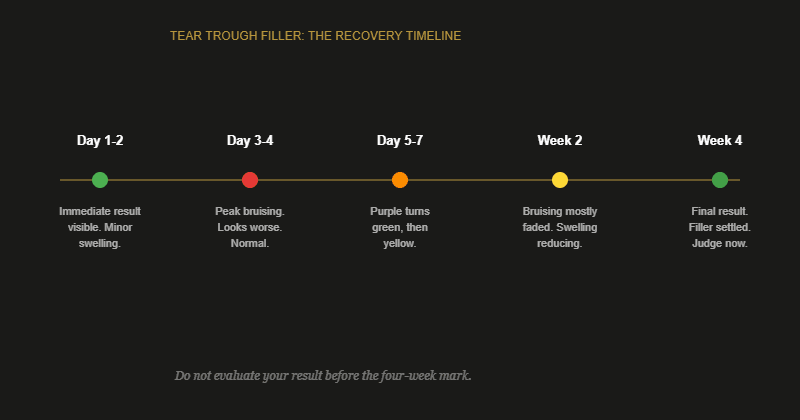
Days one and two: you may look surprisingly fine immediately after the appointment. Filler produces some initial plumping, and bruising often takes hours to develop. Do not judge the result yet, in either direction.
Days three and four: this is when patients consistently panic. Bruising deepens to purple and dark red, swelling distorts the very area that was supposed to look better, and the result looks worse than before treatment. This is the peak. It passes.
Days five through seven: bruising begins shifting from purple to green, then yellow. The color progression is reassuring once you know to expect it. The swelling starts to settle. The area is still not ready to evaluate.
Week two: most of the acute bruising has faded. Some residual swelling may remain, particularly first thing in the morning. The filler is still settling into its final position.
The final result should be assessed no earlier than two weeks after the appointment, and more accurately at four weeks. Anyone who tells you the result at day five is the result is not being straight with you.
Covering It: The Makeup Window
The puncture sites from injections need time to close before you apply anything directly over them. Most injectors recommend waiting at least 24 hours before applying makeup to the area, and some say 48. This is not a vanity recommendation. An open puncture site is a route for bacteria. Using concealer before those sites are properly closed raises infection risk.
When you do start covering: color-correcting concealer works better than standard concealer for bruising that has moved into the green and yellow phases. Orange or peach-toned correctors neutralize the green undertone. Set lightly with powder, because heavy application in a thin-skinned area tends to look cakey and can emphasize texture.
Cold compress technique matters here too. In the first 24 to 48 hours, a clean cold compress held gently (not pressed hard) over the area can reduce swelling. Do not apply ice directly to the skin. A gel pack wrapped in a thin cloth works well, applied for ten minutes at a time. After 48 hours the cold compress window is mostly closed and will not do much for bruising that has already developed.
Tyndall Effect and Lumpiness: The Known Risks
The Tyndall effect is what happens when hyaluronic acid filler is placed too superficially in the under-eye area. (Some patients with volume loss throughout the face are also treated with Sculptra, which has a very different recovery and mechanism — this guide covers HA filler specifically.) The HA scatters blue light from the skin’s surface and produces a bluish, shadowy discoloration that looks a bit like a permanent bruise. It is not bruising. It does not resolve on its own.
It is also correctable, and can be confused with filler migration, which may also present as visible irregularity under the eye. Hyaluronidase, an enzyme that dissolves HA filler, can address Tyndall effect when administered by an experienced injector. The key is not to confuse it with ordinary bruising in the first two weeks. Bruising changes color and fades. The Tyndall effect has a distinct blue-gray quality and persists. If something that looks bluish has not shifted or faded at the four-week mark, that is the conversation to have with your injector.
Lumpiness or visible ridging in the first week is usually swelling or filler that has not fully integrated. Most of it resolves. Persistent lumps at four weeks warrant a follow-up. Hyaluronidase is an option there too. The important thing is that these risks are real and correctable, not reasons to avoid the treatment with a skilled injector.
When to Call Your Injector Immediately
Ordinary bruising and swelling do not need an emergency call. What follows does.
Any change in vision, including blurring, double vision, or partial loss of vision after a tear trough injection, is a vascular emergency. Stop reading this. Call the injector now, then go to the emergency room. Vascular occlusion affecting the ophthalmic artery is rare but can cause permanent vision loss if not treated immediately. This is the non-negotiable warning sign for this area specifically.
White patches or blanching around or near the injection site, during or shortly after the injection, can indicate filler has entered a blood vessel and is blocking circulation. This should be addressed by your injector at the time of treatment. If you notice it after leaving the clinic, call immediately.
Severe pain that is escalating, rather than the mild discomfort and tenderness expected from any injection, warrants a same-day call. Pain that is getting worse over time is not typical recovery.
Dark purple bruising spreading visibly in an area that was not injected, accompanied by increasing pain, could indicate something beyond ordinary bruising. Call your injector.
Ordinary bruising, ordinary swelling, lumpiness in the first week, and the temporary distortion that makes you look worse before you look better are all within normal. The four warning signs above are not. This section deserves more than a skim. Understanding the broader picture of facial filler treatments is useful context, but the vascular warning signs are tear-trough-specific and genuinely critical.
The One Thing That Actually Determines Your Result
This is the part of tear trough filler that the industry undersells, because it is more comfortable to talk about products and techniques than to say plainly: who injects you matters more than anything else here.
The tear trough is the highest-skill filler area on the face. It is adjacent to structures that can cause vision loss if something goes wrong. The depth of placement must be precise. The volume must be calibrated. The anatomy varies substantially between patients. The person who does excellent lip filler, brow lifts, and jawline work is not automatically qualified for this area without specific training and experience in it.
Booking the cheapest provider for tear troughs is the one place in aesthetics where bargain hunting has the highest stakes. This is not fearmongering. The outcome data on poorly placed tear trough filler, including persistent Tyndall effect, asymmetry, and (in rare cases) vascular events, tracks with inadequate experience more than anything else.
Ask specifically about their tear trough experience. Ask how they handle the Tyndall effect if it occurs. Ask about their protocol if they see blanching during treatment. The answers tell you more than before and after photos.
FAQ
How long does tear trough filler recovery actually take?
Plan for two weeks before the bruising and swelling are substantially resolved, and four weeks before you can evaluate the actual result. The area continues to settle in the weeks following treatment. Judging the outcome at day five is not useful, and it is the main reason people call their injectors convinced something has gone wrong when it has not.
Can I wear glasses or contacts after tear trough filler?
Contacts are generally fine to resume after 24 hours, though some injectors recommend waiting a little longer if significant swelling is pressing on the area. Glasses that rest on the nose bridge rather than the under-eye area are usually fine immediately. Glasses or sunglasses that press directly on the treated area should be worn loosely or avoided for a few days. Your injector’s specific guidance takes priority over any general advice.
How long does tear trough filler last?
Tear trough filler tends to last longer than filler in higher-movement areas, often 12 to 18 months, and some patients find it persists beyond that. The under-eye area does not have the constant mechanical movement that breaks down filler faster in the lips or nasolabial folds. Individual metabolism, the type of filler used, and the volume placed all influence duration.
This article is for educational purposes only and is not a substitute for professional medical advice. Always follow your injector’s or surgeon’s specific aftercare instructions.