
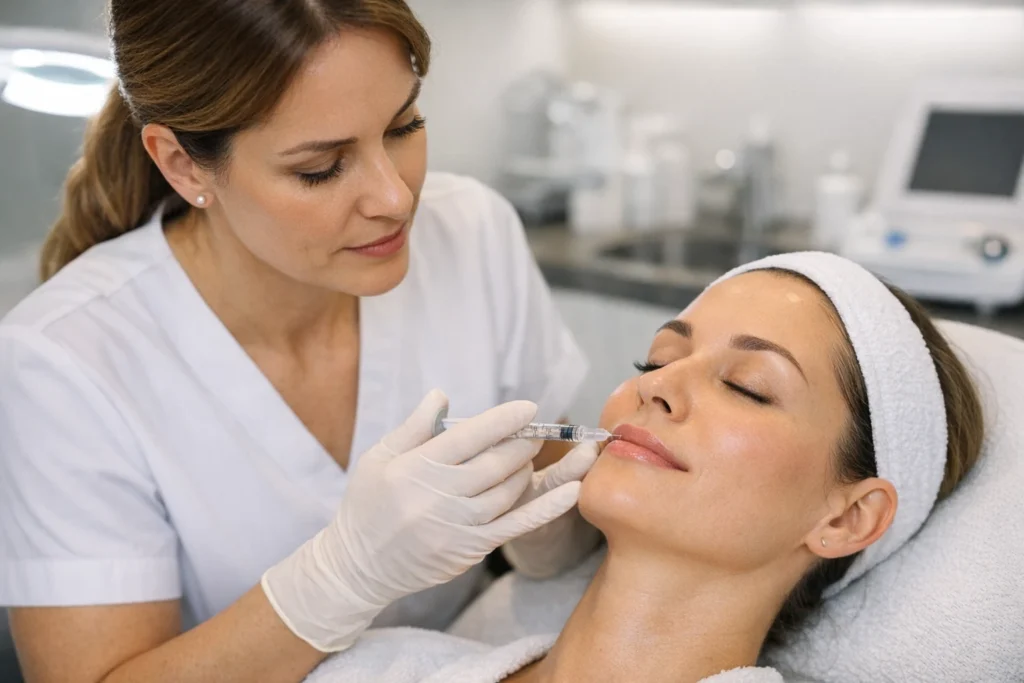
There is a phenomenon that aesthetic practitioners discuss openly at conferences but rarely explain to patients beforehand. It goes by several names: filler migration, filler spread, and tissue expansion. It accounts for a significant proportion of the subtle (and sometimes not-so-subtle) changes that patients notice in their faces in the months and years following repeated filler treatment.
Understanding it requires looking at the physics of soft tissue, the biology of how the body responds to foreign material, and the mechanics of how modern hyaluronic acid fillers actually behave inside human anatomy. This is not a conversation about poor technique, though technique does matter. It is a conversation about material science, tissue biology, and the long-term consequences of a procedure that most clinics frame as entirely reversible and risk-free.
Looking for a quick answer? Jump to the FAQ below.
The short answer
True filler migration — product moving outside the original injection zone — is less common than it looks. Most cases of ‘migration’ are either swelling in the first two weeks, product placed just outside the lip border intentionally, or the cumulative effect of repeated sessions over time. Dissolving is an option if migration is confirmed at the two-week mark.
What Filler Migration Actually Is (and What It Isn’t)
The term “migration” is somewhat misleading. Filler does not travel through the bloodstream or lymphatic vessels like a drug molecule would. What actually happens is more accurately described as product displacement or spread: the physical movement of a viscoelastic gel through tissue planes under the influence of mechanical pressure, gravity, and the degrading effects of tissue enzymes.
Clinicians distinguish between three distinct mechanisms of what is called migration: (1) intravascular migration, where product enters a blood vessel, a rare but serious acute complication entirely distinct from the chronic spreading discussed here; (2) tissue plane migration, where product moves laterally through fascial spaces; and (3) diffusion-related spread, where the gel expands through surrounding tissue as it absorbs water from the interstitium.
It is the second and third mechanisms that are responsible for the duck-lip appearance: the blurring of the vermilion border and accumulation of product in the philtrum and subnasal area. This become increasingly recognised as a cumulative consequence of repeated lip augmentation.
The Anatomy of Risk: Why the Lips Are Particularly Vulnerable
The lips are anatomically complex and mechanically dynamic. The orbicularis oris, the circular muscle that controls lip movement, generates significant compressive forces during speech, eating, and facial expression. These forces act on any material placed within or adjacent to the lips throughout the day, every day.
The superficial fat compartments of the perioral region are divided by fibrous septa, but these partitions are not rigid barriers. They are thin, compliant membranes that allow limited movement of contents between compartments. Hyaluronic acid gels, even the firmer more highly cross-linked formulations, have rheological properties (specifically, their G prime, or elastic modulus) that are orders of magnitude lower than the surrounding tissue under dynamic load. This means that under the repetitive compressive force of the orbicularis oris muscle, product can deform and, over time, translate through tissue planes.
MRI imaging studies mapping HA filler distribution in tissue over time have shown that product injected at the vermilion border consistently demonstrates lateral and superficial migration over periods of six to twelve months, with the degree of movement correlating with higher volumes injected and lower G prime (softer) product formulations.
The Role of Repeated Injections
The guide on what repeated lip filler does over time explores this in more depth. Most published literature on filler migration focuses on single treatment episodes. The cumulative effects of repeated injections over years are less rigorously studied, partly because long-term follow-up studies are difficult to conduct in elective cosmetic medicine, and partly because the industry has had limited commercial incentive to fund them.
Retrospective case series and practitioner-reported data increasingly show that each subsequent injection into a previously treated area carries a higher risk of product spreading beyond the intended zone. Several mechanisms explain this:
First, residual product from previous treatments alters the tissue microenvironment. Even as HA degrades enzymatically, cross-linked polymer fragments may persist in tissue and create a substrate that subsequent injected product adheres to and accumulates upon. This has been described as a “scaffold effect,” where prior filler deposits guide the distribution of subsequent material.
Second, repeated needle trauma and the resulting scar tissue formation changes the mechanical properties of the tissue itself. Fibrotic tissue has different compliance characteristics than native tissue, meaning the resistance pathways that normally constrain filler within an intended anatomical zone may be altered.
Third, chronic low-grade inflammation associated with the foreign body response to HA, well-documented in histopathological studies, can degrade the fibrous septa that normally compartmentalise fat compartments, reducing their effectiveness as anatomical barriers to product spread.
The industry rarely talks about what happens to filler over years of repeated treatment. That silence is where most migration stories begin.
What Migration Looks Like Clinically
The most commonly reported pattern of lip filler migration is superior spread from the vermilion border into the white lip (the skin between the lip edge and the base of the nose). Some patients also notice distinct firm areas rather than diffuse spread — those are covered separately in the guide on lumps after lip filler. Clinically, this presents as a loss of the distinct border between the red and white lip, a blurring that makes the lip appear to “bleed” upward. The philtrum columns, which are normally defined by light and shadow contrast, become less visible as product fills the philtrum valleys.
Lateral migration, where product spreads toward the oral commissures, creates a different problem: fullness in areas that are not intended to be augmented, which can alter smile dynamics and create a heaviness that patients often struggle to articulate, contributing to the kind of uneven lip filler appearance that patients notice most in photographs. “My lips look bigger but somehow worse” is a complaint that frequently reflects this type of displaced volume.
In more advanced cases, product may accumulate in the dry vermilion zone, creating persistent puffiness that does not fluctuate with hydration status and does not resolve with time. This is the clinical presentation most commonly described colloquially as the “duck lip,” a term that unfairly implies voluntary aesthetic choice when it is often an unintended structural consequence of cumulative treatment.
This is normal
- Swelling that makes filler appear to extend beyond the lip border in week one
- Slight unevenness that changes day to day in the first two weeks
- Filler that feels firm and defined before it fully integrates at 14 days
- Mild asymmetry that was present before the treatment
Call your injector if
- A visible ridge or shelf of tissue above the lip border that is present at rest at two weeks
- Filler that has visibly moved from one area to another between sessions
- Hardness or a defined lump that is not softening after four weeks
- Any vascular symptoms: blanching, mottling, or severe localised pain
The Dissolution Option: What Hyaluronidase Actually Does
For anyone considering this route, the full guide on dissolving lip filler covers what to expect from the process. Hyaluronidase is an enzyme, produced naturally by your body and also available as an injectable pharmaceutical preparation (Hylenex, Vitrase, and others), that catalyses the degradation of hyaluronic acid by cleaving the glycosidic bonds within the polysaccharide chain. When injected into tissue containing HA filler, it dissolves the product within 24–72 hours, depending on the volume of enzyme used, the cross-linking density of the product, and the location within tissue.
It is genuinely reversible, but with important caveats. Hyaluronidase is not selective: it degrades native tissue HA alongside injected product. The lips have a significant native hyaluronic acid content, and aggressive dissolution can temporarily leave the tissue depleted of its own structural support. This typically resolves within weeks as fibroblasts replenish native HA production, but patients should be counselled that their lips may look thinner than their pre-treatment baseline for a period following dissolution.
Research into outcomes following hyaluronidase dissolution in patients with what practitioners term “filler fatigue” — a term gaining traction among practitioners to describe the cluster of aesthetic concerns arising from cumulative over-treatment. The study found that a dissolution-and-rest period of six to twelve months, followed by careful re-treatment with lower volumes of higher-G-prime product placed at greater anatomical precision, produced superior long-term aesthetic outcomes compared to continuing to treat over existing displaced product.
Prevention: What the Research Supports
The most evidence-supported approach to preventing migration is straightforward, even if the industry is slow to promote it: treat less frequently, use higher-cohesivity products, and place them with anatomical precision.
Specific factors that the literature associates with lower migration rates include: the use of cannulas rather than needles for certain injection planes (cannulas cause less tissue disruption and may produce more predictable product distribution); higher G prime product formulations, which have greater resistance to deformation under dynamic load; and smaller volumes per treatment session, allowing the tissue to adapt before additional product is placed.
Post-treatment behaviour also has some evidence base: Vigorous massage of the lips in the days following injection, a practice some older protocols recommended to smooth product, has been shown in biomechanical studies to increase product displacement from the injection site. Most current evidence recommends avoiding deliberate manipulation of filler immediately post-treatment unless instructed otherwise by the treating practitioner for a specific product.
The post-procedure inflammatory response itself plays a role. Patients who experience significant swelling and inflammation after injection may experience higher rates of product spread, as oedematous tissue has lower resistance to gel movement. Supporting a controlled, reduced inflammatory response through appropriate post-procedure care, specifically gentle barrier repair, avoiding heat and vasodilatory agents, and staying well hydrated, may indirectly support better product distribution outcomes.
The Conversation Worth Having Before Your Next Appointment
Filler migration is an underacknowledged complication partly because it is gradual, partly because patients and practitioners both have interests in continuing treatment, and partly because the industry has not developed clear diagnostic criteria or reporting standards for it. Most patients who have experienced it did not receive an explanation of the mechanism before their first treatment.
If you are considering lip filler, whether for the first time or as part of an ongoing regimen, ask your practitioner: What is your protocol for assessing cumulative product burden before adding more? How do you evaluate whether existing product has spread from its intended location? Under what circumstances do you recommend dissolution before re-treatment?
A practitioner who engages thoughtfully with these questions is one whose approach to filler is genuinely in your long-term interest. The reversibility that makes hyaluronic acid filler attractive as an aesthetic tool depends on that reversibility being exercised intelligently, not simply deferred indefinitely in favour of ongoing treatment.
Migration patterns differ significantly by treatment area. For cheek filler specifically, the deeper injection planes and longer settling timeline mean that what looks like migration in the first two weeks is often still-resolving swelling rather than product movement.
Nasal filler carries a higher risk profile than other filler sites: the blood supply connects to the ophthalmic artery, and vascular events here are more serious than at lip or cheek filler sites. The full aftercare and vascular warning signs for liquid rhinoplasty aftercare are covered separately.
This article is for educational purposes only and is not a substitute for professional medical advice. Always follow your injector’s or surgeon’s specific aftercare instructions.