
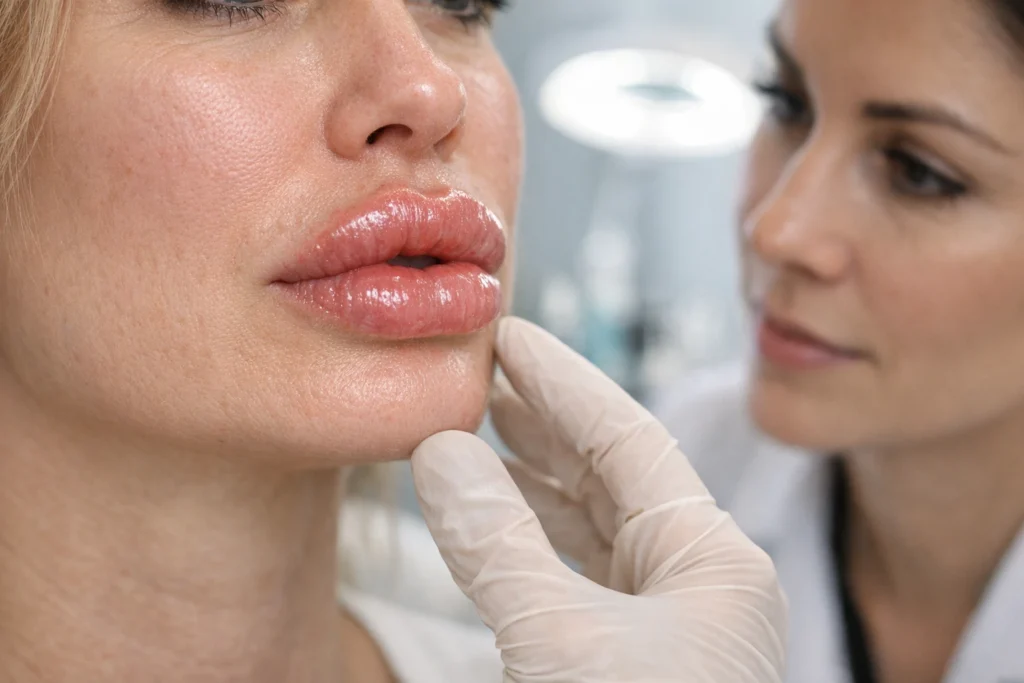
When a patient books their first lip filler appointment, the conversation in the clinic almost universally focuses on the immediate result. How much volume? Which product? How long will it last? These are reasonable questions for a single session. They are the wrong questions for a patient who intends to maintain their result over years, which in practice most filler patients do.
The question that rarely gets asked, in the consultation, in the industry press, in the glossy content surrounding aesthetic medicine, is: what does this procedure do to the tissue over repeated treatments? Not to the aesthetic result, but to the underlying biology. The fat, the muscle, the collagen architecture, the skin itself.
The answer is more nuanced and more interesting than the industry typically acknowledges. Some of what repeated filler does is beneficial. Some of it is the opposite. And a great deal depends on how it is done.
The Foreign Body Response: What Happens Every Single Time
Hyaluronic acid is biocompatible: it shares its basic molecular structure with a compound your body produces naturally. But biocompatible is not the same as biologically inert. Every injection of HA filler triggers what immunologists call the foreign body response: a cascade of immune activity directed at identifying, encapsulating, and eventually eliminating an introduced material.
In the acute phase, this looks like the swelling and tenderness covered in the 7-day lip filler recovery timeline — familiar to anyone who has had filler. In the chronic phase, which unfolds over the weeks and months following treatment, macrophages and giant cells attempt to phagocytose (engulf and break down) the filler material. Because cross-linked HA molecules are too large and structurally complex to be efficiently phagocytosed, these immune cells instead form a thin fibrous capsule around deposits of product. This is a normal, expected response to any implanted biomaterial, and it is one reason filler develops its characteristic encapsulated feel when palpated over time.
What is less commonly discussed is the chronic low-grade inflammatory milieu that this process creates. A 2019 biopsy study published in Aesthetic Surgery Journal examined perioral tissue from patients who had received multiple rounds of lip filler over several years. The authors found elevated levels of inflammatory cytokines, specifically IL-1β and TNF-α, in tissue surrounding filler deposits, compared to control tissue. These same cytokines, at chronically elevated levels, are known to stimulate matrix metalloproteinases (MMPs), enzymes that degrade collagen and elastin.
The implication is direct: sustained, repeated filler treatment can, through chronic inflammation, accelerate the breakdown of the structural proteins that give skin its elasticity and lips their natural architecture.
The Collagen Paradox
Here is where the biology becomes genuinely complicated. HA fillers have also been shown, in multiple studies, to stimulate collagen production. The mechanical stretch exerted on fibroblasts by a filler deposit, pressure applied by the gel on the surrounding tissue matrix, activates those fibroblasts and promotes the synthesis of new collagen fibres. This is the basis of the claim, widely made in aesthetic medicine, that repeated filler has a “long-term skin quality improvement” effect.
The evidence for this is real. A 2014 study in the Journal of Drugs in Dermatology used biopsy samples to confirm increased collagen I and III synthesis in skin treated with HA filler compared to untreated control skin. A 2020 review in Aesthetic and Reconstructive Surgery synthesised multiple studies and concluded that HA filler consistently demonstrates a neocollagenesis effect when product is placed in the superficial to mid-dermis.
But there are two critical nuances that the industry rarely articulates alongside this data. First, neocollagenesis is primarily observed with product placed intradermally, in the skin itself. Most lip filler, particularly volume augmentation, is placed submucosally or intramuscularly, not in the dermis. The collagen-stimulating effect is real but spatially limited to the tissue planes where the product actually sits.
Second, and more importantly: the inflammatory process that the filler simultaneously triggers may, over repeated cycles, counteract the collagen-building benefit through MMP-mediated degradation. Whether a patient ends up with net collagen gain or net collagen loss over a multi-year treatment history likely depends on the volume of product used, the frequency of treatment, the individual’s inflammatory baseline, and the specific tissue planes involved. No long-term randomised controlled trial has yet resolved this question with adequate rigor.
What Happens to the Fat
The lips and perioral region contain defined subcutaneous fat compartments that contribute meaningfully to their shape and to the overall appearance of the lower face. These fat compartments are not static. They are dynamic structures that respond to mechanical loading, hormonal changes, and inflammatory signals.
Several practitioner-reported case series, and at least one cadaveric imaging study using MRI published in Plastic and Reconstructive Surgery Global Open (2021), have documented evidence of perioral fat compartment atrophy in patients with long-term filler histories. The proposed mechanism is pressure-induced: sustained volume from filler deposits compresses adjacent fat compartments, impairing their blood supply and triggering a process analogous to pressure necrosis in adipose tissue at a microscopic level.
This would explain an observation that many experienced injectors make but rarely document: long-term filler patients sometimes require increasing volumes of product over successive treatments to achieve the same aesthetic result. If the native fat that previously contributed to lip volume is gradually being reduced by the compression effects of the filler placed to augment it, then the treatment may be creating a partial dependency: the filler replacing what its own presence is slowly displacing.
The degree to which this occurs is not well-characterised in the literature, and it likely varies significantly by individual. But the mechanism is plausible, consistent with what is known about adipose tissue responses to sustained mechanical loading, and deserves more research attention than it currently receives.
Muscle Dynamics: The Orbicularis Oris
The orbicularis oris, the sphincter muscle encircling the lips, is among the most used muscles in the body. It contracts during speech, eating, drinking, kissing, and the continuous micro-expressions that form an unconscious part of human communication. The introduction of a dense viscoelastic gel within or adjacent to this muscle changes its mechanical environment.
Evidence for filler-related changes to orbicularis oris function is limited but emerging. A 2020 electromyography study in Journal of Oral Rehabilitation detected subtle differences in orbicularis oris activation patterns in patients with a history of repeated lip augmentation compared to age-matched controls. The authors hypothesised that the increased tissue stiffness caused by fibrotic encapsulation of filler deposits may alter proprioceptive feedback from the muscle, changing how it recruits motor units during contraction.
Whether these changes are clinically significant for most patients is uncertain. But they point toward a broader principle: the lips are not a passive anatomical container into which volume can be added indefinitely without consequence to the structures that give them function and movement.
The Accumulation Problem: Filler Is Not Fully Reversible on a Timeline
HA fillers are marketed as temporary and fully reversible, and in principle, this is true: hyaluronidase can dissolve HA product. One consequence of accumulation over time is filler migration, where product shifts from its original placement into adjacent tissue planes. But in practice, “temporary” is a more complex claim than it appears.
Radiological and histological studies have documented the persistence of filler material well beyond the timeframes typically quoted to patients. A landmark ultrasound study by Schelke et al., published in Dermatology in 2018, examined patients presenting for filler treatment who had not received injections for what they reported as “over a year.” Ultrasound imaging detected residual HA deposits in the lips and perioral region of the majority of patients, at volumes that were clinically significant. The authors concluded that HA filler accumulates in tissue over time, with each successive treatment adding to a residual pool that degrades at a slower rate than the product literature implies.
This has practical implications for patient expectations. A patient who has had four rounds of lip filler over three years is not returning to a baseline state six months after their last treatment. They are carrying a residual burden of product that is gradually degrading, not fully dissolved, and that contributes to their lip volume and appearance in ways that are not entirely predictable.
The reversibility of HA filler with hyaluronidase remains one of its most important clinical advantages over other filler materials. But that reversibility is most meaningful when exercised deliberately, as part of a considered approach to managing cumulative product burden, rather than implicitly relied upon as an infinite safety net.
What the Research Suggests About Sustainable Practice
Evidence in aesthetic medicine is slowly catching up with what correction specialists have known empirically for years: the patients with the best long-term outcomes from filler treatment are those who receive conservative volumes, allow adequate intervals between treatments, and have periodic assessments of cumulative product burden by a practitioner willing to recommend dissolution when necessary.
A consensus statement from the British College of Aesthetic Medicine (2022) recommended that practitioners assess residual filler volume using palpation or ultrasound before each re-treatment, and that patients be counselled that “top-up” injections placed on top of existing, undegraded product carry higher risks of accumulation and displacement than treatment of a fully resolved baseline.
The same statement noted that maintenance intervals of twelve months or more, significantly longer than the six-month intervals many commercial clinics recommend, were associated with better tissue health outcomes and lower rates of complications requiring correction.
The Honest Frame
Lip filler, administered carefully and conservatively, is one of the most effective and technically reversible tools in aesthetic medicine. The evidence does not support avoiding it. It supports understanding it.
That understanding includes recognising that the body’s response to any implanted material changes over repeated exposure. That the collagen stimulation attributed to HA filler exists alongside an inflammatory process that can degrade collagen. That fat compartments can be compressed and potentially reduced by the volume meant to augment them. That residual product accumulates on a longer timeline than most patients are told. And that the interval between treatments, the volume used per session, and the practitioner’s willingness to recommend dissolution are not minor details. They are the primary variables that determine whether repeated filler is a sustainable, tissue-preserving approach or a cumulative process with unintended structural consequences.
You deserve to know this before your next appointment. You deserve a practitioner who knows it too, and who factors it into their recommendations.
This article is for educational purposes only and is not a substitute for professional medical advice. Always follow your injector’s or surgeon’s specific aftercare instructions.