
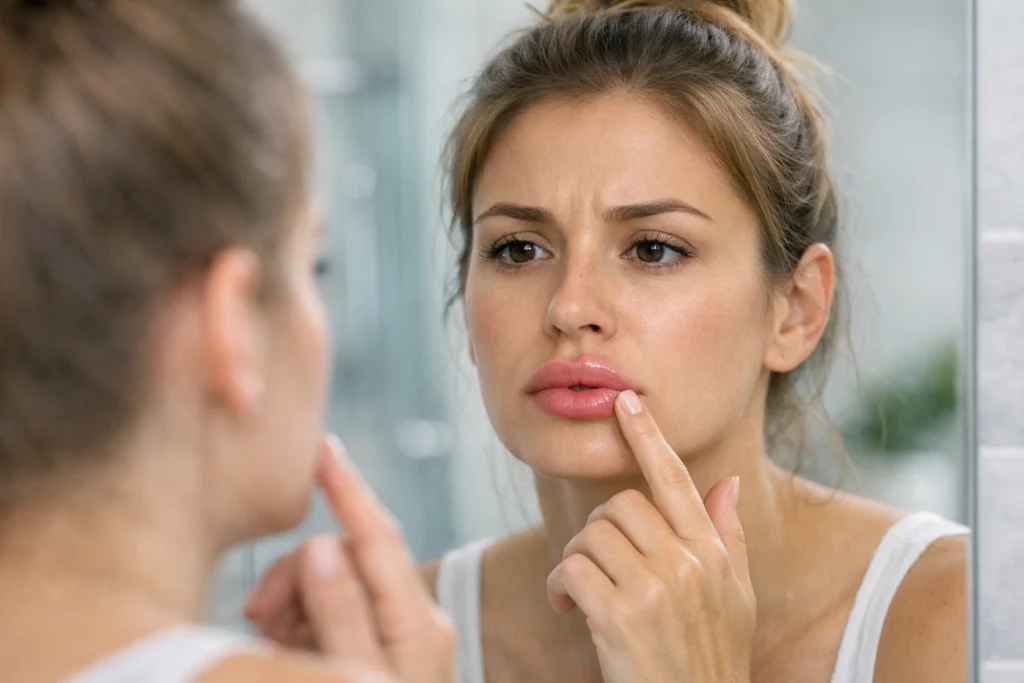
You look in the mirror two days after your lip filler appointment and one side is noticeably larger. You take a dozen photos from every angle. By day four, you are convinced your injector ruined your face. Almost certainly, they did not.
Uneven lip filler in the first two weeks is one of the most predictable experiences in aesthetic medicine, and also one of the most Googled. The problem is that most of what comes up is either alarmist or uselessly vague. Here is what is actually happening, how to tell the difference between swelling and a real placement issue, and when going back early actually makes sense.
Looking for a quick answer? Jump to the FAQ below.
The short answer
Uneven lip filler in the first two weeks is almost always swelling, not a technique problem. Swelling behaves asymmetrically — your dominant side, your sleeping position, and your lymphatic drainage all affect which side looks bigger. Assess at two weeks in natural lighting before drawing any conclusions.
The Swelling Asymmetry Window
Lips do not swell evenly. This is the single most useful thing to understand, and it almost never gets explained properly at the appointment.
In the first seven to fourteen days, swelling distribution is influenced by the dominant side of your face, differences in lymphatic drainage between the two sides, and your sleeping position. If you consistently sleep on your right side, that side of your face is compressed for several hours a night. The tissue holds fluid differently on each side. Your lymphatic system, which handles the clearance of post-injection swelling, does not run symmetrically. All of this adds up to one side looking considerably more inflated than the other, often for the first week, sometimes into the second.
This is not a filler technique issue. It is your body processing the treatment. The two-week rule before drawing any conclusions about your actual result exists because of this window. Assessing lip filler before day fourteen is almost always premature. Patients who follow the full swelling timeline in the first week and understand what drives it are significantly less likely to contact their injector in a panic on day three.
Patients who photograph their lips daily in the first week reliably report more anxiety, not less. The daily variation in swelling looks like dramatic change when it is actually normal fluctuation. Daily documentation feels like gathering data; what it actually does is amplify every normal shift.
This is normal
- One side noticeably more swollen than the other in week one
- Asymmetry that changes depending on time of day or sleeping position
- Lips looking very different in phone camera photos vs. a mirror
- Unevenness that is improving day by day even if slowly
Call your injector if
- Asymmetry that is completely unchanged across multiple days at the two-week mark
- A defined lump on one side that is not softening after two weeks
- Any blanching, purple discolouration, or severe pain — call same day
- Cold sore developing within 48 hours of treatment
How to Tell Swelling Asymmetry from Real Placement Asymmetry
They feel and behave differently. Here is the practical distinction.
Swelling asymmetry changes day to day. It is soft to the touch rather than firm or nodular. It is typically worse in the morning after lying down overnight, and it improves throughout the day as you are upright and your lymphatic system can drain. The overall shape shifts. What looked bigger on the right at 7am may look more balanced by midday.
A genuine placement issue behaves consistently across multiple days. The unevenness does not shift. You can often palpate a defined area of product that sits differently on one side. The asymmetry is present at the same time of day regardless of position.
The assessment environment matters enormously. Assess in natural lighting, not a phone camera with a beauty filter. Selfie cameras use wide-angle lenses that distort facial proportions significantly, and filters can actively even out or exaggerate differences depending on the setting. Natural light, a standard mirror, and ideally the same time of day across multiple days. That is the only honest way to evaluate what is actually there at the two-week mark.

The Pre-Existing Asymmetry Factor
Most faces are naturally asymmetric. This is not a problem with your face; it is true of almost everyone’s. The bone structure, soft tissue distribution, and muscle activation patterns are slightly different on each side.
When equal volumes of filler are placed on a face with baseline asymmetry, the result can look uneven because equal volume on an unequal canvas produces an unequal result. Skilled injectors account for this deliberately: they may place slightly more product on one side, or shape the border differently to compensate. Some injectors do not do this, either because they are not assessing for it carefully or because the consultation was too brief to map the asymmetry.
This is worth raising explicitly at your consultation if asymmetry is something you are concerned about. “Do you account for natural facial asymmetry in your placement?” is a legitimate question, and the answer will tell you a lot about the level of attention your injector brings to the assessment.
Most faces are asymmetric before filler. Filler placed symmetrically on an asymmetric face will look uneven. This is the conversation that should happen at consultation, not after.
The Migration Factor
If you have had filler in your lips before, there may already be displaced or diffuse product sitting in the tissue. Previous filler that has migrated out of the intended zone creates a baseline unevenness that a new session is placed on top of. One side might already have more residual product than the other. The new treatment amplifies rather than corrects that existing imbalance.
If you have had multiple sessions over several years and are noticing that your lips look less clean or have a slightly different shape than when you started, filler migration as a contributing factor is worth discussing with your injector before adding more product. Dissolving first and starting fresh on a clean canvas is sometimes the better approach.
What to Actually Do
Wait until two weeks minimum before reaching any conclusion. At that point, assess in natural lighting at the same time of day across at least two or three days to account for daily variation. If the unevenness is consistent and feels like a placement issue rather than residual swelling, contact your injector for a review.
Most reputable injectors include a two-week review as standard. This is the appointment where they assess the settled result, address any asymmetry, and add a small amount of product to balance if needed. If your injector does not offer this, it is still worth requesting it.
If the review confirms a genuine placement issue, dissolution is an option. Dissolving lip filler with hyaluronidase addresses confirmed placement problems cleanly and allows a fresh start two to four weeks later. It is not a failure. It is the correction tool that exists precisely for situations where the result did not land as intended.
Do not dissolve based on your day-five panic photos. Wait until the two-week assessment with your injector before making that decision.
When to Call Before Two Weeks
There is one situation where you should not wait: signs of vascular compromise.
Blanching of the skin (a white or grey discolouration immediately around the injection site), a mottled or purple discolouration pattern, or severe pain immediately after injection that is getting worse rather than better are all indicators of possible vascular occlusion. This is rare but serious. It requires same-day contact with your injector, not a wait-and-see approach. Vascular compromise needs to be addressed within hours, not days.
Normal bruising and tenderness are different. Some bruising is expected, particularly if you took ibuprofen or fish oil before the appointment. Tenderness that diminishes over the first two to three days is normal. Pain that increases, skin that changes colour in unusual patterns, or any vision changes after lip filler treatment warrant an immediate call.
Everything else, including the uneven swelling that made you spiral at 2am on day four, almost certainly belongs to the two-week window. The swelling will do what it does. Your job is to not make irreversible decisions before it settles.
FAQ
How long until I can tell if my lip filler is actually uneven?
The honest answer is two weeks minimum, assessed in natural lighting at the same time of day across multiple days. Swelling behaves unpredictably in the first week and often looks worse on one side due to sleeping position and lymphatic drainage differences. Day four and five are often when patients feel the most alarmed, and also often when the swelling is at its most asymmetric. Assessing before day fourteen is almost always premature.
Can my injector fix uneven lip filler?
If the unevenness at the two-week mark is confirmed as a genuine placement issue rather than residual swelling, yes. A small amount of product can be added to the lower side at a review appointment to balance the result. If the asymmetry is significant, dissolving with hyaluronidase and starting fresh is cleaner than trying to correct on top of existing product. Both options exist and neither is dramatic, as long as the decision is made at the right time with an accurate assessment of what is actually there.
Does sleeping position affect lip filler results?
It affects swelling distribution, which can make the result look uneven during the healing window. Sleeping on one side compresses that side of the face, and tissue holds swelling differently depending on position. This does not affect the actual placement of the product, which is set within hours of injection. What it can do is make the swelling pattern look more dramatic on one side during days two through seven. Sleeping on your back during the first week reduces this, though it is not always practical.
Cheek filler follows similar asymmetry rules but over a longer timeline: where lip filler asymmetry typically resolves by week one, cheek filler asymmetry can persist for two weeks before accurately reflecting the final placement.
This article is for educational purposes only and is not a substitute for professional medical advice. Always follow your injector’s or surgeon’s specific aftercare instructions.