

You had botox four days ago and you can still move your forehead exactly as much as you could before. So you Google “botox not working” and find a hundred anecdotes and very little useful information.
Here is the honest version.
The short answer
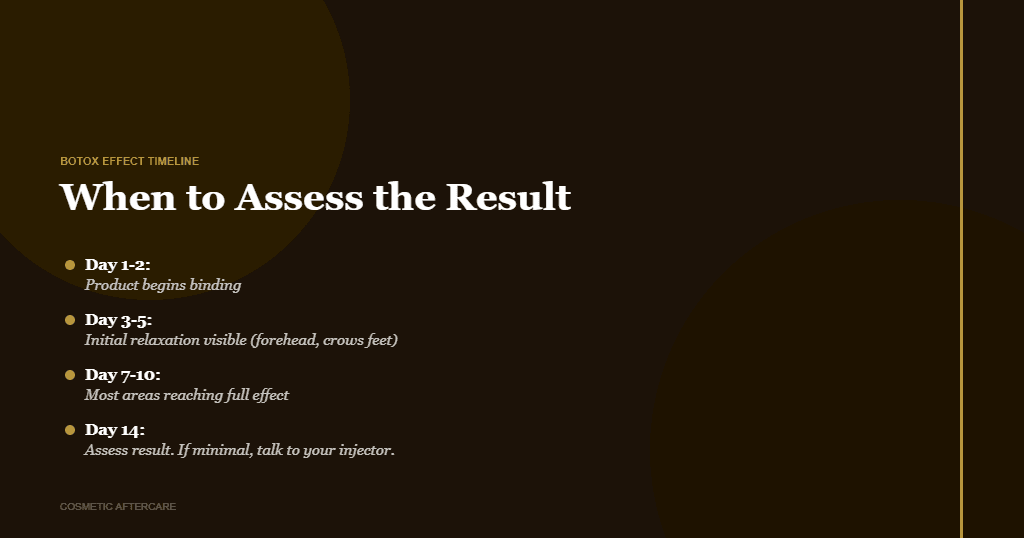
Botox takes 3–14 days to reach full effect depending on the area. Most ‘it’s not working’ moments happen at day 4–5 when the product is still binding. Wait until day 10–14 before drawing any conclusions.
The Timeline Problem
Botox takes three to fourteen days to reach full effect. The variation depends on the treatment area, the individual’s metabolism, and the depth of the muscle. Most people see the first signs of relaxation around day three to five, but full binding to the nerve terminals is not complete until around day seven to ten in most cases. Forehead and crow’s feet tend to show results earlier. Masseter and neck bands take longer.
Day four is the most common moment when patients become convinced their botox did not work. Almost universally, the treatment is still actively setting. Judging the result before day ten is almost always premature, and judging it before day fourteen in slower-responding areas is also too early.
The advice in the first week post-treatment, including what to avoid and what to expect as the product binds, is covered in detail on the botox aftercare page for the first 24 hours and beyond. The short version: if you are in week one, wait.
Judging botox at day five is like leaving a cake in the oven for half the time and deciding the recipe doesn’t work.
Underdosing: The Most Common Real Reason
If you have waited until day fourteen and the result is genuinely minimal or absent, underdosing is the most likely explanation. Units matter, and the sessions priced at a significant discount are often the ones where units are kept low to protect margins.
You are allowed to ask directly how many units were used per area. This is not an awkward or unreasonable question and any reputable injector will answer it without hesitation. Standard clinical reference ranges: forehead typically 10 to 20 units, crow’s feet 10 to 15 units per side, glabella (the lines between the brows) 20 to 30 units. If the numbers you were given are consistently at the low end of these ranges, or below them, you have your answer.
The masseter is the clearest example of an area where underdosing is common. Jaw reduction requires meaningful doses to achieve visible results, and patients who receive 15 to 20 units per side when their muscle mass warrants 30 to 40 will see minimal change. There is more detail on dose expectations in the masseter botox aftercare guide.
This is normal
- Partial movement remaining at day 5–7
- One side appearing to respond faster than the other
- Forehead feeling heavy in the first week
Contact your injector if
- No movement reduction whatsoever by day 14
- Eyelid drooping or asymmetric brow position appearing after treatment
- Any vision changes following treatment
Dilution and Product Handling
Botulinum toxin must be reconstituted from powder form before injection. The ratio of saline to product determines the concentration, and over-diluted botox delivers fewer active units per injection volume even when the recorded dose appears correct on paper.
This is not something you can identify from the outside, but there are indirect signals. If your results have been inconsistent across multiple sessions with the same provider when your dose appeared similar, or if the product seems to wear off in six to eight weeks when you previously got four to five months from equivalent sessions elsewhere, dilution or improper storage may be contributing factors. Heat and light exposure degrade botulinum toxin before it is injected, which reduces potency without any visible indication.
These are patterns worth noting and discussing with your provider. Not accusations. Patterns. “My last two sessions seemed to wear off faster than usual and I wanted to understand why” is a reasonable conversation to have.
Anatomical Factors
Some muscle groups require higher doses than others based on individual muscle mass and activity level. Men generally need more units than women in equivalent areas due to higher baseline muscle mass. Patients who use their facial muscles heavily, including musicians, public speakers, teachers, and people who habitually squint in strong light, may need higher doses than a standard protocol provides.
Strong baseline muscle activity essentially means the muscle works harder and requires a more substantial signal block to achieve the same degree of relaxation. This is not resistance. It is anatomy. The solution is adequate dosing for the individual, not a higher dose product.
The forehead is an area where this plays out particularly clearly. A patient with very active frontalis muscles who receives the minimum dose for the area may achieve partial relaxation, which creates an uneven result with some movement remaining in certain zones. This looks like the botox “didn’t work” when it actually reflects a dosing decision rather than a treatment failure.
True Resistance: Real But Rare
Neutralizing antibodies to botulinum toxin can develop after repeated exposures, particularly at high doses. The body begins to recognize the protein and produces antibodies that reduce its effectiveness. This is clinically documented and genuine.
It is also rare at standard cosmetic doses, and it is dramatically over-cited as an explanation for underwhelming results. True antibody-mediated resistance presents as a gradual reduction in both duration and effect across multiple sessions despite adequate, consistent dosing from a reputable source. Not one session that seemed weak. A sustained, progressive decline over time.
If true resistance is suspected, switching to a different botulinum toxin formulation is the practical next step. Dysport, Xeomin, and Daxxify have different protein profiles and are processed differently by the immune system. A provider who dismisses this option when genuine resistance is suspected is not engaging with the evidence.
Wrong Expectations vs. Real Underperformance
Botox reduces muscle movement. It does not erase lines that have been set into the skin over years of repeated expression. This distinction between dynamic and static lines is the most common expectation mismatch in aesthetic practice, and it almost never gets explained properly at the consultation.
A dynamic line appears during expression and relaxes when the face is at rest. Botox addresses this directly and well. A static line exists even when the face is completely relaxed. Botox will soften a static line gradually over multiple treatments as the muscle is repeatedly prevented from deepening the crease further, but it will not erase an established static line on first treatment. Filler or resurfacing treatments address static lines differently.
If your crow’s feet disappear when you relax but are still visible when you smile, that is botox working exactly as intended on a partially static line. If you expected them to vanish entirely, that is an expectations issue that the consultation should have addressed.
People who have had botox once and felt nothing are almost always in one of two situations: they assessed too early, or they were undertreated. Both are fixable and worth discussing with the injector before concluding the treatment does not work for them. How long results should last once the treatment is effective, and what affects that duration, is covered in the botox duration guide.
FAQ
How long should I wait before concluding my botox didn’t work?
Fourteen days minimum for most areas, and longer for slower-responding areas like the masseter or neck. Day four or five is the most common moment people panic, and it is also the moment the product is most actively still binding. Wait until the full two weeks before having any conversation about the result with your injector. A good injector will welcome a two-week review appointment to assess the settled outcome.
Can I ask my injector how many units they used?
Yes, absolutely. Units used per area are part of your treatment record and any reputable injector will share them without hesitation. Knowing your unit history is useful for future sessions, for comparing results to outcomes, and for having an informed conversation if you feel the result underperformed. Standard reference ranges for common areas are: forehead 10 to 20 units, crow’s feet 10 to 15 per side, glabella 20 to 30 units.
I’ve had botox multiple times and it seems to be working less well than it used to. Is that resistance?
Possibly, but more likely it is one of the fixable factors first: has your dose changed, have you changed providers, have you moved to a different practice with different reconstitution practices? True resistance develops gradually across many sessions and is accompanied by shorter duration as well as reduced effect. If all those factors look consistent and the reduction has been progressive over two or more years, discuss switching to a different botulinum toxin formulation with your provider, as different protein profiles are processed differently by the immune system.
This article is for educational purposes only and is not a substitute for professional medical advice. Always follow your injector’s or surgeon’s specific aftercare instructions.