

Arnica is particularly useful before breast and facial surgical procedures, where bruising in the first days of recovery is one of the most consistently underestimated aspects of the healing process.
Your injector mentioned arnica at the end of your appointment, maybe handed you a packet of pellets, maybe just said “you can take arnica for bruising.” Every aesthetics clinic in existence seems to recommend it. So you are standing in the pharmacy aisle, looking at eight different arnica products in three different forms, and wondering whether this is actually going to do anything or whether it is the cosmetic industry’s equivalent of a lucky charm.
The honest answer is more nuanced than either “yes it works” or “it’s a placebo.” Arnica has a plausible mechanism, inconsistent clinical evidence, a strong safety profile at normal doses, and a near-zero opportunity cost. That combination makes it a reasonable choice to use even without settled proof. But knowing what you are actually taking, and what it will and will not do, is more useful than just following the recommendation without understanding it.
What Arnica Actually Is
Arnica montana is a flowering plant. Its therapeutic use in preparations for bruising, swelling, and muscle soreness goes back centuries in European herbal medicine. The active compounds most studied are sesquiterpene lactones, particularly helenalin, which have demonstrated anti-inflammatory and some analgesic activity in laboratory settings.
The proposed mechanism for bruising specifically is that these compounds may help reduce capillary permeability and moderate the inflammatory response at a site of tissue damage. That is a biologically plausible explanation for why it might reduce the severity and duration of bruising. “Biologically plausible” is not the same as “proven to work at standard doses,” but it does mean the mechanism is not made up. There is something there worth studying.
What the Evidence Actually Says (Without Inventing Any of It)
The clinical evidence on arnica is genuinely mixed. Some trials have shown modest reductions in bruise size and duration in subjects using arnica compared to control groups. Others have shown no significant difference. The trials vary in quality, design, dose, formulation, and the type of bruising studied. This inconsistency is not unusual in botanical medicine research, but it does mean no honest practitioner can tell you “arnica is clinically proven to reduce bruising” without significant caveats.
What the evidence does not show is any meaningful harm at standard doses in otherwise healthy adults. Arnica has a well-established safety profile when used topically at appropriate dilutions and orally in homeopathic preparations. That matters when weighing the risk-benefit calculus of a supplement with an unclear efficacy signal.
The practical framing: if the question is “will arnica definitely reduce my bruising,” the honest answer is “probably somewhat, maybe significantly, or possibly not much.” If the question is “is there any reason not to try it,” the honest answer is “very few, at standard doses, with your injector’s awareness.” Those are different questions with different weights.
Recommended: Arnica Gel
If you use arnica, use it topically on closed skin and keep expectations modest; it helps bruise appearance, it does not speed healing. Boiron’s Arnicare gel is the standard pharmacy-grade option.
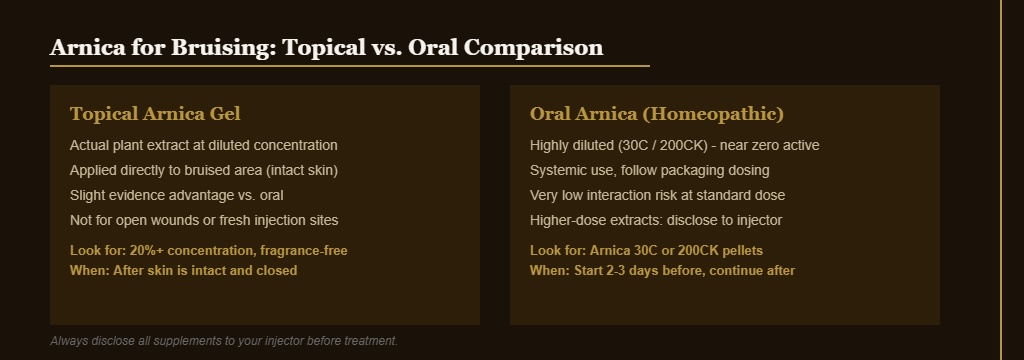
Oral vs. Topical: Two Different Products Doing Different Things
This distinction is more important than most patients realize. Oral arnica (most commonly encountered as small homeopathic pellets, typically labeled Arnica 30C or similar) and topical arnica gel are genuinely different products with different mechanisms.
Topical arnica contains actual plant extract in concentrations that deliver the active compounds to superficial tissue. It is applied directly to a bruising area after the skin is intact and healed sufficiently to tolerate it. The evidence for topical arnica is slightly stronger than for oral, partly because the delivery mechanism is more direct.
Oral homeopathic arnica (30C dilution) is so diluted that it contains essentially no detectable arnica molecules. The mechanism by which homeopathic preparations work, if they do, is still debated and not well supported by standard pharmacology models. Many practitioners recommend oral homeopathic arnica anyway, not necessarily because they believe in the homeopathic mechanism specifically, but because many patients report improvement, the risk is essentially zero at these dilutions, and the placebo effect on inflammation-related symptoms is measurable and real. This is not dishonest. It is an acknowledgment that the full picture of why things help sometimes is not always known.
For the oral route
If you are going the tablet route, Boiron Arnicare Tablets are the one we recommend. Start per the package directions and tell your surgeon you are taking it.
Higher-dose oral arnica extracts (not homeopathic, actual plant extract capsules at higher concentrations) are a different category and warrant more caution. They may have real biological activity at those doses and come with the corollaries: potential interactions with medications and effects on bleeding that need to be considered. Always discuss these with your injector before your appointment.
The Medication Interaction Note You Need to Read Before Your Appointment
Arnica at higher doses can affect bleeding and may interact with anticoagulant medications. If you take any blood thinners, aspirin regularly, or other medications that affect clotting, this is a specific conversation to have with your injector before adding arnica to your pre-procedure routine. Standard homeopathic pellet doses are generally not considered a clinical concern for most people, but confirm this with your practitioner rather than assuming.
The broader principle applies to all supplements: disclose everything to your injector before treatment. Supplements are not automatically safe simply because they are not prescription. The interaction between arnica and other supplement categories matters too, particularly if you are taking anything else for anti-inflammatory purposes. Your injector may have timing preferences, such as stopping arnica (or not starting it) a certain number of days before a procedure. Follow those preferences rather than starting a regimen independently.
For additional context on what else helps with swelling and bruising after filler, the evidence on pineapple enzyme for filler swelling covers bromelain, which is a complement to arnica and worth understanding separately.
What Arnica Will and Will Not Do
At standard doses, arnica may reduce the severity and duration of mild to moderate bruising. It is not a bruise eliminator. A deep hematoma from a significant vessel disruption will not be resolved by arnica pellets. A surface bruise from a superficial injection point may fade somewhat faster. For specific guidance on bruising after lip filler — which tends to be the most visible and most worrying — see the guide on lip filler bruising. The difference is clinically modest in many cases.
Cold compresses for the first twelve hours, elevation, and avoiding activities that increase blood flow to the treated area are the interventions with stronger and more consistent evidence for immediate bruise prevention. Arnica fits most logically as a complement to these measures, not a replacement for them.
Patients consistently report that beginning arnica a day or two before a procedure and continuing for several days after feels like it makes a difference. Whether that is arnica specifically, the placebo effect, or simply good combined aftercare practices is hard to disentangle in the real world. For most cosmetic procedure patients, it does not need to be disentangled. The question is whether to use it, and the case for using it is reasonable.
For the full context of lip filler recovery, including what the first week looks and feels like and when bruising typically peaks, the 7-day lip filler recovery timeline covers the sequence you should actually expect.
How to Choose: Standing in the Pharmacy Aisle
If you are buying topical arnica: look for a gel or cream with arnica listed as a main active ingredient rather than a trace additive. Check that it is formulated for skin application at a dilution appropriate for cosmetic use. Do not apply to any broken skin, fresh injection sites, or anywhere with active bleeding. Intact, already-closed skin only. Standard tube sizes in the 7-20g range are fine for a single procedure recovery.
If you are buying oral arnica: standard homeopathic pellets (Arnica 30C, Arnica 200CK) are what most aesthetic injectors refer to when they say “take arnica.” The dosing on the box is what to follow. These have essentially no interaction risk at homeopathic dilutions. Higher-strength oral extracts (actual plant concentrates, often in capsule form at 50mg or more) require more care and a conversation with your injector first.
One honest category note: most “bruise-reducing serums” that contain arnica as a secondary ingredient alongside multiple other compounds are primarily marketing products. The arnica concentration in a serum marketed for bags or dark circles is unlikely to be at a level that meaningfully affects bruising. A straightforward arnica gel with actual concentration listed is what you want, not a multi-ingredient serum that mentions arnica fourth.
For skin healing after more intensive procedures, the role of copper peptides in recovery addresses a different mechanism that works well in concert with short-term bruise management strategies.
FAQ
When should I start taking arnica before a procedure?
Many injectors suggest starting two to three days before the appointment. Some suggest the night before or day-of only. Follow your specific injector’s preference since timing protocols vary by practice. Starting after the procedure is also reasonable if you did not have time to start beforehand. Post-procedure use is where most of the proposed mechanism applies anyway.
I bruise heavily. Will arnica help more for me?
If you consistently bruise significantly from injections, arnica alone is unlikely to fully compensate. More useful conversations with your injector include technique adjustments, cannula use where appropriate, pre-procedure ice, and whether timing your appointment around your cycle or medication schedule affects your bruise pattern. Arnica is one tool, not the primary intervention for heavy bruisers.
Is it safe to use both topical and oral arnica at the same time?
At standard homeopathic oral doses combined with topical gel at normal dilutions, this combination is generally considered safe for healthy adults. If you have any concerns, check with your injector. The caution about medication interactions applies primarily to higher-dose oral extracts, not homeopathic preparations.
Arnica’s use in injectable recovery is particularly relevant for Botox bruising, where the same periorbital and lip flip areas that bruise most often are also the areas where arnica shows the clearest benefit in reducing severity and duration.
This article is for educational purposes only and is not a substitute for professional medical advice. Always follow your injector’s or surgeon’s specific aftercare instructions.Arnica is particularly relevant for surgical procedures like blepharoplasty, where bruising around the eyes is one of the most visible and distressing parts of the recovery arc.
For a complete list of what to avoid in the days before a procedure, the pre-op supplement and medication guide covers the full picture, including blood-thinning supplements that affect bruising risk.
Arnica sits alongside collagen peptides as a peri-surgical supplement with genuine clinical support — both occupy the same evidence tier: real clinical backing, low risk for most cosmetic surgery patients, and worth including in the peri-surgical routine.