
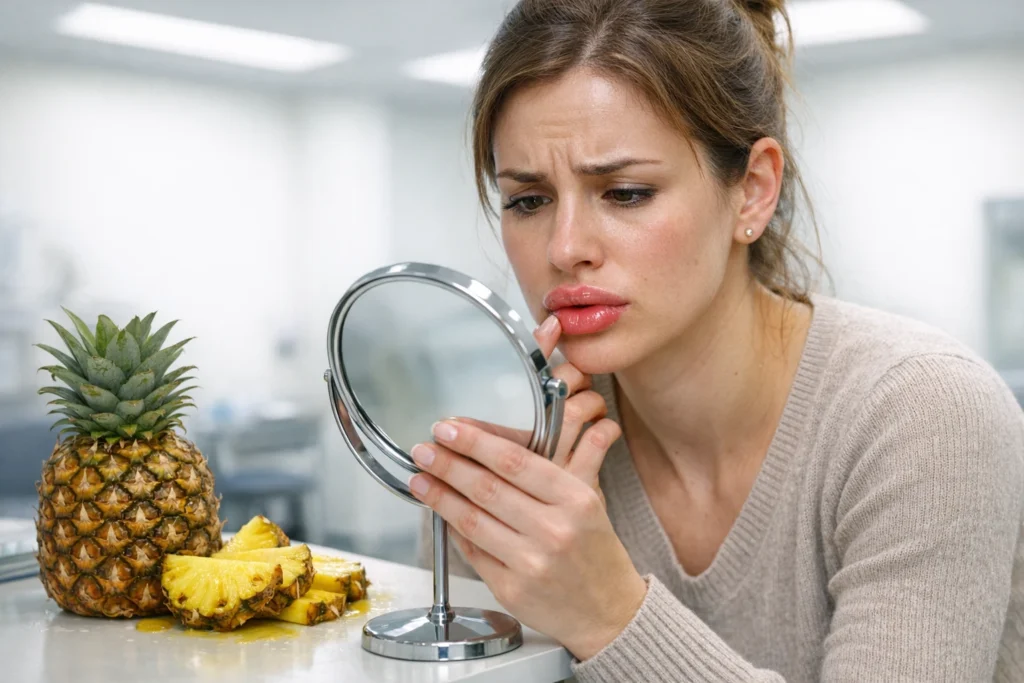
Your injector just left the room and your lips are already twice their normal size. Someone at work will ask if you “did something” by tomorrow. You Google “how to reduce lip filler swelling” and find fourteen posts recommending pineapple. Here’s the actual story: there’s a kernel of biochemical truth in there, but the pineapple advice got distorted into something that will have you choking down fruit chunks when the cold compress you skipped would have done ten times more.
Where the Pineapple Advice Comes From
Pineapple contains bromelain, a naturally occurring enzyme with anti-inflammatory properties. Bromelain has been studied in clinical settings for its potential to reduce swelling and bruising, primarily after surgery or injury, and has been used as a supplement in some post-surgical protocols in Europe.
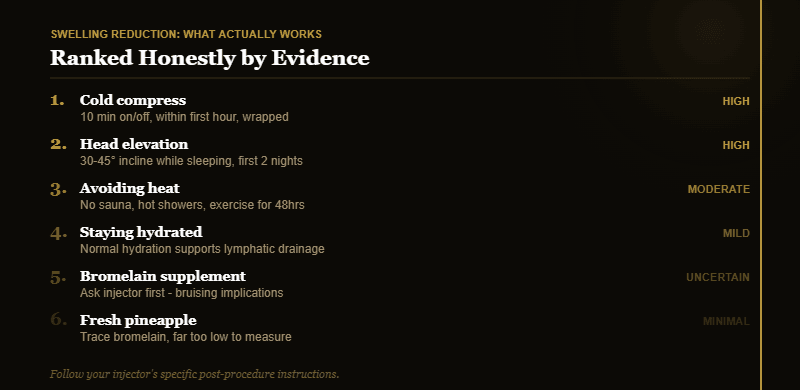
That’s the true part. Here’s where it breaks down for the pineapple advice specifically: the concentration of bromelain in fresh pineapple is low and highly variable. Cooking destroys it, canned pineapple has effectively none, and the supplement protocols that showed any meaningful results used concentrated doses many times higher than what you’d consume from eating a bowl of fruit. What you’re actually doing when you eat pineapple after lip filler is consuming a trace amount of an enzyme with a mild anti-inflammatory mechanism. It won’t hurt you. It won’t rescue your recovery either.
Bromelain Supplements vs. Fresh Pineapple: The Disagreement Worth Knowing About
Some injectors recommend bromelain supplements before and after lip filler, particularly for patients who bruise easily. Others won’t, because bromelain has blood-thinning effects and they’d rather patients not take anything that could increase bruising risk. Both positions are defensible, and neither is clearly wrong based on available evidence.
If your injector mentioned bromelain supplements and you want to explore that option, ask them specifically about timing and dosage. The supplement is a different conversation from the fruit. Before taking any supplements after a cosmetic procedure, check with your injector, since some affect healing and bruising in ways that matter.
What Actually Moves the Needle on Lip Filler Swelling
Cold compress, applied correctly, is the most effective thing you can do in the first 24 hours. The key word is correctly: wrapped ice or a gel pack, applied for 10 minutes on and 10 minutes off, never directly against skin, started within the first hour after your appointment. Most people either skip it because they went straight back to work or they apply it continuously, which doesn’t help more and can cause skin irritation. The window matters. An ice pack applied four hours after your appointment has a fraction of the effect of one applied within the first hour.
Head elevation while sleeping matters more than most people expect. Lying flat allows fluid to pool in the lips overnight. Sleeping at a 30 to 45 degree incline for the first two nights makes a visible difference in morning swelling for many patients. This is one of those instructions that sounds minor and isn’t.
Avoiding heat in the first 48 hours. Hot showers, saunas, hot drinks, and intense exercise all dilate blood vessels and increase fluid movement to the area. The effect is not dramatic, but it’s consistent. If you have a hot yoga class scheduled for the morning after your filler appointment, reschedule it.
Hydration supports lymphatic function, which processes the swelling fluid. This doesn’t mean forcing down gallons of water, but staying normally hydrated supports the clearing process.
The Day 2 Panic and Why It Resolves
Patients consistently describe day two as the day they panic. You wake up, look in the mirror, and your lips look worse than they did the day of the appointment. This is normal. Swelling typically peaks somewhere between 24 and 48 hours post-procedure as the inflammatory response completes its initial phase. The unevenness, the firmness, the “they look completely wrong” feeling that day two brings is not a sign something went wrong.
By day three or four, most patients see meaningful improvement. By day seven, the majority of swelling has resolved for most filler products, though final results may take two to four weeks as residual swelling settles and the filler integrates. The 7-day lip filler recovery timeline covers what to expect day by day, including the common day 4-5 moment where the lips look slightly uneven before the filler fully settles.
When to Call Your Injector: Don’t Skip This Section
Normal swelling is bilateral, meaning both sides are affected similarly. It is soft and presses down under gentle touch, resolving visibly by day three. It does not have color changes in the skin around it beyond the pink flush typical of inflammation.
Call your injector the same day if you notice: a white or bluish-white area anywhere in or around the lips, sudden severe pain that is disproportionate to what you experienced right after the procedure, blanching or pale patches that don’t return to normal color within a minute or two, or any change in vision. These are potential signs of a vascular complication, which is rare but requires immediate attention. Do not wait to see if it improves. This is not a “call tomorrow if it’s still there” situation.
Asymmetry that is significant and persists past day seven is worth a follow-up appointment, not a cause for alarm but something to address. A lump that is firm, tender, and growing after day three rather than softening warrants a call. And any sign of infection, including warmth that increases over time, redness spreading beyond the immediate injection site, or fever, should be reported promptly. For more on how filler can migrate or behave unexpectedly over time, the filler migration guide covers what to watch for and when it becomes a concern.
FAQ
Should I eat pineapple before or after lip filler?
Eat it if you like pineapple. Fresh pineapple contains bromelain which has mild anti-inflammatory properties, but the concentration in dietary amounts is too low to have a meaningful clinical effect on post-filler swelling. For more on managing post-filler bruising, the guide on lip filler bruising covers what to expect and what actually helps. If you are interested in bromelain supplements specifically for bruising reduction, discuss it with your injector before your appointment since there are considerations around blood thinning that vary by patient. Arnica for bruising is another evidence-backed option worth considering alongside bromelain.
How long does pineapple for lip filler swelling take to work?
This question assumes a level of effect that the evidence doesn’t support for dietary pineapple. You won’t see a measurable difference in swelling from eating pineapple. The cold compress and head elevation protocols described above have far more evidence behind them and produce results you can actually observe. Focus there first.
Is it normal for lip filler swelling to be worse on day 2?
Yes, completely. Swelling peaks between 24 and 48 hours after the procedure for most patients, which means the morning after often looks worse than the afternoon of. This is the normal inflammatory timeline. If swelling is also accompanied by significant asymmetry, increasing pain, or any skin color changes, those are the signals worth paying attention to, not the general volume increase which is expected.
This article is for educational purposes only and is not a substitute for professional medical advice. Always follow your injector’s or surgeon’s specific aftercare instructions.