
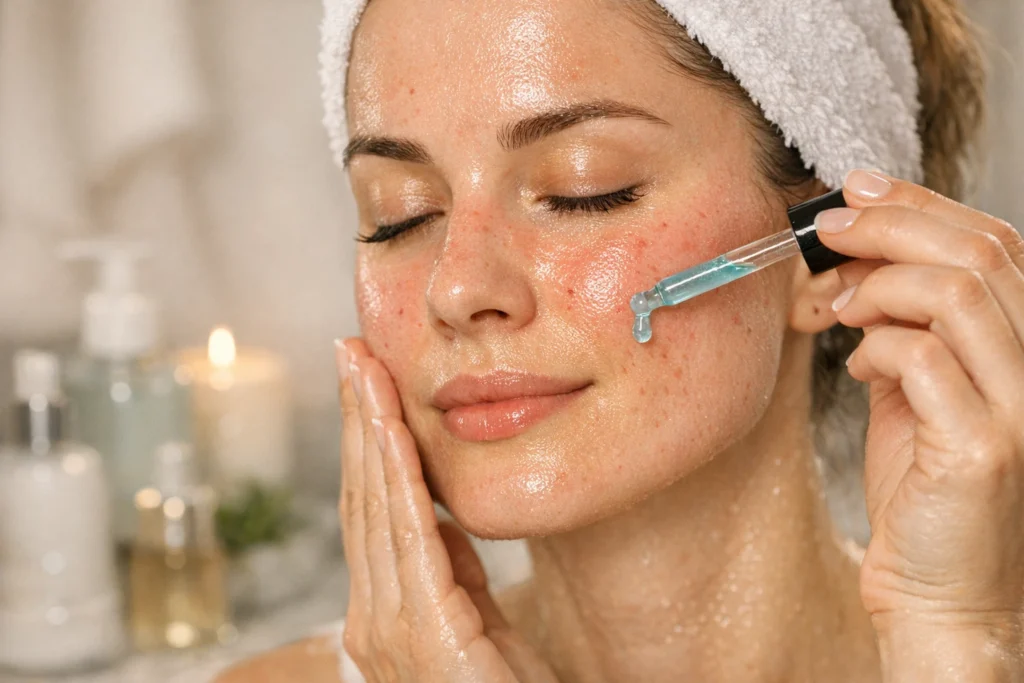
You just had microneedling and you’re reading about copper peptides because someone in a skincare forum said they’re essential post-procedure. Someone else replied that they started them immediately and had no issues. A third person said they caused a reaction on day two. All three of those things can be simultaneously true, because the question isn’t really about copper peptides. It’s about timing and skin barrier status, and most of the advice circulating online skips that part entirely.
What GHK-Cu Actually Is
GHK-Cu is a naturally occurring copper peptide, a small protein fragment bound to copper that exists in human plasma and wound fluid. (For those experiencing bruising at injection points from the needles, the guide on arnica for bruising covers topical and oral options worth pairing with your skincare routine.) It was identified decades ago in research on wound healing and liver regeneration. What makes it relevant to post-procedure skincare is its role in signaling: GHK-Cu has been studied for its involvement in collagen and elastin synthesis, antioxidant activity, and processes involved in skin repair.
Unlike many trendy skincare ingredients, the interest in GHK-Cu predates the Instagram era by a significant margin. That doesn’t make it magic, but it does mean the mechanism is reasonably understood. It functions as a biological messenger rather than an active exfoliant or retinoid, which matters for how you think about timing after a procedure.
Why Broken Skin Changes Everything
Microneedling creates hundreds of micro-channels in the skin. For a window of time after the procedure, your skin barrier is compromised. This is actually part of why microneedling works: the controlled injury triggers a repair response. But it also means that whatever you apply in that window absorbs differently than it would on intact skin.
Deeper penetration isn’t always better. An ingredient that’s gentle and beneficial at normal absorption rates can become irritating at elevated ones. The other consideration is that freshly needled skin has an active inflammatory response running, and piling multiple actives onto it in the first 24 hours doesn’t give that response room to proceed without interference.
This is the baseline you need before the question of copper peptides becomes answerable. The question is not just “are copper peptides good for skin repair?” but “is right now the right time to introduce them?”
The 24 to 72 Hour Window Question
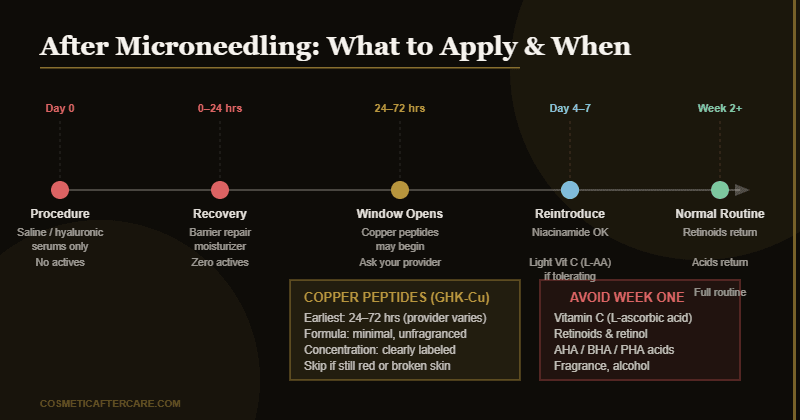
Practitioners genuinely disagree on this, and the honest answer is that the evidence doesn’t firmly settle it. Some practitioners apply copper peptide serums immediately post-procedure as part of the in-office protocol, believing that the increased absorption enhances the benefit. Others instruct patients to wait 24 to 48 hours and focus on pure barrier repair first: plain hyaluronic acid, ceramides, nothing else.
The distinction matters because GHK-Cu is being applied to open channels immediately after they’re created in the first scenario, versus applying it to skin that has begun to close those channels in the second. Different risk profile, potentially different benefit profile.
Whatever your practitioner used or recommended in the first 24 hours is what you follow. Their protocol is calibrated to what they did, the depth and density they worked at, and any other actives they applied. The timing question for your home routine starts after that.
What to Look for in a Copper Peptide Serum
The market for copper peptide products is polarized. On one end you have clinical-grade serums with transparent concentration ranges and minimal formulas. On the other end you have products that list a copper-containing compound in the middle of a 40-ingredient list and rely on the ingredient’s reputation to justify the price.
When evaluating a product for post-procedure use, the things that actually matter are: concentration transparency (the manufacturer should be able to tell you what percentage of GHK-Cu is in the formula), a minimal ingredient list without fragrance, alcohol as a primary ingredient, or exfoliating acids, and a packaging format that doesn’t degrade the peptide (opaque or airless dispensing, not a wide-mouth jar).
Most over-the-counter copper peptide serums are dramatically underdosed relative to what research uses. That’s not necessarily fatal to their effectiveness, since cosmetic benefits don’t always require clinical dosing, but it is a reason to be skeptical of anything that makes dramatic claims about collagen remodeling without stating concentration. Concentration transparency is the single most honest signal a brand can send.
What Not to Layer with Copper Peptides in Week One
Vitamin C (specifically ascorbic acid) and copper peptides are chemically antagonistic. Ascorbic acid oxidizes GHK-Cu, reducing its effectiveness, and the combination can cause irritation on post-procedure skin. If you use vitamin C in your routine, pause it for at least the first week and introduce it after your skin is fully recovered. Same vitamin C caveat applies for lower pH formulations generally.
Retinoids of any kind should be off the table for at least the first week post-microneedling, regardless of copper peptides. Irritation from retinoids on compromised skin is real and well-documented, and the repair work your skin is doing in week one doesn’t need to compete with retinoid-induced turnover. Exfoliating acids, including AHAs and BHAs, carry the same logic. Your skin does not need help exfoliating right now. It needs barrier support.
For context on recovery timelines, the 7-day filler recovery timeline covers similar barrier-sensitivity logic in a different procedure context, and illustrates why the first week’s product choices are disproportionately consequential compared to later choices.
Do You Actually Need Copper Peptides at All?
This is the question the skincare industry doesn’t want asked. The honest answer: no, not necessarily. Plain barrier repair, meaning fragrance-free moisturizer with ceramides and possibly hyaluronic acid, is genuinely sufficient for most people’s post-microneedling recovery. Microneedling initiates a repair process that runs mostly on its own. The role of what you apply topically is to support the barrier and avoid interfering, not to drive the repair.
Copper peptides are an evidence-adjacent upgrade for people who want to optimize, particularly for collagen-focused goals. They are not rescue equipment for a compromised barrier. If you use a quality moisturizer and protect the skin from sun exposure in the first week, you’ll heal well without them. If you decide to add GHK-Cu starting around day three to five and your skin tolerates it, you may be doing something useful. What you won’t be doing is making a critical mistake either way.
For those exploring the broader category of post-procedure skincare actives, the gap between what’s evidence-supported and what’s heavily marketed is widest here. Snail mucin, growth factor serums, stem cell extracts: each of these has a marketing story. Few have the mechanistic clarity of GHK-Cu research. That doesn’t make the others worthless, but it does make copper peptides the most defensible choice for someone who wants to add one ingredient to a minimal post-procedure protocol.
When to Call Your Injector or Aesthetician
Redness that persists past 72 hours, skin that feels increasingly hot or painful rather than calming, any sign of infection including pus, crusting beyond normal healing, or warmth that spreads. Unexpected breakout patterns across microneedling zones can sometimes be folliculitis and worth mentioning. And if you applied a product in the first 24 hours and had an obvious reaction, contact the provider who performed the procedure before trying to treat it yourself.
FAQ
Can I use copper peptides the same night as microneedling?
Some in-office protocols do apply them immediately post-procedure. For your home routine the same night, it depends entirely on what your provider instructed and what they applied during the session. If they didn’t specify, a safe default is plain barrier repair only on the day of the procedure. Introducing copper peptides starting day two or three, once your skin has begun closing the micro-channels, is a less variable approach for most people.
How long should I use copper peptides after microneedling?
There’s no fixed protocol, but most of the benefit to skin remodeling occurs in the weeks following a procedure when collagen synthesis is elevated. Continuing for four to six weeks post-procedure is reasonable. After that, copper peptides become part of a general maintenance routine rather than post-procedure support, which is fine if your skin tolerates them well and you find value in the results.
Do copper peptides interfere with hyaluronic acid or ceramide products?
No. These ingredients don’t interact negatively. A sensible post-procedure routine might be: immediately after the procedure and for the first day or two, pure hyaluronic acid and ceramide-based moisturizer only. From around day three, add copper peptide serum under the moisturizer. What to avoid in that first week is anything with low pH, ascorbic acid vitamin C, retinoids, or exfoliating acids.
Copper peptides are most effective when you understand what the skin goes through in the first week of microneedling recovery — the bronzing, the flaking, and the quiet collagen-building that follows.
Copper peptides work well alongside niacinamide as a gentle supportive ingredient during recovery, with niacinamide handling barrier support and copper peptides supporting the repair and synthesis side.
PRP is frequently used as part of the same skin recovery protocol as copper peptides, particularly after microneedling. The two do not conflict, but they apply at different stages of the healing process. The PRP aftercare guide explains what the skin actually needs in the first 48 hours post-PRP and when it is appropriate to reintroduce actives, including peptides, into your routine.
If you are researching injectable peptides in the recovery space, the article on BPC-157 evidence separates what the animal research actually shows from what the community has been claiming without adequate human trial support.
This article is for educational purposes only and is not a substitute for professional medical advice. Always follow your injector’s or surgeon’s specific aftercare instructions.