
The instruction “avoid actives” gets applied like a blanket to every cosmetic procedure, and the result is that patients abandon their retinol for weeks or months when they could have restarted in days, or restart in days when they genuinely needed to wait longer. Retinol is not just another active. It has a specific mechanism that makes it actually problematic on compromised skin, but the nature of that compromise varies completely depending on what procedure you had. A botox patient and a microneedling patient have almost nothing in common when it comes to the retinol question.
What Retinol Actually Does to Skin Cells
Retinol accelerates cell turnover by binding to retinoic acid receptors in skin cells and signaling them to divide and move to the surface faster than they would naturally. This is why it works: the faster turnover improves texture, reduces the appearance of fine lines, and supports collagen production over time. It is also why it is the wrong ingredient on freshly treated skin.
Increased cell turnover on a barrier that is already compromised, inflamed, or in the middle of healing creates additional stress. The skin is already working on a repair process. Asking it to also accelerate turnover at the same time can extend irritation, slow healing, and in some cases cause sensitivity reactions that would not have occurred on healthy skin. The specific risk is not dramatic injury, it is disrupting the organized healing cascade that produces a good long-term result.
This is also why the pause window is not the same for every procedure. It is proportional to how much barrier disruption occurred and how long that disruption lasts.
The Restart Guide by Procedure
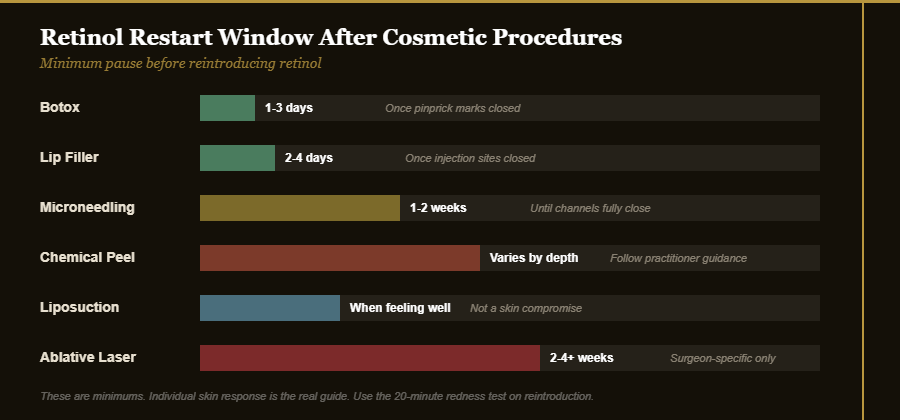
Botox does not compromise the skin barrier — for all other aftercare rules in the first 24 hours, the botox aftercare guide is a useful companion read. The needle used is extremely fine and the injection points are small enough that they typically close within hours. There is no open wound, no ablation, and no significant surface disruption. Most patients can resume retinol within one to three days, once any pinprick marks have visibly closed and the treated area is not showing signs of irritation or bruising. If there is significant bruising, wait for it to resolve before reintroducing.
Lip filler follows the same logic. The skin itself is not being treated, the product is placed beneath the surface, and the entry points close quickly. A few days is a reasonable standard pause, waiting until the injection sites are no longer visible and initial swelling has begun to subside. The botox aftercare guide covers the first 24-hour window in detail, which applies similarly to the immediate post-injection period for lip filler.
Microneedling is a different situation. The entire point of the procedure is creating controlled microchannels in the skin surface, which then trigger a healing response. Those channels need to close completely before you introduce anything that accelerates turnover or stresses the barrier. Most practitioners recommend a minimum of one week, with two weeks being the more conservative and commonly safer standard, particularly for deeper needling sessions. Do not let anyone rush you back to retinol before the one-week mark after microneedling. The copper peptides after microneedling guide covers what you should be using in the gap instead.
Chemical peels require surgeon-specific guidance and the answer changes entirely based on peel depth. A superficial glycolic peel at a low percentage may allow retinol restart within a week or so. A medium-depth TCA peel involves real barrier disruption and a genuine wound healing phase that can take two to three weeks before the skin is ready for any active ingredients. A deep peel extends that further. There is no general answer for peels: follow your practitioner’s specific post-peel protocol.
Liposuction is often the one that surprises people. Lipo is a subcutaneous procedure, meaning it occurs below the skin surface, not at it. Unless incision sites are directly relevant to where you apply skincare, there is no reason to pause retinol based on lipo alone. The body is recovering from surgery overall, and general fatigue and inflammation are real, but the skin on your face or wherever you apply retinol is not affected by a subcutaneous abdominal procedure. Resume when you generally feel well enough to maintain your normal skincare routine.
Laser treatments are the category where the answer is most firmly surgeon-specific and should never be generalized. Ablative laser resurfacing creates significant surface disruption that can take weeks to heal. Non-ablative lasers vary widely in their impact. “Laser” covers too many procedures at too many intensities to give a useful general number. Ask your practitioner for the specific restart window for the specific device and setting used on you.
How to Reintroduce Retinol Without Relapsing
The instinct after a break is to jump straight back to where you left off. If you were using retinol nightly before your procedure, restarting nightly the day you get clearance is a reliable way to experience the irritation you were trying to avoid. Your skin adjusted to retinol over time initially. Coming back from a pause of several weeks is a partial reset.
Start every three nights. Use a pea-sized amount, the same as always. Watch for any redness that persists beyond 20 minutes after application. Some warmth and mild tingling is normal when reintroducing retinol. Redness that is still visible half an hour later means the skin is not fully ready. Wait another week before trying again. After two to three applications with no significant irritation, step to every other night, then back to nightly if that was your previous routine.
What to Use Instead During the Pause
The pause is not a do-nothing period for your skin. It is a period for ingredients that support healing rather than accelerating turnover. Hyaluronic acid serums provide hydration without stress, which is particularly useful when the skin is repairing. After lip filler, HA makes obvious sense for the treatment area as well; the hyaluronic acid serum after lip filler guide covers the specific application context there.
Peptides, particularly copper peptides, support the structural repair phase that procedures like microneedling are designed to trigger. Using copper peptides in the retinol gap after microneedling is not just safe, it is actively aligned with the healing process. A good barrier cream with ceramides protects without interfering. Plain SPF matters more during procedure recovery than at any other time, as treated skin is more susceptible to UV damage during the healing phase.
The category of ingredients that can wait alongside retinol: exfoliating acids (AHAs, BHAs), vitamin C in active L-ascorbic acid form (which has a low pH and can irritate already stressed skin), and anything marketed as resurfacing or brightening that works through cell turnover acceleration.
The Irritation Signal
Redness that lingers beyond 20 minutes after applying retinol is the clearest signal that the skin is not ready. This is not about the mild warmth that retinol users recognize from normal use. It is visible, ongoing redness that does not fade quickly. If you see it, remove the product gently with cool water, apply a plain barrier cream, and extend the pause by another week before trying again. Do not push through it. The skin is telling you something useful.
Frequently Asked Questions
Can I use retinol the day after botox?
Most practitioners consider it safe to resume retinol within one to three days after botox, once the injection sites have visibly closed. The skin barrier is not meaningfully compromised by botox injections. If you have noticeable bruising, wait for that to resolve first, as retinol can thin skin slightly and may prolong bruising in some people. When in doubt, a three-day pause is a reasonable conservative default.
I used retinol two days after microneedling and my skin is now red and irritated. What do I do?
Stop the retinol immediately. Apply a plain barrier cream or healing balm without any active ingredients, keep the skin hydrated, and avoid any other actives until the irritation completely resolves, which usually takes a few days to a week. This situation is not a permanent problem. It is skin irritation that will resolve with simple barrier support. Once everything has calmed down completely, you can restart both your normal skincare and plan a more conservative microneedling recovery timeline for next time.
My aesthetician said I could use retinol after one week post-microneedling but it still feels sensitive. Should I push through?
No. One week is a minimum, not a target. Skin sensitivity at one week post-microneedling is a real signal, and your skin may simply need more time than the average patient. The 20-minute redness test is more reliable than a calendar. If the skin reacts, it is not ready. Wait until a test application produces no prolonged redness before resuming your routine. You will not lose your retinol results by waiting another week.
Before returning to retinol, niacinamide is the better first choice to reintroduce before returning to retinol because it supports barrier recovery rather than accelerating cell turnover on healing skin.
SPF is the foundation that everything else, including retinol reintroduction, builds on. The guide on SPF after cosmetic procedures covers the mineral vs. chemical distinction that matters specifically during the healing window, and explains why consistent SPF use protects the investment in the procedure itself.
If you are on prescription tretinoin rather than OTC retinol, the stop and restart windows are similar in structure but the stakes are higher given tretinoin’s greater potency. The full stop and restart playbook by procedure type is covered in tretinoin after cosmetic procedures.
This article is for educational purposes only and is not a substitute for professional medical advice. Always follow your injector’s or surgeon’s specific aftercare instructions.Understanding the broader skin barrier repair framework before you start reintroducing retinol gives useful context for why the timing matters and what you should be applying in the weeks before restarting your actives.