
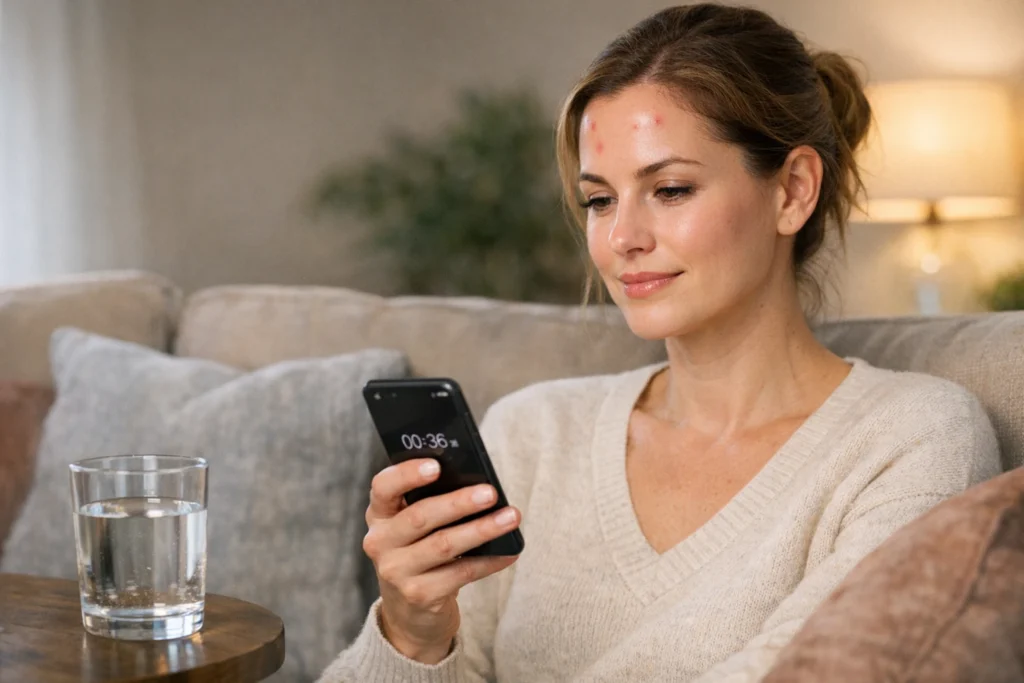
The short version: Stay upright for four hours. Don’t touch or rub the treated area for 24 hours. Skip exercise, alcohol, heat, and saunas for the rest of the day. Results begin appearing in three to seven days and are complete at two weeks. Most side effects are minor and resolve on their own.
You walked out of your appointment feeling fine. Maybe a little pink at the injection sites, maybe not even that. The procedure took fifteen minutes. Now you’re wondering whether you actually need to follow all those instructions they printed for you, or whether they’re just legal boilerplate.
Some of them matter more than others. Here is the honest version of what the first 24 hours actually requires, and why.
The Four-Hour Window Everyone Gets Wrong
The first instruction you’ll hear is “stay upright for four hours.” Most patients interpret this as “don’t take a nap.” That’s the right idea but incomplete.
What you’re actually trying to do is keep the botulinum toxin localized to the injection site while it begins binding to the nerve receptors in the targeted muscles. The Massachusetts General Hospital’s published patient aftercare guidelines note that this binding process begins anywhere from three to seven days after injection and isn’t complete for two weeks. During the early hours, the product is still relatively mobile.
Staying upright prevents gravity from working against the placement. Bending deeply forward, lying face-down, or doing anything that puts your head below your heart for an extended period in the first four hours is the actual risk. A short bend to pick something up off the floor is not going to ruin your results. Doing a headstand, lying on a massage table, or taking a long nap face-down is a different matter.
The same logic applies to tight headbands, hats with snug brims, or anything pressing on your forehead. Keep pressure off the treated areas until the product has had time to settle.
The No-Touch Rule: Why It Exists and When It Stops Mattering
Don’t rub, massage, or apply firm pressure to the injected areas for at least 24 hours. This is the most consistently supported piece of botox aftercare advice, and it has a clear mechanism: physical pressure can spread the toxin beyond the intended injection site into adjacent muscle groups. That’s how you end up with results in the wrong place.
Worth knowing: Dr. James Zins, a board-certified plastic surgeon at Cleveland Clinic, has noted that most undesirable Botox outcomes trace back to injection technique rather than patient aftercare. Poor placement is a more common cause of unwanted spread than touching your face. That said, the no-touch rule is simple enough to follow and the downside of skipping it is real, so follow it.
You can wash your face gently later in the day. Use light pressure, cool or lukewarm water, and pat dry. What you’re avoiding is rubbing and sustained firm contact, not all facial movement or touching your face entirely.
Facial expressions are fine. Moving your eyebrows, smiling, frowning — none of this is a problem. Some injectors actually encourage gentle facial exercises in the first hour post-treatment to help the product settle into the muscle, though WebMD notes the evidence on this is mixed and it’s not essential.
Exercise, Heat, and Alcohol: The Actual Risks
These three restrictions all share the same underlying reason: increased blood flow.
Strenuous exercise raises your heart rate and circulation throughout the body, which can theoretically dilute and spread the toxin before it has fully bound to its target. The 24-hour exercise restriction is the standard recommendation across major clinical guidelines. A gentle walk is fine. A HIIT class, run, or heavy lifting session is not. For the full breakdown of when you can safely return to different types of exercise, see our working out after Botox guide.
Heat carries the same risk through a different route. Saunas, hot tubs, steam rooms, and hot showers raise your body temperature and dilate blood vessels, increasing circulation to the face. The Massachusetts General Hospital aftercare guidelines specifically call out saunas and hot tubs, recommending avoidance for at least four hours. The practical advice is to avoid all of these for the rest of the day.
Alcohol thins the blood and raises bruising risk. It’s worth skipping for 24 hours post-treatment, ideally the evening of your appointment at minimum.
What does not need to be avoided: cold water, a cool shower, a gentle cleanse. Cold actually helps — it constricts blood vessels and reduces any minor swelling or redness at the injection sites. Ice wrapped in a cloth, applied gently for ten minutes at a time, is appropriate if you want to reduce any immediate puffiness.
When Results Appear (And Why Two Weeks Is the Real Benchmark)
This is where most first-time patients get caught off guard. You will not see your results in the first day or two. You might see some mild relaxation by day three or four. Full effect takes ten to fourteen days.
Massachusetts General Hospital’s published aftercare guidelines are explicit on this point: Botox’s muscle-weakening effect begins anywhere from three to seven days after injection and is not complete for two weeks. Assessing your results before that point, or panicking that something has gone wrong before two weeks, is premature.
If you’re still seeing no effect at all after two weeks, that’s when a follow-up conversation with your injector is warranted. Not before.
What’s Normal vs. What Warrants a Call
NORMAL
- Small pink marks or dots at injection sites, fading within hours
- Mild tenderness or sensitivity at injection sites for a day or two
- Slight headache on the day of treatment — take paracetamol or acetaminophen, not ibuprofen
- Minor bruising, especially around the eye area or laugh lines, lasting up to a week
- Feeling of tightness or heaviness in treated muscles in the first few days
- Results appearing gradually over days three to fourteen
CALL YOUR INJECTOR
- Drooping eyelid (ptosis) appearing in the week after treatment — this is treatable but needs to be assessed
- Asymmetry that persists past two weeks and doesn’t match your natural face
- Spreading heaviness or weakness in areas that weren’t treated
- Any difficulty swallowing, speaking, or breathing — seek emergency care immediately
- Significant bruising that worsens after day three rather than fading
Bruising at injection sites is the most common side effect, particularly around the eye area where blood vessels are more superficial. It typically fades within a week. Arnica gel applied gently — not rubbed in — can support this process. See our guide to arnica for bruising for what the evidence shows.
The Skincare Question
The injected area has tiny punctures in the skin. For the first 24 hours, keep it clean and product-free. After that, your regular skincare routine is fine with one exception: hold off on retinol, tretinoin, and active exfoliants (AHAs, BHAs) directly on the treated area for about a week. These don’t affect the Botox itself, but they can irritate skin that’s still in the early stages of healing at the puncture sites.
SPF is non-negotiable from the day after treatment onward. UV exposure degrades collagen and can counteract the results over time.
If you’re wondering which skincare products are safe to use around other procedures, our skincare ingredient guide covers timing by ingredient and procedure type.
FAQ
Can I sleep normally after Botox?
Yes, with one caveat. Avoid sleeping face-down for the first night. Back-sleeping, or on your side with your face not pressed into the pillow, keeps pressure off the treated areas while they settle. After the first night, sleep however you normally would.
When can I wear makeup after Botox?
Most injectors recommend waiting four to six hours before applying makeup to the treated areas. When you do apply it, use a light touch and clean applicators. Pressing or rubbing foundation into the injection sites is what you’re avoiding, not makeup itself. After 24 hours, apply normally.
Can I get other treatments done on the same day?
No. Wait at least 24 hours before any facial treatment, massage, or skin procedure. For more intensive treatments like chemical peels or microneedling, the standard recommendation is two weeks. Both can interfere with how the Botox settles or irritate the treated area.
This article is for educational purposes only and is not a substitute for professional medical advice. Always follow your injector’s or surgeon’s specific aftercare instructions.