
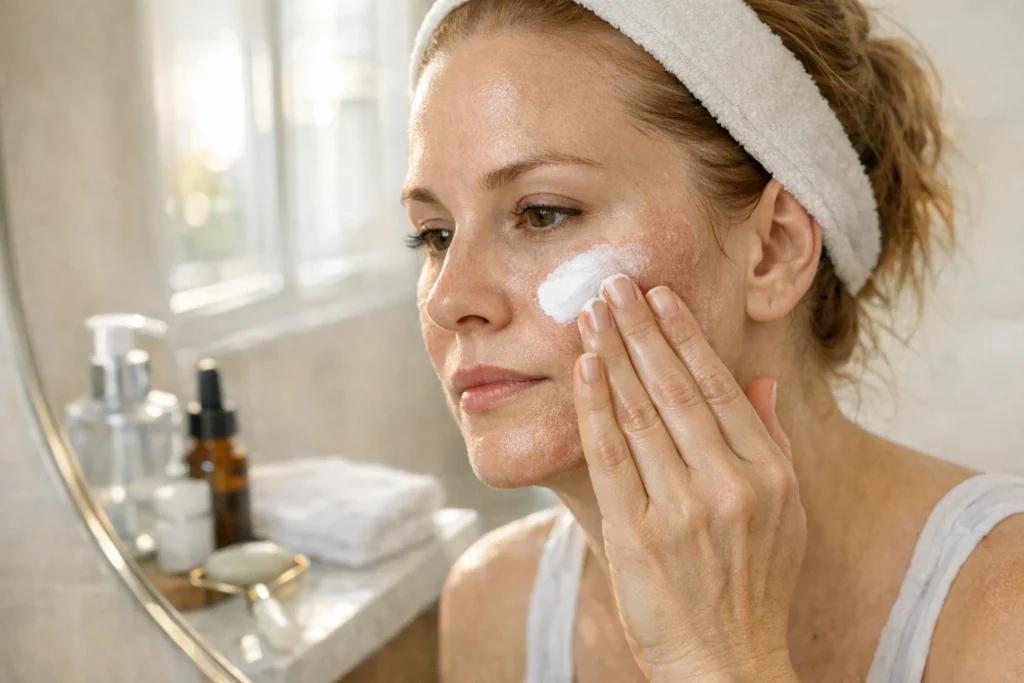
Most patients recovering from a cosmetic procedure know they are supposed to wear sunscreen. What most of them do not know is that the sunscreen they use every other day of their lives, the one with the elegant texture and the SPF 50 that absorbs without a trace, may be the wrong choice during their recovery window. Chemical UV filters, the active ingredients in the majority of non-mineral sunscreens, convert UV radiation into heat. On normal, intact skin, this is not a problem. On freshly treated skin that is inflamed, compromised, and actively healing, that heat on the tissue raises the risk of post-inflammatory hyperpigmentation and can prolong the inflammation cycle. The switch to mineral-only during recovery is not a preference. It is the clinically sensible choice for a specific, temporary reason.
Jump to the FAQ section for quick answers on SPF type, timing, and level after cosmetic procedures.
Quick Answer
Use mineral SPF (zinc oxide or titanium dioxide) during your recovery window, regardless of procedure. Chemical sunscreens convert UV to heat, which can trigger excess melanin production on compromised healing skin and worsen post-inflammatory hyperpigmentation. Once your skin has fully healed, you can return to whatever sunscreen formula you prefer. Minimum SPF 30; SPF 50 is the stronger choice for outdoor exposure.
Why Post-Procedure Skin Is Uniquely Vulnerable to UV Damage
Healthy, intact skin has a functioning barrier that regulates what enters and exits the tissue, moderates the inflammatory response, and provides a degree of UV buffering. After a cosmetic procedure, that barrier is temporarily compromised. The degree of compromise varies by procedure: microneedling opens micro-channels in the epidermis; chemical peels remove the upper skin layers; laser resurfacing causes more extensive epidermal disruption. Surgical procedures involving incisions create a different but equally significant vulnerability at the incision and healing tissue level.
New, healing tissue is more reactive than established skin. UV exposure on this reactive tissue can trigger excess melanin production, particularly in medium to deeper skin tones where the melanin pathway responds more readily to inflammatory signals. Post-inflammatory hyperpigmentation (PIH) is one of the most common and frustrating complications after cosmetic procedures, and UV exposure during the recovery window is one of the most preventable causes of it. The window during which the risk is elevated is finite. Protecting skin properly during that window is worth taking seriously.
Mineral vs. Chemical Sunscreen: Why the Type Matters During Healing
Chemical UV filters, including oxybenzone, avobenzone, octinoxate, and others, work by absorbing UV radiation and converting it into heat energy that is released through the skin. On normal, intact skin, this is an established and effective mechanism. On healing skin that is already experiencing inflammation, the additional heat generation raises the risk of triggering the melanin overproduction that leads to PIH.
Zinc oxide and titanium dioxide, the active ingredients in mineral sunscreens, work differently. They physically reflect UV radiation rather than absorbing and converting it. No heat is generated. Research examining sunscreen use after microneedling has found that physical-mineral sunscreens remain more superficial in the skin compared to chemical formulas, which penetrate more deeply through the compromised barrier. That superficial positioning is an additional advantage during the recovery window: the filter stays where it belongs and does not enter the tissue through channels that should not be open to topical penetrants.
To be direct about something this nuance often gets wrong: this does not mean chemical sunscreens are harmful. They are safe and effective on intact skin. The point is that they are not the right tool for the specific situation of active healing and compromised barrier. Once your skin has recovered, return to whatever formula you actually find comfortable enough to use consistently.

SPF Timeline Rules by Procedure: What to Use and When to Start
| Procedure | When to Start SPF | Type During Recovery | Duration of Mineral-Only Window |
|---|---|---|---|
| Microneedling | Wait approximately 24 hours (micro-channels are open during this period). Then apply once skin surface is closed. | Mineral SPF 30+ only | 7 to 10 days; reintroduce chemical SPF after skin is no longer irritated |
| Light/Superficial Chemical Peel | Start the day after, once treated surface is no longer actively open | Mineral SPF 30+ only | 7 to 14 days of strict sun precaution |
| Medium-to-Deep Chemical Peel | Per provider guidance; typically once surface is partially re-epithelialized | Mineral SPF 30+ only | 4 to 6 weeks of strict sun precaution |
| Laser Resurfacing (CO2, Fractional) | Per provider guidance; mineral SPF applied daily throughout the full healing process | Mineral SPF 30+ only; strict sun avoidance for 2 to 4 weeks | Full healing process; one of the highest-risk procedures for post-procedure hyperpigmentation from UV exposure |
| Filler, Botox, Kybella | Next day; no barrier compromise so standard SPF habits apply | Mineral or chemical; no clinically meaningful distinction here | N/A; no recovery window restriction |
| Surgical (Facelift, Rhinoplasty, Blepharoplasty) | Healing incision sites are photosensitive; mineral SPF recommended for incision lines during scar maturation | Mineral SPF at and around incision sites; standard SPF habits elsewhere | Duration of active scar maturation; typically several months |
For more detail on microneedling-specific aftercare during the first 24 hours, our microneedling aftercare guide covers exactly what to avoid and when to start applying products again. For the chemical peel recovery timeline, including when the skin is ready for any topical application, the chemical peel recovery guide maps out each stage.
SPF Level: 30 vs. 50 and Why the Formula Matters as Much as the Number
SPF 30 blocks approximately 97% of UVB radiation. SPF 50 blocks approximately 98%. The practical difference between 30 and 50 is modest, and either is a reasonable choice for routine daily use when applied correctly and reapplied regularly. During post-procedure recovery, SPF 50 is the stronger choice for anyone who will be spending time outdoors, because the margin matters more on compromised skin and the additional protection costs nothing.
The formula matters as much as the number. A well-applied SPF 30 that actually gets used provides better protection than an SPF 50 that goes on unevenly because the texture is uncomfortable or leaves a white cast. This is especially relevant for patients with medium to deeper skin tones, who may find many mineral sunscreens leave an unacceptable white cast. Tinted mineral formulas or well-formulated zinc oxide SPFs developed specifically for darker skin tones address this without compromising the mineral-only requirement during recovery.
UVA Through Glass Is Real: Indoor Recovery Days Still Need SPF
UVA rays penetrate glass. This is not a frequently discussed fact, but it matters significantly for patients spending their recovery days at home near windows. UVB rays (the ones responsible for sunburn) are largely blocked by standard glass. UVA rays, which penetrate more deeply into the skin and are associated with both aging and hyperpigmentation, pass through glass with minimal reduction. A patient spending recovery days positioned near a sunny window is receiving real UVA exposure that is meaningful enough to affect healing skin.
The practical implication is that applying mineral SPF daily during recovery is not just for outdoor excursions. It applies on indoor days too, particularly for procedures involving the face. For patients who find daily SPF application uncomfortable because of texture or the extra step, the skin barrier repair guide covers how to layer SPF with barrier repair products without overloading the skin during recovery.
The Post-Procedure SPF Marketing Problem
Products marketed as “post-procedure SPF,” “recovery sunscreen,” or “clinical SPF for healing skin” are frequently standard fragrance-free mineral sunscreens packaged with procedural language and priced accordingly. A well-formulated drugstore mineral zinc oxide SPF does the same job. The requirement during recovery is: mineral active (zinc oxide or titanium dioxide), fragrance-free, and SPF 30 minimum. Those criteria can be met at any price point. The word “post-procedure” on the label tells you nothing additional about the formula that the ingredient list does not.
Normal After SPF Application
- Mild white cast with some mineral formulas (particularly on deeper skin tones)
- Slight heaviness or film with high-zinc oxide formulas during first application
- Slight redness or tingling during the first few days post-procedure when skin is most compromised
Call Your Provider
- Significant burning, stinging, or redness on application beyond day 2 to 3 post-procedure
- Rash, hives, or allergic reaction to any topical product applied to healing skin
- Darkening or new discoloration at treatment sites that develops or worsens over time
Frequently Asked Questions
Can I use my regular SPF 50 after microneedling if it’s a high-end formula?
The issue is not the quality or price of the formula, it is the type of UV filter. If your SPF 50 uses chemical UV filters (check the active ingredients for oxybenzone, avobenzone, octinoxate, homosalate, or similar), it is not the appropriate choice during the active recovery window after microneedling. Chemical filters convert UV to heat, and micro-channels from microneedling allow deeper penetration of topical products. The combination raises the risk of irritation and hyperpigmentation on freshly treated skin. Switch to a mineral formula for the first 7 to 10 days and return to your preferred SPF once the skin is no longer irritated.
How long do I need to use mineral-only SPF after a facelift?
For healing incision sites specifically, mineral SPF is the appropriate choice during the scar maturation phase, which typically spans several months. The incision lines themselves remain photosensitive longer than the surrounding skin. Standard SPF habits (mineral or chemical) are appropriate for the rest of the face once the skin away from incision lines has healed. Your surgeon will advise on when incision sites are considered fully matured; until that clearance, mineral SPF is the conservative and appropriate choice for those areas.
Do I need SPF if I’m staying inside all day during recovery?
Yes, if you are near windows. UVA rays penetrate glass and reach healing skin even on indoor days. For procedures involving the face or any sun-exposed skin surface, daily mineral SPF during the recovery window applies regardless of whether you are going outside. If you are in a windowless room for the full day, the risk is negligible, but in most living situations, a window exists and UVA exposure is real. The habit of applying SPF daily during recovery protects against the UV exposure that is easier to underestimate than direct sunlight.
This article is for educational purposes only and is not a substitute for professional medical advice. Always follow your injector’s or surgeon’s specific aftercare instructions.