
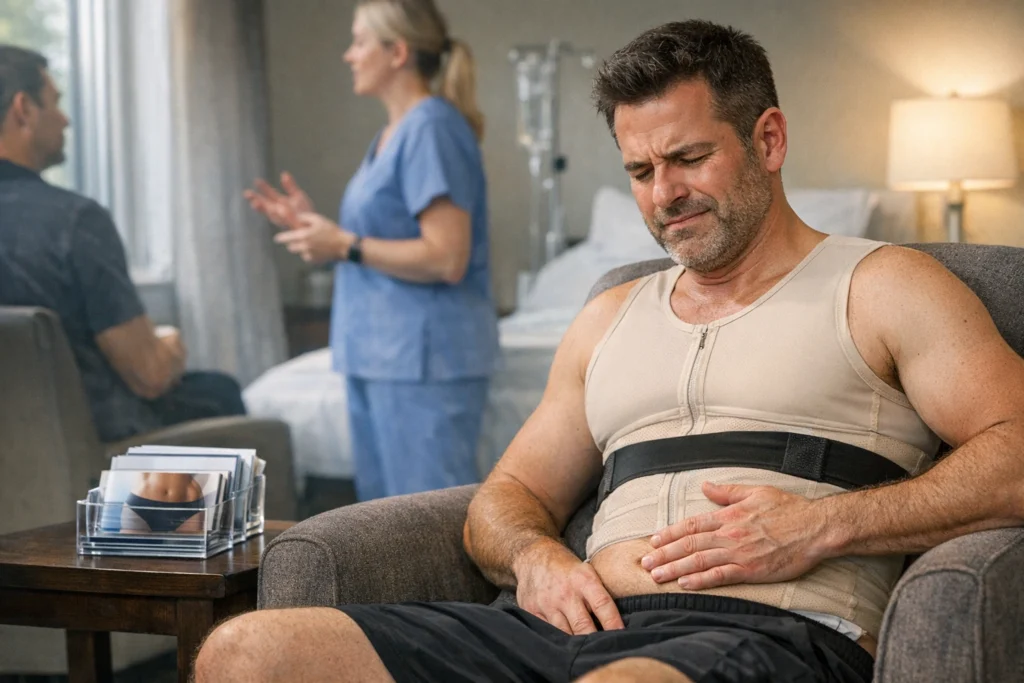
The standard liposuction recovery content on the internet was written with a specific patient in mind. The references to fajas, to the stage one and stage two hook-and-eye systems, to hip and thigh contours: these reflect the most frequently treated areas in female patients. Male liposuction is not the same procedure in a different body. The most common treatment areas in men, the abdomen, the flanks, the chest, carry more post-operative discomfort and different compression requirements, and the question male patients ask most often, when can I get back to training, gets a longer answer than most are given at their pre-op appointment.
Jump to the FAQ section for answers to the most common questions about male liposuction recovery.
Quick Answer
Male liposuction recovery differs from the standard content in three key ways: abdominal and trunk treatment areas carry more discomfort than lower body work; compression is via vests and tanks, not fajas; and return to weight training takes 4 to 6 weeks depending on treatment area, with chest and abdominal work requiring longer gym abstinence. Visible results typically continue improving for 3 to 6 months.
Why Abdominal Lipo Hurts More Than Thigh Lipo: The Trunk Is Different
The abdomen and flanks are the most common liposuction treatment areas in male patients, and they are also the areas most likely to produce pronounced post-operative discomfort. This is not a pain tolerance issue. The trunk is more pain-sensitive than the lower extremities after liposuction, and the mechanics of why matter: tight abdominal muscles engage constantly, including during breathing, coughing, and almost any movement. When those muscles are pulling against treated tissue in the first days post-op, the discomfort is immediate and unavoidable. Patients who had thigh or hip lipo in comparison often describe a markedly different and more manageable first week.
This information is not meant to be discouraging; it is meant to calibrate expectations so that the first three days do not feel like something went wrong. They did not. The soreness is expected. Plan for it specifically: have the help you need lined up for the first week, do not plan to return to desk work in two days, and do not underestimate how much the abdominal discomfort will affect your ability to sleep, sit up, and move around.
Male Compression After Lipo: Vests, Tanks, and No Faja in Sight
If you have read any standard post-lipo compression guidance and found it entirely confusing, the likely reason is that it was written about fajas, the structured hook-and-eye compression garments designed for female anatomy and predominantly used after female body contouring. There is no faja equivalent for the male trunk. Men wear compression vests or full compression tanks for chest and abdominal treatment, and compression shorts for lower body work. The garment style depends entirely on the treatment area your surgeon targeted.
Full-time compression for the first one to two weeks is standard, followed by a transition to lighter compression for roughly another month. Total compression wear of four to six weeks is typical across patients. After the first two weeks of full-time wear, most men find the lighter compression garment manageable enough to continue without significant disruption to normal daily activities. The discretion question, whether the garment is visible under clothing, is a real concern for men returning to work or social settings: most modern compression vests for men are trim enough to wear under standard clothing without obvious showing.
Our faja guide is written primarily for female anatomy and garment systems, but the underlying logic of staged compression, firmer in early recovery and transitioning to lighter support, applies across all liposuction patients. The garment type differs; the phased approach does not.
Return to the Gym: The Answer Is Longer Than You Want
Light walking is appropriate within the first few days post-lipo. It supports circulation, reduces the risk of blood clots, and does not compromise healing. Everything else waits.
Return to weight training typically takes four to six weeks depending on the treatment area and your surgeon’s clearance at your follow-up appointments. Chest and abdominal lipo requires longer abstinence from the gym than lower body work, and this is the part many male patients resist. Pressing movements, rowing movements, planks, any exercise that directly loads the chest or abdominal wall, engage the exact tissue that was treated. The patient who returns to bench pressing at three weeks because he feels fine is the patient most likely to experience prolonged swelling, contour irregularities, and results that take longer to fully appear.
The full lymphatic drainage schedule for lipo recovery, including the timing of massage and activity reintroduction, is mapped out in detail in our post-lipo lymphatic massage schedule from day 1 to day 60. The return-to-exercise milestones in that guide apply directly to male patients. For the specific gym timeline guidelines your surgeon will set at your follow-up appointments, our exercise after liposuction guide covers what to expect across the full recovery window.
The honest pattern across male patient recovery accounts: the men most satisfied with their results are the ones who waited the full clearance period before returning to loading the treated areas. The ones most frustrated with their results are the ones who went back early.
Swelling Timeline in Men: Why the Result Takes Longer to Show
Male skin tends to be thicker and less elastic than female skin. This is relevant to liposuction recovery because thicker skin can mean slower swelling resolution and a longer wait for the final contour to become fully visible. Patients typically see the most dramatic change in the first few weeks as major swelling resolves, then a slower and more gradual reveal of the final result over three to six months. The shape visible at two months is not the final shape. The shape at six months is closer to it.
This biology collides directly with the typical expectation pattern for male patients, who often expect faster, more visible payoff. The abdomen or flank result that looks good but not fully defined at month two will typically be notably sharper and more defined by month four to six as residual swelling resolves. Lymphatic drainage massage during the recovery window supports this process by reducing fluid retention and softening early fibrosis in treated areas.
Gynecomastia Lipo: The Compression and Discretion Dimension
Chest liposuction for gynecomastia follows the same compression principles as abdominal lipo, with a specific compression vest worn continuously for the first one to two weeks and lighter compression continuing for the full four-to-six-week garment period. The vest is designed specifically for male chest compression and is not the same garment used for abdominal-only work.
The dimension worth addressing directly is discretion. Many patients who pursue gynecomastia correction do so because the condition has affected how comfortable they feel shirtless or in fitted clothing. During recovery, the compression vest raises a new set of discretion concerns: at the gym, at work, in any situation where someone might notice the outline of a compression garment under a shirt. A well-fitted compression vest for male chest work is trim enough that it reads as an undershirt to most observers. For the first week or two when full-time wear is required, fitted crewneck or V-neck shirts over the vest tend to conceal it most effectively. This is a practical concern your surgical team may not think to address and it is a real one.
Normal During Male Lipo Recovery
- Significant abdominal/flank soreness in the first 3 to 5 days
- Uneven swelling across the treated area, sometimes one side more than the other
- Firmness and lumpiness under the skin in treated areas during first 4 to 8 weeks
- Numbness or reduced sensation in treated areas lasting weeks to months
- Bruising extending beyond the immediate treatment area
Call Your Provider
- Fever above 101°F / 38.3°C
- Increasing redness, warmth, or discharge at incision or port sites
- Pain that is worsening rather than gradually improving after day 3 to 4
- Sudden significant increase in swelling in a localized area
- Shortness of breath or chest pain at any point post-surgery
Recommended: Men’s Compression Vest
Male compression after lipo is a vest or tank covering the chest, flanks, and abdomen rather than a faja. Look for a front closure so it goes on without raising your arms overhead in the first week. This post-surgical compression vest uses a hook-and-eye front for that reason.
Recommended: Arnica Gel
A fragrance-free topical gel applied consistently through the first two weeks is what we point bruising questions to. This arnica gel is our standard pick for that window.
Frequently Asked Questions
How long does swelling last after male abdominal liposuction?
Major swelling typically resolves within the first four to six weeks. Residual swelling, the kind that affects contour definition rather than overall size, continues to resolve over three to six months. Male skin’s tendency toward less elasticity than female skin can mean the full result takes longer to appear. Do not evaluate the outcome before the three-month mark, and recognize that month six is a more accurate final assessment point for most male lipo patients. This timeline runs even longer for men specifically pursuing definition work, our ab etching recovery guide covers why that procedure looks worse before it looks sculpted.
Can I do cardio before I return to lifting after lipo?
Light walking is appropriate within the first few days and is actually encouraged for circulation. Low-impact cardio that does not engage the treated areas, like stationary cycling without resistance, is sometimes cleared earlier than weight training, around week two to three, depending on your surgeon. High-impact cardio, running, HIIT, and any exercise involving significant abdominal or chest engagement, follows the same return timeline as weight training: typically four to six weeks with surgeon clearance. Get specific guidance at your follow-up appointments rather than applying a general rule.
Do men need lymphatic drainage massage after liposuction?
Yes, and the recommendation applies equally regardless of patient sex. Lymphatic drainage massage after liposuction helps reduce fluid accumulation, address early fibrosis, and support the smoothing of the final contour. Most surgeons recommend six to twelve sessions in the first six weeks, at $75 to $150 per session. For male patients with abdominal and trunk treatment, where swelling resolution tends to take longer, completing the full recommended massage course is particularly worth prioritizing. The investment in massage during recovery is directly related to the quality of the long-term result.
Recommended: Lipo Foam
Firm, cut-to-fit foam for the abdomen and flanks that sits flat under a garment without digging in at the edges is worth having a spare set of. This lipo foam set covers the abdomen and flank area for male patients.
This article is for educational purposes only and is not a substitute for professional medical advice. Always follow your injector’s or surgeon’s specific aftercare instructions.