

Your surgeon just told you six weeks. Your trainer is asking what that actually means in terms of rescheduling. And you’re sitting there wondering whether the light walks you’re already doing count, whether your heart rate is going to wreck something, and whether there’s a more specific answer than “listen to your body.”
There is. The answer is not a date. It is a sequence of tissue readiness signals, and the patients who push back into the gym too early almost never ruin their results in one session. They ruin them through a pattern of elevated swelling they notice, dismiss as normal, and keep training through.
Why Walking Is Not Optional in the First Week
Short, gentle walks beginning within the first day or two post-surgery are not something most patients expect to hear encouraged. But the reason is straightforward: blood clots are a real risk in the days after any significant procedure involving general anesthesia or sedation, and controlled movement helps circulation without stressing healing tissue.
Walking at this stage means slow, flat-ground movement for five to ten minutes at a time. Not a neighborhood loop. Not “light cardio.” Movement that keeps your blood flowing while your body is still in active drain phase. You should feel tired, not winded. Stop if you feel dizzy or if your drainage increases noticeably after movement.
The garment stays on for every single one of these walks, without exception. Compression during early movement is part of the recovery, not an inconvenience to manage around it. If you are in a Stage 1 faja and wondering when to make the transition, this question becomes relevant around week three to four for most patients, but the timing depends heavily on your swelling pattern and your surgeon’s protocol. The full breakdown on when to switch from Stage 1 to Stage 2 compression is worth reading before you make that call independently.
What Elevated Heart Rate Actually Does to Post-Surgical Tissue
This is the explanation most patients never get at their pre-op appointment, because it takes longer than thirty seconds to explain.
In the weeks after liposuction, your body is routing blood and lymphatic fluid into the treated areas to begin tissue repair. Elevated heart rate increases systemic blood pressure and speeds lymphatic flow faster than the damaged lymphatic channels in the treatment zone can handle. The result is increased swelling, which is not just uncomfortable: it applies pressure to tissue that is trying to knit back together, can contribute to fibrosis formation, and in areas where liposuction was done through small incision points, can cause those sites to stay open or irritated longer.
Intra-abdominal pressure is the other piece, especially for abdominal and flank procedures. Any exercise that increases pressure in the abdominal cavity, including crunches, heavy lifting, and Valsalva breathing during exertion, can push fluid into areas that should be draining. It is why core work is specifically the last category to return, not just one of several categories. This restriction matters most for patients recovering from ab etching specifically, where our ab etching recovery guide covers why compression discipline, not early core training, is what actually protects the result.
The Graduated Return: What Goes Back First, and When
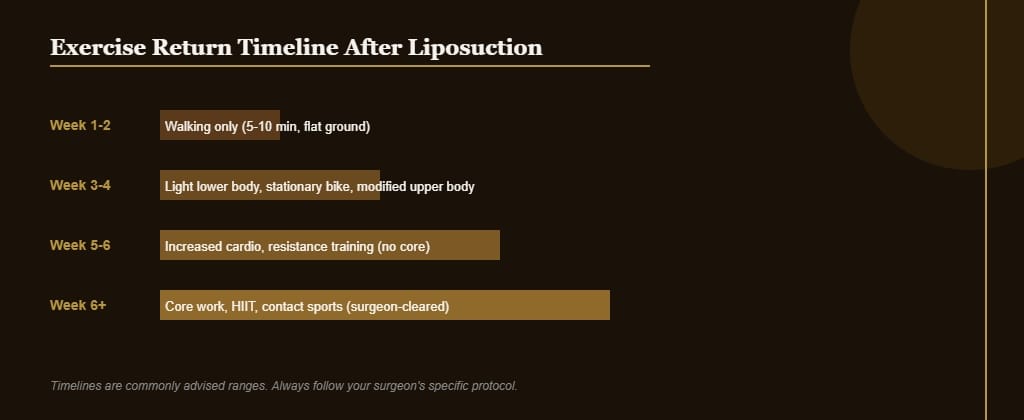
Framed as commonly advised ranges, because your surgeon’s protocol governs. These are the typical milestones, not a permission slip.
Weeks one through two: walking only. Gradual increase in duration each day as tolerated. No resistance. No elevation changes that significantly raise your heart rate. Stairs are fine; hills are borderline; incline treadmill is too much too soon.
Weeks three through four: light lower body movement that does not require breath-holding or significant core activation. Slow stationary bike is a common first return for many patients. Gentle leg extensions in a controlled range. Upper body with modifications, avoiding anything that uses the core as a stabilizer, which eliminates more upper body exercises than most people expect. No plank position anything.
Weeks five through six: increased cardio intensity, introducing resistance training to the lower body, upper body movements with moderate weight if abdominal bracing is not required. This phase still excludes core-specific work and anything high-impact.
Six weeks and beyond: core work, high-intensity training, and contact or competitive sports enter the conversation with your surgeon specifically, not as a default calendar flip. Some patients are cleared for everything at eight weeks. Others, particularly those with larger volume procedures or combined surgeries, are still modifying at twelve.
When your surgeon clears you for stage 2, the Sonryse stage 2 faja is our pick. Size from current measurements, not pre-surgery ones.
The Swelling Feedback Signal Nobody Explains Clearly
If swelling increases noticeably in the hours after exercise and has not returned to baseline by the next morning, you went too early or too hard. Full stop. Back off by one week and try again at a lower intensity.
Patients consistently describe day three of any new exercise return as the day they panic, because swelling from the previous two sessions has accumulated. If you started a new movement category on Monday, Wednesday’s swelling is Monday’s response, not Wednesday’s. This delay is why people underestimate the impact of what they’re doing until they’re already three sessions in.
The swelling signal is your clearest indicator of tissue readiness, more reliable than any calendar. If your swelling is not trending down week to week by the six-week mark, that conversation needs to happen with your surgeon before you escalate activity, not after. Your lymphatic massage schedule during this period matters too: consistent sessions help keep fluid moving and make the swelling signal more readable, not masked.
Wearing Your Garment During Exercise
Yes, you are still wearing your compression garment during all exercise for the duration your surgeon specifies, typically through at least the first six weeks for any meaningful activity. The garment is doing active work during movement, not just at rest.
For patients wondering how long the faja commitment extends overall, the full wearing schedule and when you get to stop answers that question in detail. The short version: exercise does not earn you garment-free hours. Movement while supported is better than the same movement unsupported.
Practical note: if you are returning to gym training, bring your garment. If it is a Stage 1 with hooks and eyes, factor in that changing in a gym locker room is slower than you expect. Stage 2 zipper closures are meaningfully more practical for this phase of life.
Foam sheets spread the garment’s pressure evenly and protect healing skin. The Bruizex lipo foam 3-pack is the one we recommend.
When to Call Your Surgeon Instead of Pushing Through
Pain that escalates during or after exercise, rather than the expected mild soreness that fades: call your surgeon.
Heat in the treatment area that does not resolve within an hour after exercise ends: call your surgeon. Warmth during exertion is normal. Warmth that persists and is localized to a specific spot is not.
Asymmetric swelling, where one side of the abdomen or flanks is significantly more swollen than the other after comparable activity: call your surgeon. Symmetric swelling from exercise is expected. Asymmetric swelling warrants eyes on it.
Any new discharge from incision sites after exercise begins: call your surgeon.
These are not push-through situations. The instinct to downplay symptoms during a return-to-training period is completely understandable, and it is also the most common way patients extend their recovery by weeks. The surgeon’s office has seen these presentations hundreds of times. Yours has not. Call.
FAQ
Can I walk on a treadmill instead of outside in week one?
Yes, a flat treadmill at a slow pace is fine. Keep the incline at zero and the speed slow enough that you could hold a conversation without effort. The goal is circulation, not training, and the controlled environment is actually easier to manage than uneven outdoor terrain.
What about swimming? Everyone says it’s low-impact.
Swimming has two problems in early lipo recovery: water exposure to incision sites, and the core demand of nearly every stroke pattern. Most surgeons clear swimming somewhere between six and eight weeks when incisions are fully closed, but check yours specifically. Pool walking, similarly, requires closed sites before any water immersion.
My friend was back at CrossFit at four weeks. Should I be?
Recovery timelines vary based on procedure volume, surgical technique, individual healing rates, and how well compression was maintained. Four weeks might be someone else’s reality with a very small-volume procedure and an unusually fast recovery. It is not a benchmark to compare yourself against. The swelling feedback signal is more informative than anyone else’s timeline.
This article is for educational purposes only and is not a substitute for professional medical advice. Always follow your injector’s or surgeon’s specific aftercare instructions.

Pingback: What to Eat After Liposuction: Recovery Nutrition