
Looking for a quick answer? Jump to the FAQ below.
If you use prescription tretinoin, the pre-peel stop window depends on peel depth: 7 days before a superficial peel, 14 days before a medium or deep peel. Pre-treated skin peels more aggressively, which is why the timing matters. The full stop and restart guide by procedure type is at tretinoin after cosmetic procedures.
The short answer
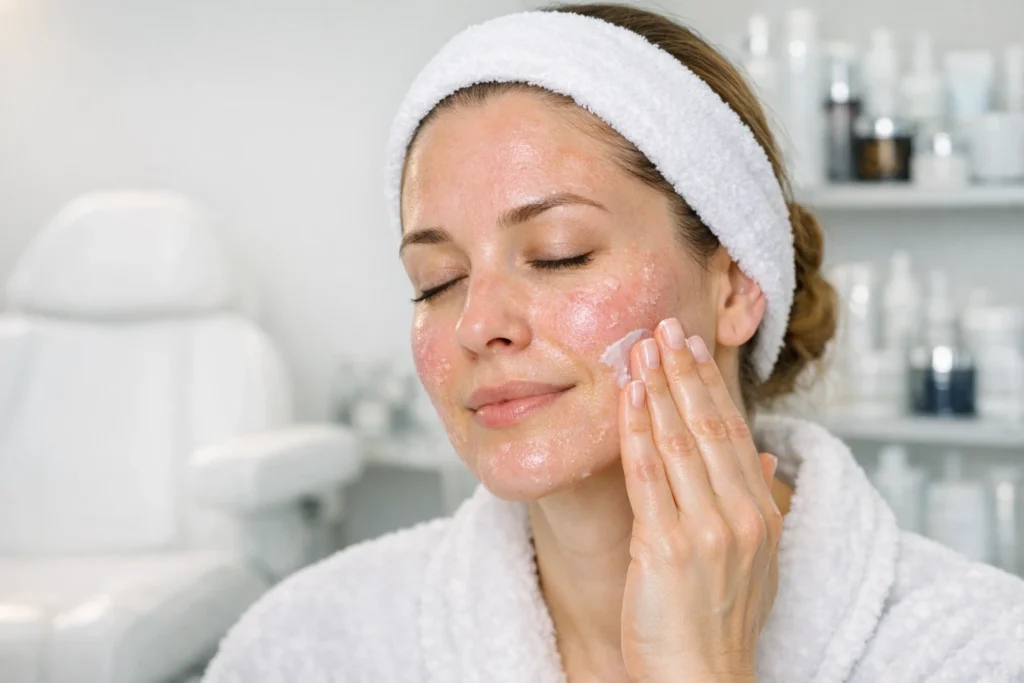
Superficial peel: 1-3 days of mild redness and possible light flaking. Medium TCA peel: 5-7 days of visible peeling, raw-looking skin, clear by week two. Deep phenol peel: 10-14 days of significant downtime, medical-level recovery. These are not the same experience. Which peel you have determines everything about what to expect.
Before the appointment, you search “chemical peel recovery.” Some results say two days. Some say two weeks. A few mention crusting and raw skin. Others describe a light flush and some flaking. The reason the information conflicts is that it is describing completely different procedures. A glycolic acid peel and a phenol peel share a name and almost nothing else. If no one has told you which type you are having, you are searching for the wrong thing — and you may be catastrophically underprepared, or needlessly alarmed, because of it.
Here is the honest, separated version.
Superficial Peels: The Lunchtime Myth and What’s Actually True
Superficial peels use mild acids including glycolic, salicylic, and lactic acid to treat the outermost layer of skin — the stratum corneum and uppermost epidermis. Recovery is 1-3 days of mild redness, possible light flaking, and some sensitivity. There is no significant visible peeling in most cases. It is more of a refinement than a shed.
Most patients can wear makeup within 1-2 days. The “lunchtime peel” label is accurate in that the visible recovery is minimal — but it comes with a marketing implication that results are impressive and immediate, which is also not accurate. Superficial peels produce subtle, cumulative results over a series. They will improve texture, tone, and brightness over time. They will not address deep wrinkles, significant scarring, or structural changes. Setting realistic expectations before the appointment prevents the disappointment that comes from comparing a glycolic peel to a TCA peel’s before-and-after photos.
Superficial peels can be repeated every 2-4 weeks. They are suitable for most skin types, including sensitive skin, when formulated appropriately.
Medium Peels (TCA): The Recovery Most Patients Don’t See Coming
TCA, trichloroacetic acid, penetrates into the upper dermis. The mechanism is fundamentally different from a superficial peel: TCA causes actual cellular protein denaturation, called frosting, which is the white or grey blanching visible immediately after application. This is substantially more powerful than a spa-grade glycolic peel and the recovery reflects it.
Days 1-2: skin appears red-to-bronze and feels very tight. This is the phase most providers under-explain. The skin does not look normal. It does not feel normal. Patients who were not explicitly told what to expect at this stage often contact their provider in alarm. Days 3-5: visible peeling begins, often in sheets rather than fine flaking. The skin underneath is raw and pink. This is expected. Days 5-7: peeling completes. The new skin is visible but still pink and sensitive. Most patients are presentable by end of week one with makeup, cleared by around day 7-10 for most practitioners.
Back to a normal routine at week 2. No sun exposure without SPF for at least 2 weeks. Medium peels can be performed every 3-6 months.
The most common mistake with TCA peels is underestimating this recovery. Patients who book TCA the week before a significant social event, or who return to work at day 3 because they feel fine on the inside, are the ones who end up with compromised healing. The downtime is not optional. Picking at the peeling skin before it separates naturally causes scarring. Do not do it.
| Peel type | Recovery | Visible peeling | Back to normal |
|---|---|---|---|
| Superficial (glycolic, salicylic) | 1-3 days | Light flaking, if any | Day 2-3 with makeup |
| Medium (TCA) | 5-7 days | Visible sheets, raw skin | Day 7-10 with makeup |
| Deep (phenol) | 10-14+ days | Significant crusting and raw skin | Week 2-3 minimum |
Deep Peels (Phenol): A Medical Procedure, Not a Skin Treatment
Phenol peels treat into the papillary and reticular dermis layers. This is a medical procedure. It is frequently performed under sedation. The recovery involves significant swelling, crusting, raw skin surface, and a minimum of 10-14 days of genuine downtime. Sun avoidance is required for months. A phenol peel can typically only be performed once in any given area due to the depth of tissue change — this is a lifetime treatment in that sense.
The results can be dramatic for severe wrinkles and significant sun damage. The results are also months in the making — final outcomes are not visible for 3-6 months after treatment. Patients who expect to look better in two weeks will be disappointed. Patients who understand they are committing to a 6-month process involving genuine planning, assistance at home during recovery, and months of sun protection will approach it with appropriate expectations.
Deep peels are not a spa treatment with a high-grade version. They are in a different category. Patients should be selected carefully, counseled extensively, and treated by providers with specific experience in phenol peeling.
What All Peels Share: The Universal Recovery Rules
Across all three depths, the same principles apply — only the timeline differs.
No unprotected sun exposure during recovery. UV over fresh post-peel skin triggers post-inflammatory hyperpigmentation, particularly in patients with darker skin tones. SPF is non-negotiable from day 1. Gentle, non-active cleanser and a basic, non-irritating moisturiser during the recovery window. No retinol, acids, or active ingredients until the skin is fully healed — knowing when retinol can safely restart after a peel is a specific question worth asking your provider. Same applies to vitamin C — timing reintroduction correctly matters, particularly after a medium or deep peel, and the guidance on vitamin C reintroduction after cosmetic procedures applies here.
No picking. Ever. The impulse to pull off the peeling skin before it separates naturally is almost universal and almost universally damaging. If the skin is not ready to separate on its own, it is still attached to living tissue. Pulling it causes scarring. This applies at every peel depth.
Skin Tone and Peel Selection: The Honest Conversation
Patients with darker skin tones, specifically Fitzpatrick types IV-VI, have a higher risk of post-inflammatory hyperpigmentation after chemical peels at any depth. This is not a reason to avoid peels. It is a reason to see a practitioner specifically experienced in treating darker skin tones, who will select peel type, concentration, and application technique with this risk factor explicitly in mind.
The redness and bruising that can accompany medium and deep peels can also be supported during recovery — arnica for bruising and post-procedure inflammation is one option worth discussing with your provider. The pigmentation risk in darker skin tones is the more serious concern and requires competent clinical management, not just supportive topicals.
Generic “chemical peel” content that does not account for Fitzpatrick type is writing for a narrow slice of the patient population. If your provider has not discussed your skin tone and its implications for peel selection with you, that is the question to ask before the appointment — not after.
This is normal
Redness and tightness immediately after any peel depth.
Bronze or brown discolouration before peeling begins, especially with medium peels.
Peeling in sheets for medium TCA peels on days 3-5.
Skin looking worse before it looks better in the first week of a medium or deep peel.
Sensitivity to skincare and makeup for 1-2 weeks post-peel.
Call your provider if
Significant blistering beyond what was described as expected for your peel depth.
Fever or signs of infection: increasing heat, pain, pus.
Pigmentation change that is patchy and darkening rather than fading at week two.
Skin that has not improved at all past week two for a medium peel.
Frequently Asked Questions
How long does a chemical peel take to heal?
It depends on the peel depth. Superficial peels heal in 1-3 days with minimal visible recovery. Medium TCA peels take 5-7 days of active recovery with visible peeling, and most patients are back to normal at week 2. Deep phenol peels require 10-14 days of significant downtime and the skin continues improving for months afterward. Conflating these timelines is the most common source of confusion in chemical peel recovery.
Can I wear makeup after a chemical peel?
After a superficial peel, most patients can wear makeup within 1-2 days. After a medium TCA peel, makeup can typically be worn around day 7-10 once the active peeling phase is complete and the new skin has closed. After a deep phenol peel, the timeline extends to week 2-3 minimum. In all cases, wait until the skin has fully closed and healed before applying makeup — makeup on compromised skin increases infection risk and can affect healing.
Is it normal for skin to look worse before it looks better after a peel?
Yes, particularly for medium and deep peels. The bronze or brown discolouration in the first 1-2 days, and the raw pink skin visible after the peel completes on days 3-7, are expected parts of the healing process. The final result is not visible during this phase. Patients who assess their outcome during the active peeling period are looking at the process, not the result. The honest timeline for seeing the real outcome of a TCA peel is 4-6 weeks, not 7 days.
For patients comparing options, CO2 laser resurfacing is the closest comparison to a deep chemical peel in terms of recovery intensity, though the mechanisms and depth of each treatment differ significantly.
Sun protection after a chemical peel follows the same mineral-only principle that applies to microneedling. The guide on SPF after cosmetic procedures breaks down when to start SPF, which type to use during the peeling phase, and why chemical sunscreens should be avoided while the barrier is compromised.
This article is for educational purposes only and is not a substitute for professional medical advice. Always follow your injector’s or surgeon’s specific aftercare instructions.