
Looking for a quick answer? Jump to the FAQ below.
The short answer
A seroma is a pocket of clear fluid that collects in the space where fat was removed. It feels like a soft, squishy swelling that moves when tapped. Most are treated by needle aspiration at a follow-up appointment. Small ones sometimes resolve on their own with continued compression. Call your surgeon if the fluid becomes cloudy or the area becomes very painful.
It is week two after liposuction. The initial swelling has started to settle, things were looking like they were progressing. Then you notice something new: a soft, squishy area that wasn’t there at week one. It feels like a water balloon under the skin. It moves when you press it gently. You are alarmed, and you are right to take it seriously — but this is one of the most common post-liposuction complications, and it is one of the most manageable when identified early.
What you are likely feeling is a seroma.
What a Seroma After Liposuction Actually Is
A seroma is an abnormal accumulation of serous fluid in a dead space — clear plasma and lymphatic fluid that has collected in the area where tissue was removed. When liposuction removes fat, the space that fat occupied needs time to collapse and adhere as the body heals. During that process, fluid produced as part of the normal inflammatory healing response can accumulate in the space rather than being reabsorbed into surrounding tissues. The result is a soft, fluctuant pocket of fluid beneath the skin near the surgical site.
Seromas are one of the most common postoperative complications after liposuction and plastic surgery procedures. They are also consistently under-discussed in pre-operative consultations, which means most patients who develop one encounter information that should have been provided months earlier.
How to Identify a Seroma: the Fluid Wave Test
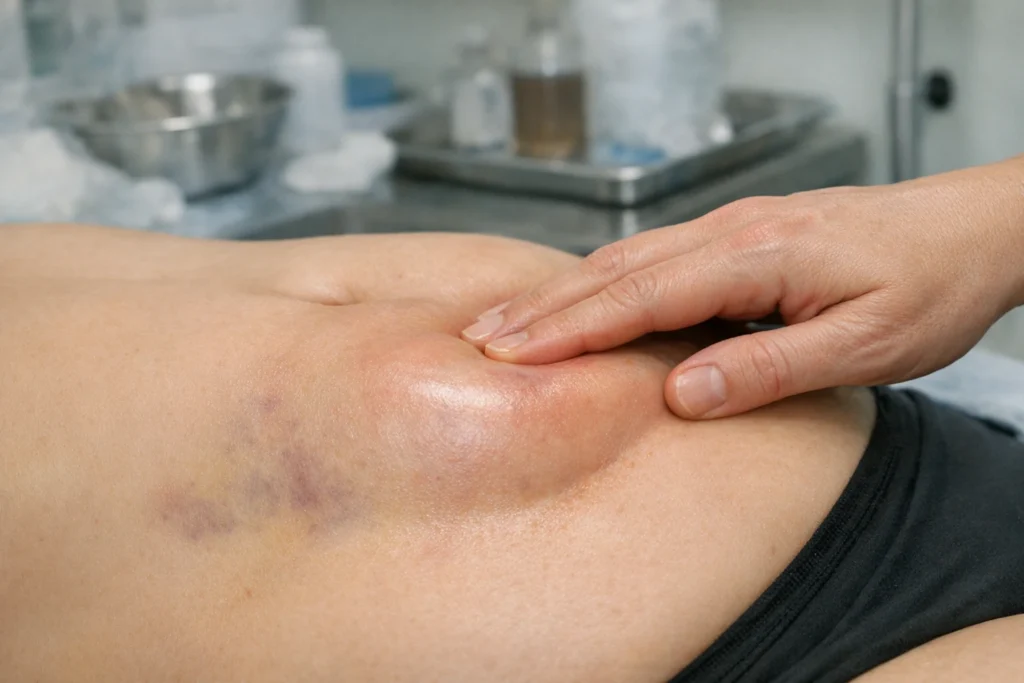
A seroma presents as a soft, raised, swollen area that feels distinctly different from the general post-surgical swelling. General post-surgical swelling is firmer, more diffuse, and consistent across the area. A seroma feels localized and fluid-filled.
The classic identification test: gently tap one side of the suspected area and watch for a wave-like motion beneath the skin, similar to tapping a water balloon. This is called the fluid wave sign, and its presence indicates fluid collection rather than solid post-surgical swelling or developing fibrosis. If you feel the wave, you likely have a seroma.
Additional signs: the swelling appeared 7-10 days after surgery or after drain removal (though seromas can appear earlier or later than this window). Mild tenderness is common. Significant pain is not typical of an uncomplicated seroma and warrants a call to your surgeon. Clear to pale yellow fluid may leak from the incision site.
Seromas discovered at follow-up appointments before the patient noticed them are common. Surgeons find them on examination. This is one of the reasons attending every follow-up appointment matters even when you feel fine.
Why Liposuction Specifically Increases Seroma Risk
Liposuction removes large volumes of fat tissue, creating dead space. The larger the surface area of tissue disruption, the greater the seroma risk. High-volume procedures including lipo 360, flanks, and full abdominal liposuction carry higher risk than smaller, targeted treatments. The body has more space to fill with fluid and more disrupted lymphatic channels to manage.
VASER-assisted liposuction carries a higher seroma rate than standard liposuction techniques. The additional thermal energy from ultrasound produces greater tissue trauma, which increases the inflammatory response and the fluid production associated with it. Patients who have had VASER should be specifically alert to seroma signs during recovery. The VASER liposuction recovery guide covers the seroma risk and other ways that VASER recovery differs from standard lipo.
This is one of the clinical reasons compression garments are not optional after liposuction. The external pressure from a properly fitted stage 1 or stage 2 faja helps close the dead space created by liposuction, encouraging tissue adherence and minimizing fluid collection. The faja is doing structural work, not just shaping work. Patients who abandon compression garments early because the procedure site feels fine are removing one of the primary mechanisms preventing seroma formation.
Treatment Options: From Wait-and-See to Drainage
Not every seroma requires active intervention. Small seromas — present on the fluid wave test but not growing and not causing significant discomfort — can be managed with continued compression and monitoring. A wait-and-see approach with close clinical oversight is appropriate for small, stable collections.
The most common active treatment is needle aspiration. The surgeon uses a needle and syringe to draw out the accumulated fluid during a follow-up appointment. The procedure is typically painless or mildly uncomfortable. Fluid may reaccumulate after the first aspiration, requiring a second or third session, but repeated aspiration is preferable to leaving a large seroma to resolve on its own, which it often does not.
For larger or recurrent seromas, a temporary small catheter is placed to allow continuous drainage over several days. This is removed once output reduces significantly. Sclerotherapy, an injection of a sclerosing agent into the seroma cavity to close it and prevent reaccumulation, is used when aspiration alone keeps failing. Surgical removal is rare and reserved for chronic cases where a thick-walled capsule has formed around the fluid and the seroma is not responding to other approaches.
Lymphatic massage, as part of a structured post-operative schedule, supports the body’s own fluid reabsorption during seroma recovery. Understanding the post-lipo lymphatic massage schedule from day 1 to day 60 gives context for when massage is most beneficial relative to seroma development.
This is expected and manageable
A soft, fluid-filled swelling appearing 1-3 weeks after surgery that moves when tapped gently.
Clear to pale yellow fluid if any leaks at the incision site.
Mild tenderness at the seroma site.
Seroma requiring one or two aspiration sessions before fully resolving.
Call your surgeon promptly if
The swelling is growing rapidly over days.
Fluid leaking from the incision is cloudy, thick, or has an odour — these can indicate infection and require urgent attention.
Fever develops alongside the swelling.
The area becomes increasingly painful rather than mildly tender.
Skin over the seroma changes colour or feels hot.
Prevention: The Non-Negotiables That Reduce Risk
Consistent compression garment wear throughout the prescribed recovery period is the most impactful preventive measure. Using appropriate abdominal support tools — understanding the difference between abdominal boards and lipo foam and when each adds value — supports the compression garment in keeping dead space closed. These tools are often dismissed as minor accessories. Clinically, they are part of how seroma formation is prevented.
Avoiding strenuous activity during the recovery period matters. Physical exertion before the dead space has adhered increases fluid production and disrupts the tissue adherence process. The timeline for returning to exercise is not arbitrary; it maps to the healing phases where seroma risk is highest.
Attending every scheduled follow-up appointment is not optional if you want early identification of any fluid accumulation. The patients who arrive at their two-week follow-up with a seroma that was discovered on examination, rather than by patient report, are significantly better positioned than those who skipped the appointment because they felt fine and arrived at week five with an established, larger collection.
Frequently Asked Questions
How long does a seroma after liposuction last?
Small seromas managed with compression can resolve in 2-4 weeks. Seromas requiring aspiration typically resolve after 1-3 drainage sessions, each spaced 1-2 weeks apart. Larger or recurrent seromas may require continuous drainage over days or weeks. Untreated seromas that are left to resolve independently can persist for months and may develop a fibrous capsule that complicates later treatment. Early identification and intervention gives the best outcome.
Does seroma after liposuction affect the final result?
A seroma that is identified and treated appropriately generally does not affect the final aesthetic result. An untreated seroma that persists long enough to develop a fibrous capsule can, in some cases, affect contour or contribute to irregular texture in the treated area. This is one of several reasons that prompt treatment and regular follow-up are the right approach rather than hoping it resolves without intervention.
Is seroma the same as normal post-lipo swelling?
No. Normal post-lipo swelling is diffuse, firm, and distributed across the treated area. It does not have the fluid wave sign. A seroma is localized, soft, and produces a wave-like movement when tapped on one side. Swelling that peaks in the first week and gradually improves is consistent with normal post-surgical healing. Swelling that appears or increases at week 2 onward in a localized area with a fluid-filled quality should be assessed by your surgeon rather than assumed to be normal.
It is worth noting that seroma is also a known risk after the liposuction component of gynecomastia surgery, particularly after procedures that involve a significant liposuction component such as grade II-III gynecomastia surgery with extensive fat removal.
Among procedures, seroma risk is particularly high after body lift in weeks 3-4 when activity increases — the extensive dead space created by circumferential skin removal makes fluid accumulation particularly likely when patients push activity too early.
This article is for educational purposes only and is not a substitute for professional medical advice. Always follow your injector’s or surgeon’s specific aftercare instructions.