

Looking for a quick answer? Jump to the FAQ below.
The short answer
Splint off at day 7. Most bruising gone by day 14. Back to desk work at day 10–14. About 80% of swelling resolved by month 3 — but the nose at month 3 is still not the final result. Final results at month 12–18, with the tip taking longest. No glasses on the bridge for 4–6 weeks minimum.
Day 7: The Moment Nobody Prepares You For
The splint comes off. The surgeon hands you a mirror. And the nose looking back at you is bigger than the nose you had before you went into surgery.
Swollen. Possibly slightly upturned. Nothing like the image you held in your head through the consultation, the pre-op appointment, and the first week of lying in bed with your head elevated. This is the moment most rhinoplasty patients panic. It is also the moment that most surgeons have not adequately prepared them for.
The nose at day 7 is not the result. It is not even close to the result. That is the most important sentence in this article.
What you are looking at is the full extent of post-surgical swelling that has been building underneath the splint, now exposed to open air for the first time. The splint created external pressure that was partially containing the swelling. Once it is removed, the nose can actually swell slightly more in the first 24 hours as pressure equalises. This is documented and expected. It is not a sign that something went wrong.
The Rhinoplasty Recovery Timeline, Week by Week
| Timeframe | What to expect |
|---|---|
| Day 1–7 | Splint in place. Swelling and bruising peak at 48–72 hours. Head elevated, rest only. |
| Day 5–7 | Splint removed. Nose appears more swollen than expected. This is normal. |
| Day 10–14 | Most bruising faded. Return to desk work. Comfortable in public with makeup. |
| Week 3–4 | Daily improvements. Shape becomes clearer. Tip still swollen. |
| Month 3 | 70–80% of swelling resolved. Nose looks close to result but is not final. |
| Month 6–12 | Continued refinement. Tip resolves last. |
| Month 12–18 | Final result. Subtle tip improvements possible to 18 months for thicker skin. |
Swelling and bruising reach their peak at 48–72 hours after surgery. Puffiness around the eyes, cheeks, and upper lip is common and typically clears within 10–14 days. During the first week, the splint holds the nasal bones in alignment while initial healing begins. The rule is simple: head elevated, no blowing your nose, and rest only. No negotiation on any of those three.
By the end of week two, most patients feel comfortable in public. Makeup covers residual discolouration. Return to desk work is typical at day 10–14. The swelling is still very much present — just less alarming than it was at splint removal. The shape is beginning to emerge, but this is not the time to draw conclusions.
Weeks three and four bring daily visible improvements. Patients often report their social confidence returning here, which matters because the psychological weight of rhinoplasty recovery is heavier than most procedures. The nose looks recognisably like a nose again. Exercise, however, remains restricted. Increased blood pressure from exertion raises nasal swelling and risks late-stage nosebleeds.
By month three, approximately 70–80% of swelling has resolved. The nose looks close to the final result. Many patients believe they are seeing the final result. They are not. This is the critical misconception this article exists to address.
The 80/20 Rule: The Framework Rhinoplasty Patients Need Before Surgery
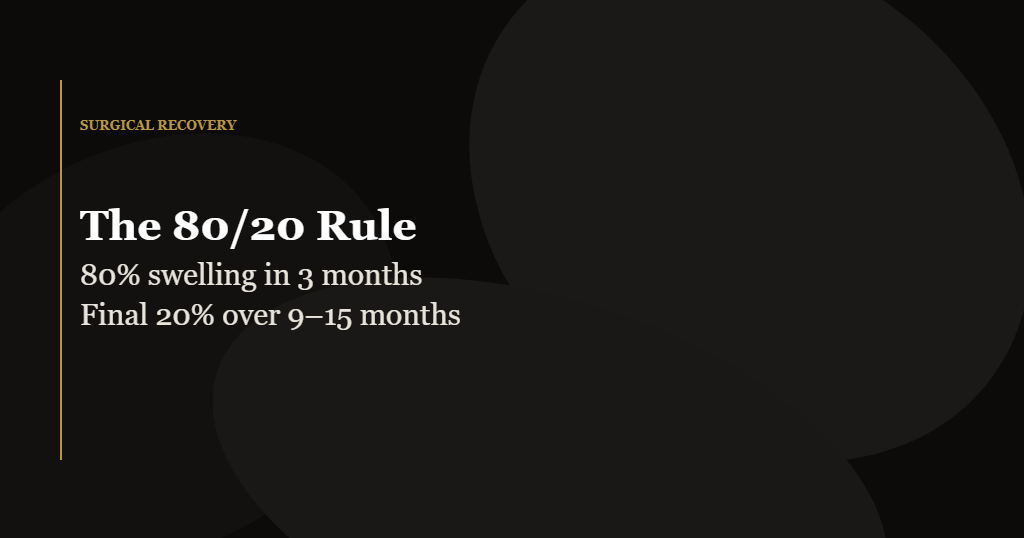
The most useful way to think about rhinoplasty recovery is this: 80% of swelling resolves in the first three months. The remaining 20% takes another nine to fifteen months. Patients who know this before surgery manage month three with perspective. Patients who discover it at month three, when their nose still doesn’t look the way they expected, often describe it as the point of peak anxiety in their entire recovery, even when the nose looks significantly better than it did at week two.
The result you see at month three is not the final result. The result at month twelve is close. The result at month eighteen is final.
Managing this expectation is the single most important thing a rhinoplasty surgeon can do for patient satisfaction, and the single thing most consistently omitted from pre-surgical consultations. Patients leave consultations with a timeline that ends at six to eight weeks. The actual timeline ends at twelve to eighteen months.
Why the Nasal Tip Takes Longest
Not all parts of the nose heal at the same rate. The nasal bridge, which sits directly over bone, refines more quickly. The nasal tip is a different story.
The tip is composed of cartilaginous tissue covered by thicker skin with more oil glands and a richer blood supply. These structural characteristics mean swelling in the tip is the last to leave. A tip that looks bulbous, undefined, or upturned at month three can look completely different at month twelve. Patients who had tip refinement as part of their procedure should specifically plan for this: the tip will be the final area to reveal its shape.
Patients with thicker skin may continue seeing subtle improvements to month eighteen. Thicker skin holds swelling longer, but it also means the final result, when it arrives, has a softness to it that thinner-skinned patients don’t always achieve.
The bridge, by contrast, typically refines significantly earlier. This can create a strange period around months four to six where the bridge looks largely finalised but the tip still appears swollen by comparison. This is normal anatomy, not a problem with the surgery.
Restrictions That Catch Patients Off Guard
Glasses. This is the restriction most patients forget about before surgery and most regret at the two-week mark when they cannot wear their everyday frames.
No glasses resting directly on the nasal bridge for four to six weeks minimum. Glasses exert continuous pressure that can indent healing bone and cartilage during the remodelling window. Options during this period include contact lenses, tape suspension from the forehead, or special supports that transfer weight away from the bridge. None of these are convenient. All of them are preferable to indenting a healing nasal bridge.
On exercise: strenuous activity is off the table for at least three to four weeks. Walking is generally fine from week two. Contact sports, anything with collision risk, and any activity that puts the nose in danger of a knock should be avoided for six weeks minimum. Some surgeons recommend three months. The reasoning is straightforward — bone and cartilage need time to fully heal and set before absorbing impact. A knock to the nose at week three is a very different situation to the same knock at week sixteen.
Air travel is generally safe seven to ten days after surgery once the splint is removed, though some surgeons recommend waiting two to three weeks. Cabin pressure changes can increase congestion temporarily but do not affect healing outcomes for most patients. Check with your surgeon before booking anything. If you have concerns about bruising in public, the timing matters for a different reason entirely.
One more thing worth saying: the nose looks different in photos versus in a mirror versus in different lighting conditions during recovery. Swelling distorts perception in ways that change with camera angle and light direction. Do not use photos taken in the first few months to assess your result. Use a neutral mirror in consistent natural lighting at six months and beyond.
If you are managing bruising in the first week, arnica as a pre-surgical supplement has a reasonable evidence base for reducing bruising intensity and duration, though no supplement should be taken without your surgeon’s approval given interactions with anticoagulants.
Rhinoplasty sits within a broader category of facial surgical recoveries where the visible result lags significantly behind the healing process. If you are reading this having also considered or undergone blepharoplasty recovery, the principle applies there too, though the timeline is considerably shorter. And if you are managing recovery expectations across multiple procedures, the same principle that governs rhinoplasty timelines applies in different proportions to procedures like tummy tuck recovery, where internal healing continues long after surface appearances normalise.
This is normal
Nose looking more swollen at day 7 splint removal than it did before surgery. Slight increase in swelling in the 24 hours after splint removal as external pressure releases. Nasal tip remaining significantly swollen at month 3 when the bridge has largely refined. Nose looking different in photos versus mirror versus different lighting — swelling distorts perception. Feeling congested for several weeks.
Call your surgeon if
Significant or increasing pain after the first week. Fever at any point during recovery. Heavy or ongoing bleeding from the nose. Signs of infection at the incision sites. Asymmetry that is severe and unchanged at month 3. Any vision changes following surgery.
Frequently Asked Questions
How long does rhinoplasty swelling last?
Most bruising resolves by day 14. Approximately 70–80% of swelling is gone by month three, and about 90% by month six. Final results are visible at 12 months when all swelling resolves. Patients with thicker skin may continue seeing subtle improvements up to 18 months, particularly in the nasal tip area.
When can I wear glasses after rhinoplasty?
You should wait four to six weeks before resting glasses directly on the nasal bridge. During this period, use contact lenses, tape suspension from the forehead, or glasses supports that shift weight away from the nose. The healing bone and cartilage are vulnerable to pressure indentation during this window, and it is not a restriction worth cutting short.
Why does my nose look worse after splint removal?
The splint was providing external pressure that partially contained swelling. When it is removed, that constraint is gone, and the nose can swell slightly more in the first 24 hours as pressure equalises. The nose at day 7 reflects surgical swelling, not the result. The shape visible at month 12 is what the surgery achieved.
Recovery experiences after rhinoplasty vary significantly based on surgical technique, whether bone and/or cartilage work was performed, skin thickness, and individual healing response.
Rhinoplasty is commonly combined with upper face procedures, and patients considering or recovering from multiple facial surgeries may also want to understand what happens in the forehead and brow area. The brow lift recovery guide covers the scalp numbness progression and the timeline for brow position settling, which is useful context whether you are planning a combined procedure or considering a brow lift separately. Patients who combine rhinoplasty with lower face work may also find the facelift and neck lift recovery guide useful for understanding what the simultaneous healing of multiple facial zones involves.
This article is for educational purposes only and is not a substitute for professional medical advice. Always follow your injector’s or surgeon’s specific aftercare instructions.