

Most people put lipo foam wherever it fits and assume they’re done. Then they hit the three-month mark and wonder why there’s a crease across their abdomen that looks exactly like the edge of the foam sheet they’ve been wearing for eight weeks. The foam didn’t cause that crease randomly. They placed it in a way that guaranteed it.
What Lipo Foam Actually Does (and What It Doesn’t)
Lipo foam is not a healing device. It doesn’t speed up lymphatic drainage, dissolve fibrosis, or repair tissue. What it does is distribute compression evenly across an irregular surface. Your faja applies pressure, but skin and soft tissue aren’t flat. Without foam, the garment creates pressure points wherever the underlying anatomy protrudes. High pressure at one spot and almost none at the adjacent hollow is the recipe for uneven results.
The foam fills the gaps. It creates a uniform surface so the faja applies consistent pressure across the treated area. That’s it. Simple mechanism, significant results when done right, and the opposite when done wrong.
Where the Foam Goes: Zones for Lipo 360
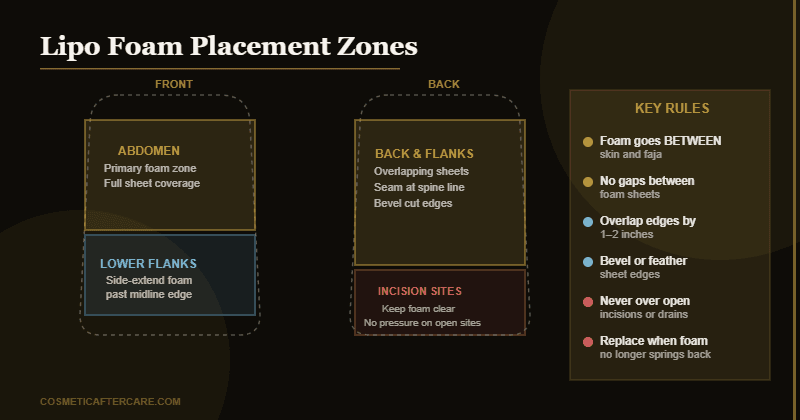
For lipo 360, you’re covering three zones: the abdomen from just below the bra line to the hip crest, the flanks (love handle area wrapping toward the back), and the lower back. The abdomen takes the most foam and is where most people make the most mistakes. The flanks are awkward to cover because the foam wants to slide, and the lower back is often undertreated because it’s hard to see what you’re doing.
The ab board is a related but different tool. Think of it as the foam’s rigid sibling. Where foam distributes pressure across curved surfaces, the ab board flattens specifically the upper and central abdomen. For lipo 360 patients who had work done across the flanks and back, foam typically covers those areas while the board handles the anterior trunk. For more on when to use the board versus foam, the full abdominal boards vs. lipo foam comparison breaks down the decision by procedure type and healing phase.
Recommended: Lipo Foam
Foam goes between skin and faja to keep compression even across the whole treated area. Buy a multi-pack since single sheets wear out mid-recovery, especially for lipo 360 where you need coverage on the abdomen, flanks, and back at once. This lipo foam set is cut to fit under a garment.
The Mistakes That Create the Creases You’re Trying to Avoid
Gaps between sheets are the number one mistake. If you’re using two pieces to cover the abdomen, overlapping them by about half an inch is better than butting them edge to edge. Even a small gap creates a pressure differential directly under your faja, which over weeks of wear becomes a visible indentation. The faja presses hard at the foam edges and has no resistance at the gap. That geometry is the crease.
Edge digging is related. Raw-cut foam has hard perpendicular edges that press into soft tissue, especially when the foam compresses under the faja. The fix takes ninety seconds: bevel the edges of each sheet at a 45-degree angle using scissors, creating a gradual taper instead of an abrupt step. Patients who do this consistently have far fewer edge-mark issues at the two-month mark.
Placing foam directly over open incisions or drain sites is a mistake that should be obvious but still happens. Foam over a drain site can block drainage or introduce pressure on a wound that needs to stay uncovered. Cut small notches or holes around active drain sites and skip those areas until the surgeon clears them.
Then there’s migration. Foam that shifts during the day ends up bunched, folded, or covering the wrong area. A few strips of medical tape along the sheet edges holds them against the skin long enough for the faja to go on. Some patients prefer to hand-stitch a few loops of soft elastic inside their faja to act as foam guides. Either works; doing nothing and hoping the foam stays flat does not.
How Long a Sheet Lasts and When Compressed Foam Stops Working
Fresh lipo foam sheet compressed under a stage 1 faja provides meaningful resistance. The same sheet after two to three weeks of constant compression has lost a significant amount of its rebound. You can test it: press the sheet firmly between your palms for five seconds and release. If it doesn’t bounce back to close to its original thickness within a couple of seconds, it’s done. You’re wearing a flat slab of semi-rigid material with edges that dig in, not foam doing its job.
For lipo 360 patients wearing foam full-time, plan for a fresh set every seven to ten days for the first month. After transitioning to stage 2 and part-time wear, sheets last longer because the compression is lighter. Budget for at least four to six replacement cycles during active recovery. Foam is inexpensive enough that this is not the place to economize.
Recommended: Lipo Foam (Replacement Set)
Once your first sheets compress and flatten out they stop doing their job, so plan on a second set rather than stretching one sheet across the whole recovery. This lipo foam set matches your original sheets, so the fit under your garment does not change.
The Honest Take on Foam vs. Board
Here’s the one most people dance around. Foam and the ab board are not interchangeable, and they are not cumulative. Using both simultaneously on the same surface area without understanding why creates its own problems. Too many compression layers generates heat, restricts movement in ways that affect circulation, and if the board goes on top of thick foam, you lose the flattening effect that makes the board useful in the first place.
The practical rule: foam goes on curved and posterior areas where a rigid board can’t conform. The board goes on the flat or semi-flat anterior trunk where you want maximal flattening. Many lipo 360 patients use both, but in different zones. If your surgeon said to use a board, confirm with them whether they mean instead of foam on the abdomen or in addition to it in different areas. That one question prevents a lot of layering confusion. The abdominal boards comparison covers the timeline for each, including when to drop the foam and keep the board and vice versa. For lymphatic support alongside compression, the post-lipo lymphatic massage schedule explains how manual drainage works alongside your garment, not against it.
When to Call Your Surgeon
Skin redness or raw areas where foam edges sit, especially if they don’t resolve within a day after removing the garment, should be reported. If you notice a firm, raised ridge along where a foam edge has been sitting for several weeks, mention it at your next visit. Not all post-lipo firmness is fibrosis, but some induration patterns are worth evaluating. Any significant skin color change (darkening, purpling) under the foam zone warrants a same-day call.
FAQ
Can I cut lipo foam to any shape I need?
Yes, and you should. Pre-sized sheets rarely match any individual’s anatomy exactly. Use fabric scissors for a cleaner cut, and bevel the edges as described above. The goal is a sheet that covers the treated area without leaving gaps or creating hard borders against untreated tissue. Irregular shapes that wrap around the flank or cover the lower back are fine and often necessary.
Should lipo foam go between skin and faja, or outside the faja?
Always between your skin and the faja. The foam’s job is to modify the compression the faja applies to your skin. Outside the faja, it does nothing except add bulk under your clothes. Some patients also wear a thin cotton layer directly against the skin first, then foam, then faja, which is fine and can reduce skin sensitivity in the early weeks.
Why does my foam indent even when I bevel the edges?
If you’re getting edge impressions even after beveling, the foam sheet is almost certainly too compressed to provide proper cushioning and needs replacing. An adequately thick, fresh sheet should transition pressure gradually enough that even an imperfect edge doesn’t mark skin. If you’ve just replaced the foam and still see marks after a few hours of wear, the sheet may be too thick or too firm for your current stage of recovery, worth discussing with your surgeon.
This article is for educational purposes only and is not a substitute for professional medical advice. Always follow your injector’s or surgeon’s specific aftercare instructions.