
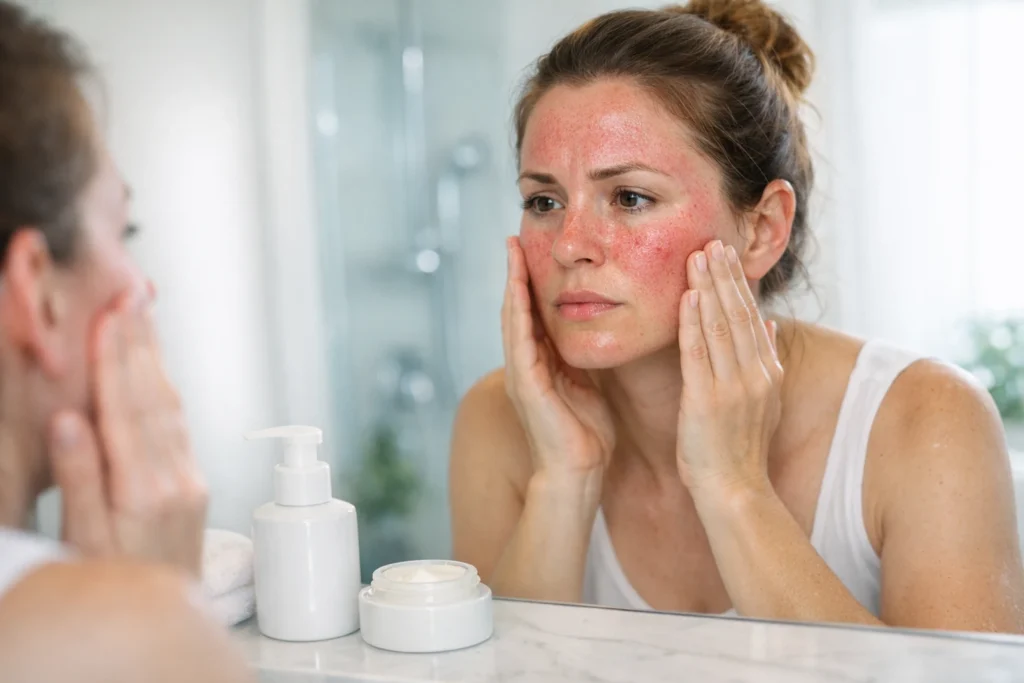
Your face is still warm. You are home, standing in the bathroom mirror, and your skin looks the way it does after a long day at the beach without sunscreen. Nobody warned you it would feel quite like this for quite this long. The clinic gave you a sheet that said “avoid retinol and sun.” That was most of it. What the sheet did not tell you is what your skin is actually doing over the next seven days, and why some of what happens at day three is going to look alarming but is completely normal. For the first day protocol in detail, see the microneedling aftercare guide covering everything you need to do in the first 24 hours.
Looking for a quick answer? Jump to the FAQ below.
The short answer
Days 1-2: redness and warmth like a sunburn. Days 2-4: a temporary bronzing effect before flaking begins. Days 3-5: light peeling, dry texture, rough feel. Days 6-7: calm skin, early brightness, most side effects gone. Full collagen results build over 4-6 weeks.
Day 1: Red, Warm, and Tighter Than You Expected
Treatment day skin looks red and flushed, similar to a moderate sunburn, according to board-certified dermatologist Dr. Michael Paltiel MD. That redness is typically consistent and even across the treated area. The skin feels warm, tight, and mildly swollen. Some patients notice tiny pinpoint marks where the needles penetrated. These are normal and they fade within a few hours to a day.
Do not apply any actives tonight. No vitamin C. No retinol. No acids. If your skin is tolerating it, a gentle fragrance-free moisturiser is fine. If your skin feels very sensitive, even that can wait. A gentle cleanser or plain water only for the first few hours is the safer default.
SPF the next morning. Non-negotiable.
Days 2-4: The Bronzing Effect Nobody Warns You About
This is the part most microneedling content skips entirely, and the part most likely to send you spiralling if you do not know it is coming.
On days 2 through 4, a temporary bronzed or tan tone can appear before light shedding begins. The skin takes on a slightly darker, brownish cast. It can look like a shallow tan, or like your skin has oxidised. It is not hyperpigmentation. It is not a burn. It is not a reaction. It is surface oxidation and normal early cell turnover, a sign that the top layer of skin is preparing to shed. This is documented in clinical microneedling recovery guides and is consistent across multiple sources.
Patients with darker skin tones should be particularly aware of this phase. The bronzing can be more visible, and it can feel alarming. It is worth confirming with your provider before treatment that the needle depth used was appropriate for your skin type, because that variable does matter for your overall risk profile. But the bronzing itself, in isolation, is the normal shedding process showing up at the surface.
The pattern across patients is consistent: those who describe their day 3 or 4 skin as “looking worse than before the treatment” are almost always in this phase. The skin looks its least impressive exactly when it is doing the most work.
Days 3-5: The Flaking Phase (Do Not Pick It)
Light flaking and peeling begin around the nose, chin, and forehead first. These are areas with higher oil production where cell turnover becomes visible earliest. This is the desquamation phase: the dead surface cells that were disrupted during treatment are shedding to reveal fresher skin beneath. It concentrates around the nose, chin, and forehead, and that is normal and expected.
This is not dramatic peeling like a sunburn peel. It is subtle, dry, patchy flaking. If you try to put foundation on during days 3 to 5, it will look rough and uneven. That is also normal.
Do not pick. Do not scrub. Do not exfoliate. Picking at flaking skin after microneedling can cause scarring and post-inflammatory hyperpigmentation. There is broad clinical agreement on this point. The flaking is working. Leave it to finish.
A gentle moisturiser twice daily helps with the tight, rough feeling. Use copper peptides as a supportive ingredient during this healing phase: they support wound repair, reduce inflammation, and are one of the few actives that is appropriate to use during microneedling recovery without risking additional irritation.
When to Reintroduce Actives: Days 5-7
Retinol, vitamin C, AHAs, and BHAs should wait until day 5 to 7 at the minimum, once redness and sensitivity have settled. The key instruction here is to reintroduce one active at a time, not to resume your full routine all at once. If you go back to everything simultaneously and your skin reacts, you will not know what caused it.
If your skin is still sensitive at day 5, wait until day 7. There is no prize for rushing this. For a detailed breakdown of how to restart retinol specifically without triggering a reaction, the guide on retinol after a cosmetic procedure covers exactly when and how to reintroduce it safely.
What happens when people apply retinol or acids too early is not purging. It is an irritant reaction that looks like purging, extends inflammation, and can delay healing by several days. The incentive to wait is real.
Days 6-7: The Glow Arrives (and What It Actually Means)
By days 6 and 7, most visible side effects have resolved. The skin looks brighter and smoother. This is described across multiple clinical sources as the “microneedling glow,” driven by improved circulation and fresh cell turnover at the surface.
This brightness is real. It is also not the full result. Collagen remodeling continues for 4-6 weeks after treatment, and more noticeable improvements in firmness, pore size, and fine line softening develop gradually between weeks 6 and 12. The day 7 glow is the surface result. The deeper structural result takes longer and builds quietly over the following weeks.
Setting that expectation before you reach week 7 and wonder why nothing has changed prevents a lot of unnecessary disappointment.
Microneedling Recovery Day by Day
| Day / Period | What Happens | Key Rule |
|---|---|---|
| Day 1 | Red, warm, tight. Like a moderate sunburn. | Avoid all actives. |
| Day 2 | Redness persists. Bronzing begins. | Apply gentle moisturiser. SPF essential. |
| Day 3 | Bronzing most visible. Light flaking starts around nose and chin. | Do not pick. |
| Day 4-5 | Flaking most active. Skin feels rough and dry. Redness mostly gone by day 5. | No exfoliation. |
| Day 6-7 | Skin calms. Early glow appears. | Resume normal routine cautiously, one active at a time. |
| Week 2-6 | Deeper collagen remodeling underway. Texture, firmness, and pore improvements build gradually. | Protect with SPF daily. |
This is normal
Red, warm, flushed skin for 24-72 hours
A temporary bronzed or tan tone on days 2-4
Dry, tight, flaking skin on days 3-5
Skin looking less impressive on day 3 than day 1
Mild sensitivity to skincare products for up to a week
Call your provider if
Redness spreading or worsening after 48 hours
Blistering or open skin not present immediately after treatment
Hives, widespread swelling, or signs of allergic reaction
Fever following the treatment
Skin darkening that is patchy and not resolving after two weeks
What Goes Wrong Most Often
Three things cause most microneedling complications, and all three are avoidable.
Picking at flaking skin causes scarring and post-inflammatory hyperpigmentation. This is the most common mistake and the most preventable. The flaking looks bad but it is temporary. Scarring is not.
Applying retinol or acids too soon extends irritation and triggers an inflammatory response that looks like purging but is not. It delays healing, sometimes significantly.
Sun exposure over unprotected healing skin causes hyperpigmentation. The skin after microneedling is more vulnerable to UV damage, not less. Daily SPF 30 or higher, from day 2 onward, is not optional.
Frequently Asked Questions
Is the bronzing effect after microneedling the same as hyperpigmentation?
No. The temporary bronzed or tan tone that appears on days 2-4 is surface oxidation and normal early cell turnover, not hyperpigmentation. It resolves on its own as the surface cells shed, usually within a few days. Post-inflammatory hyperpigmentation looks different: it is patchy, concentrated, and does not resolve with normal shedding. If darker areas have not changed at all after two weeks, contact your provider.
Can I wear makeup during the first week after microneedling?
Most providers advise waiting at least 24-48 hours before applying makeup, and mineral-only formulas are preferred over standard foundation for the first few days. During the flaking phase on days 3 to 5, why makeup looks patchy during the flaking phase comes down to dry, uneven skin texture that no formula fully covers. Foundation will sit unevenly on the skin regardless. If you need coverage, lightweight mineral products are less likely to interfere with healing than liquid foundations.
When will I see actual microneedling results?
The brightness and smoothness at day 6-7 is a real surface result. The deeper improvements in collagen, firmness, and pore size take longer. Collagen remodeling continues for 4-6 weeks post-treatment, with more significant texture and firmness improvements developing between weeks 6 and 12. If you are assessing results at day 7, you are seeing only the beginning.
Breakouts in the days after microneedling are common, and whether what you are seeing is purging or a reaction is a distinction worth understanding before you call your provider in a panic.
RF microneedling like Morpheus8 has a different recovery profile from standard microneedling. The Morpheus8 recovery guide covers the additional considerations for treatments that include radiofrequency energy, including the pinpoint scabs that appear days 2-4.
This article is for educational purposes only and is not a substitute for professional medical advice. Always follow your injector’s or surgeon’s specific aftercare instructions.