
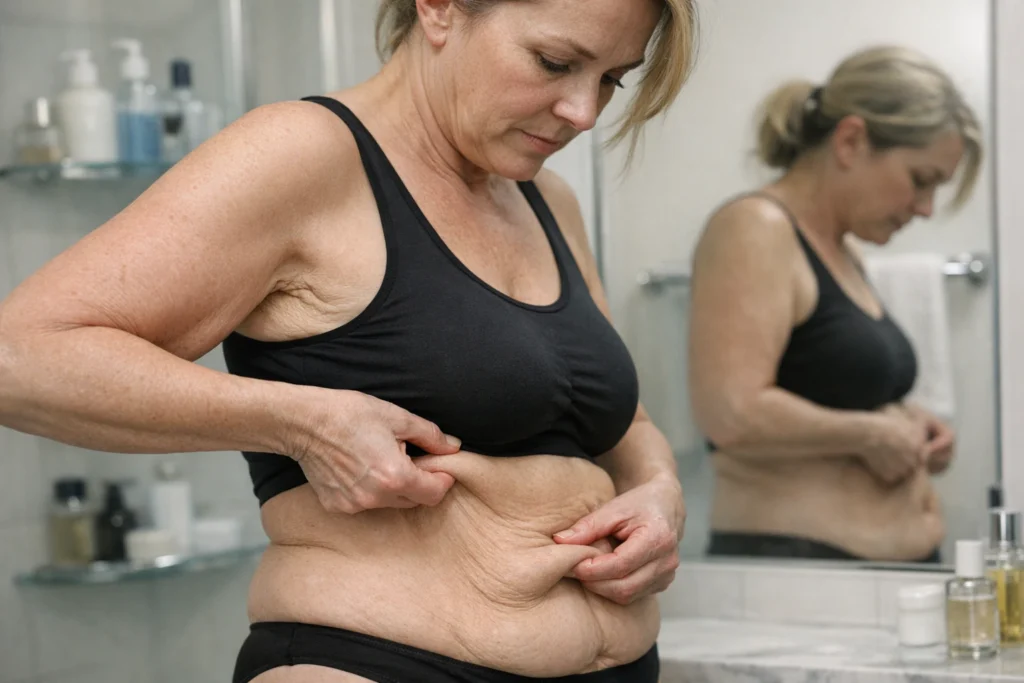
The weight is coming off, and that is the whole point. But somewhere around month three or four, you stand in front of the mirror and notice something the before-and-after photos never quite show: the skin is looser than you expected. At the arms, the inner thighs, the belly, the jaw. You start searching “does your skin tighten up” and land on a mixture of optimistic articles that promise it will and realistic ones that say it depends. The honest answer is the second kind.
Skin laxity after GLP-1 weight loss is real, it is common with significant loss, and how much it affects any given patient depends on a set of variables, some within your control and some not. This article maps the actual picture without pretending the non-surgical options do what surgery does.
Looking for a quick answer? Jump to the FAQ below.
The short answer
Skin laxity after significant GLP-1 weight loss is real and varies widely by age, genetics, and how much weight was lost. Non-surgical tightening treatments help with mild to moderate laxity. Significant redundant skin after major weight loss generally requires surgery to address meaningfully. The honest version of what helps depends entirely on the degree of laxity.
Why Rapid Weight Loss Causes Skin Laxity
Skin elasticity depends on collagen and elastin fibers woven through the dermis. Fat tissue provides structural support from inside, keeping the skin stretched across a framework. When that fat is lost rapidly, the skin does not have time to contract and remodel at the same pace. Think of it as the interior scaffolding being removed faster than the exterior envelope can adjust.
GLP-1 medications can drive significant body weight loss over 6-18 months of treatment, a pace that outstrips skin contraction capacity for many patients. The skin has some ability to retract as fat is lost, but this is slower than the rate of loss most patients on weekly GLP-1 medications experience. The faster and more significant the loss, the more pronounced the laxity.
This is not a medication side effect in the conventional sense. It is a mechanical consequence of significant body composition change happening faster than the skin can accommodate. The same thing happens after any rapid major weight loss, bariatric surgery included. GLP-1 medications are simply now creating this scenario at scale for a larger patient population.
Volume loss shows up most visibly in the areas that held the most fat to begin with, which is why the breasts and buttocks are so often the focus of patient concern alongside the arms and thighs. We cover why breasts and buttocks deflate first in a dedicated piece on the shape changes that come with rapid GLP-1 weight loss.
Who Is Most Affected and Why
Age is the single biggest predictor. Skin elasticity decreases significantly with age, making older patients more susceptible to post-weight-loss laxity. A patient under 35 who has lost 25 to 30 pounds often sees reasonable natural skin contraction over 12 to 18 months after their weight stabilizes. A patient over 45 who has lost 50 or more pounds is facing a different biological picture: skin that has been stretched longer, with less collagen and elastin remaining, and less capacity for the contraction that younger skin can achieve.
Starting body weight matters too. The more the skin was stretched to accommodate a higher body weight, the less likely it is to retract fully after the weight is gone. This is not about effort or patience. It is a structural limitation of the tissue itself.
Genetics plays a role that no intervention fully overrides. Some people have inherently more elastic skin that contracts well after loss. Others do not. This is not reliably predictable in advance. Smoking history, UV damage, and nutritional status during the loss phase all contribute at the margins.

The Face: A Separate and Specific Problem
Facial fat loss at the pace driven by GLP-1 medications creates changes that often read as aging rather than slimming. The temples hollow. The midface deflates. The nasolabial folds deepen. The jowl area loses structural support. This is the picture that has been described in detail as part of the broader aesthetic changes associated with GLP-1-related facial volume loss and it represents a specific clinical problem that body-focused laxity treatments do not address.
Facial options divide roughly into two categories. Hyaluronic acid fillers address acute volume loss directly, restoring specific areas of deflation. They are temporary and require maintenance. Biostimulators like Sculptra stimulate the body’s own collagen production for longer-term structural support, rather than filling a specific area. For patients considering this approach, the details of the recovery and aftercare protocol for Sculptra as a biostimulator option cover what the treatment process involves practically. The broader aesthetic picture of significant GLP-1 weight loss, including what changes at the face, body, and skin surface simultaneously, is covered in detail in the full aesthetic impact of significant GLP-1 weight loss.
Non-Surgical Body Options: What They Actually Do
Radiofrequency and ultrasound skin tightening technologies, including devices operating under names like Thermage, Ultherapy, Morpheus8, and Emtone, stimulate collagen production in the dermis and provide some degree of skin tightening. These devices are not the same as each other in mechanism or depth of effect, but they share a common limitation: they work with the skin the patient has, stimulating it to perform better, rather than removing the excess of it.
For patients with mild to moderate laxity and good baseline skin quality, meaning some elasticity remaining and not dramatically stretched skin, these treatments can produce meaningful improvement. For patients with significant redundant skin after major weight loss, the improvement is more limited. The clinical consensus is clear: non-surgical tightening treatments are appropriate for mild to moderate laxity. They do not replicate surgical results for significant excess skin, and positioning them as equivalent is not accurate.
The pattern that shows up consistently: patients who pursue multiple rounds of expensive non-surgical skin tightening with poor results before consulting a plastic surgeon for the surgical option consistently report wishing they had the surgical conversation first, so they could have made an informed choice from the start rather than spending significant money on treatments that were never going to achieve what they needed. Non-surgical options are not wrong for the right patient. They are wrong when they are used to delay or avoid a conversation about surgical options for a patient who actually needs the surgical option.
Surgical Options: Honest About What They Require
For significant laxity after major weight loss, surgery is the most effective intervention available. Body lift, arm lift (brachioplasty), thigh lift, tummy tuck, and facelift all address excess skin that non-surgical treatments cannot meaningfully reduce. These are not minor procedures. Recovery is significant. Scarring is the trade-off for removing the excess skin, and the scars are permanent. These are facts worth stating plainly before any consultation.
The timing of surgical intervention matters. Operating while active weight loss is still ongoing is generally not recommended, as further loss after surgery changes the results and may require revision. Most surgeons prefer to wait until weight has been stable for six to twelve months before planning body contouring surgery after major loss. This means the surgical conversation should start early, so patients can plan appropriately, not wait until they have been at a stable weight for a year with no plan in place.
Nutrition and What You Can Control During the Loss Phase
Protein intake during active weight loss supports the structural proteins in skin and is the most accessible intervention for giving the skin the best chance to contract as loss proceeds. This is not a guarantee of avoiding laxity with significant loss, but it is a genuine factor at the margins. Patients on GLP-1 medications who are eating significantly less than before and not tracking protein are at higher risk of compounding both the laxity and the hair loss that can accompany rapid caloric restriction.
Vitamin C supports collagen synthesis, which is established biochemistry. Regular vitamin C use during active weight loss is a low-downside, mechanistically sound choice for supporting skin structure during the change. It does not prevent significant laxity in patients with major loss, but it supports better skin outcomes at the margins. Losing weight more slowly, if medically appropriate, gives skin more time to contract as loss proceeds. Whether this is within any individual patient’s control on a GLP-1 medication is another matter.
Expected with significant weight loss
Some degree of skin looseness in areas of major fat loss, particularly the abdomen, inner thighs, and upper arms. More pronounced laxity in patients over 40 with significant loss. Facial hollowing and volume loss alongside body changes. Skin that takes 12 or more months to fully contract after weight loss stabilises. Improvement that continues slowly over time as collagen remodels.
Discuss with an aesthetic provider if
Skin folding or chafing in areas of significant excess, which can cause hygiene and skin health problems beyond aesthetics. Laxity that is affecting confidence or daily comfort significantly. You are considering body contouring procedures and want to understand surgical versus non-surgical options with honest information about what each achieves. Skin changes are progressing rapidly during active weight loss and you want to plan ahead.
Frequently Asked Questions
Will my skin tighten on its own after GLP-1 weight loss?
For some patients, yes, partially and over time. The degree of natural contraction depends heavily on age, the amount of weight lost, how quickly it was lost, and individual skin elasticity. Younger patients with moderate loss and good baseline skin quality often see meaningful natural contraction over 12 to 18 months after weight stabilises. Older patients or those with significant loss are less likely to see contraction that fully addresses the laxity. Allowing 12 to 18 months of stable weight before making surgical decisions gives the skin maximum time to contract first.
Are skin tightening devices worth trying before surgery?
For mild to moderate laxity with good baseline skin quality, yes. RF and ultrasound skin tightening devices can produce meaningful improvement in the right candidate, and trying non-surgical options first makes sense when the laxity is moderate and the patient has realistic expectations. For patients with significant redundant skin after major weight loss, these devices are unlikely to produce results comparable to surgery. The most useful approach is a consultation with a plastic surgeon to assess the degree of laxity honestly before committing to multiple rounds of non-surgical treatment.
When is surgery the right option for skin laxity after weight loss?
When the laxity is significant enough that non-surgical treatments are not going to produce a meaningful result, and the patient has realistic expectations about what surgery involves. This includes patients with truly redundant or folding skin in areas like the abdomen, arms, or thighs, patients whose laxity is causing practical problems like chafing or hygiene issues, and patients who have waited for natural contraction and are not seeing sufficient change. The surgical conversation is most useful early, not as a last resort after years of non-surgical treatments that did not achieve what was needed.
For patients who have lost significant weight on GLP-1 medications, neck lift is one of the most common procedures for patients addressing GLP-1 weight loss changes in the neck and jawline area.
When skin excess is extensive and distributed circumferentially around the lower torso, a lower body lift is the most comprehensive surgical solution for significant post-GLP-1 skin laxity — addressing the abdomen, flanks, thighs, and buttocks in a single surgical procedure.
This article is for educational purposes only and is not a substitute for professional medical advice. Always follow your injector’s or surgeon’s specific aftercare instructions.