
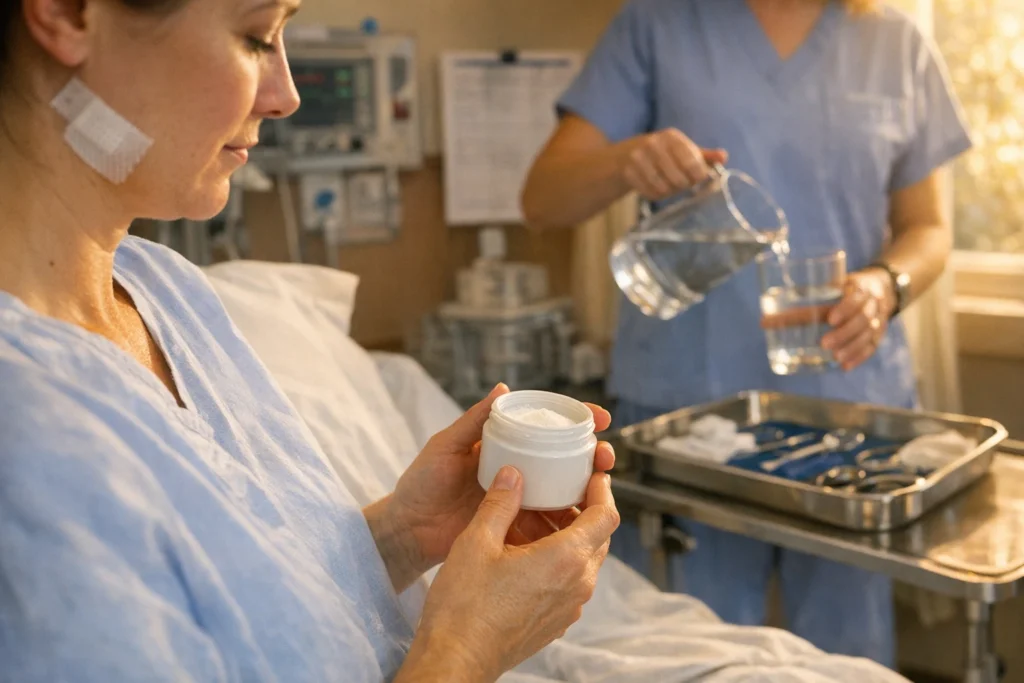
Your surgeon mentioned collagen supplements, or you came across them while researching recovery. The question you are actually asking is simple: do they work, or is this another wellness industry upsell dressed up in clinical language? The honest answer is that the evidence is more solid than most supplement evidence — and less definitive than the marketing around it. Here is what the research actually shows and what it does not.
Looking for a quick answer? Jump to the FAQ below.
The short answer
The evidence for hydrolyzed collagen peptides in surgical recovery is real but not definitive. The best-supported approach: 10-15g of hydrolyzed collagen peptides daily, combined with vitamin C, starting 1-2 weeks before surgery and continuing for 4-6 weeks after. Patients prone to keloid scarring should discuss with their surgeon first. Buy an unflavoured powder — branded collagen drinks contain the same ingredient at 5-10x the cost per gram.
What Collagen Is and Why It Matters for Surgical Healing
Collagen is the most abundant protein in the human body, accounting for roughly 30% of total body protein mass. It provides the structural framework for skin, tendons, ligaments, cartilage, and blood vessels. In surgical wound healing, collagen is active in every phase of the repair process: platelets interact with exposed collagen to initiate clotting at the wound site, collagen scaffolding guides new tissue formation during the proliferative phase, and collagen remodelling continues for months in the final maturation phase.
When surgical tissue is disrupted — whether in a tummy tuck, a facelift, or a lipo procedure — the body needs adequate collagen synthesis capacity to rebuild it. The question collagen supplementation addresses is whether providing additional precursor material accelerates or improves that process. The clinical answer is: sometimes yes, with specific parameters.
What the Clinical Evidence Actually Shows
The evidence for collagen peptide supplementation in post-surgical healing is genuinely supportive, though not definitive. A 2022 review in Nutrients noted that collagen peptides, particularly when combined with antioxidants like vitamin C, may improve wound tensile strength and reduce healing time post-surgery. Clinical data using hydrolyzed collagen peptides at 15 grams per day, started within 24 hours of surgery or injury, showed accelerated tissue repair — particularly in patients with baseline protein deficiency. A 2021 systematic review found that initiating supplementation within 24 hours of surgery or injury produced stronger effects than delayed supplementation. Patients who received collagen peptides immediately before and after surgery showed faster epithelialization and reduced wound complications compared to controls.
The mechanism is consistent across studies: collagen peptides appear to accelerate the proliferative phase of healing, reduce inflammation, and improve the quality of newly formed tissue. That is a coherent, plausible mechanism. It is not the same as definitive proof of clinical significance in every patient type. But for most cosmetic surgery patients, the evidence-to-risk ratio is favourable.
If you are building out your pre-surgical nutrition approach more broadly, pre-surgery nutrition covers the full picture of what supports healing before a procedure — collagen is one piece of that.
When to Take It and at What Dose
The most consistent clinical effects are seen at 15 grams per day of hydrolyzed collagen peptides, with some evidence supporting 10 grams as a minimum effective dose. For acute wound healing, supplementation is typically initiated immediately before surgery or within 24 hours, and continued for four to six weeks — covering the proliferative and early remodelling phases.
Practically, starting one to two weeks before your surgery date gives the body time to build substrate before it is needed. Continuing for four to six weeks post-surgery aligns the supplementation window with the most active phases of wound repair.
Collagen supplements taken without adequate vitamin C are less effective. Vitamin C is an essential cofactor for the enzymes that synthesise and stabilise the collagen triple helix structure. Specifically, it is required for the hydroxylation of proline and lysine residues that give the collagen molecule its stability. Without adequate vitamin C intake, collagen synthesis cannot proceed normally regardless of how much collagen peptide substrate is present. Take them together.

The Keloid Caveat: When More Collagen Is Not the Goal
Patients prone to keloid or hypertrophic scarring should discuss collagen supplementation with their surgeon before starting. Keloid scars form because collagen production in the healing wound does not switch off appropriately, continuing to generate scar tissue beyond the boundaries of the original wound. Supplementation that supports collagen production generally may, in keloid-prone patients, increase rather than decrease the likelihood of excessive scar formation.
For breast reconstruction surgeries specifically, there is a positive correlation between the Type I to Type III collagen ratio and scar formation. Patients with a personal history of raised, firm, itchy scars extending beyond the original wound boundary after previous injuries or surgeries should flag this specifically before starting any collagen supplementation around a procedure. This is not a reason to avoid collagen categorically — it is a reason to have the conversation with your surgeon explicitly rather than assuming it is safe for everyone.
What to Look for in a Collagen Supplement
The active ingredient is hydrolyzed collagen peptides, also called collagen hydrolysate. Type I and Type III collagen are the most relevant for skin and wound healing — Type II is primarily for joint cartilage and is not what you want here. Marine collagen (fish-derived) and bovine collagen are both well-studied and appropriate. Look for third-party tested products for purity. Avoid products with added sugars, unnecessary fillers, or heavy flavouring where possible.
Powder forms are significantly more practical than capsules for reaching therapeutic doses. Capsules typically provide one to two grams per serving. Reaching 10 to 15 grams via capsules means taking ten or more pills per day. An unflavoured powder dissolved in water or coffee achieves the same dose in a single serving.
What the Evidence Does Not Support
The evidence does not support the idea that any specific branded “beauty collagen” product is meaningfully superior to generic hydrolyzed collagen peptides at equivalent doses. The active ingredient is hydrolyzed collagen. The branding, flavouring, celebrity endorsements, and packaging are marketing. Patients who buy expensive branded collagen drinks marketed specifically for post-surgical recovery are almost always paying five to ten times more per gram of hydrolyzed collagen than they would for an unflavoured powder from a reputable supplement brand at equivalent dosing. The ingredient is the same. The label is different.
It is also worth knowing that arnica for bruising and collagen peptides occupy a similar evidence tier — both have real clinical support, neither has definitive proof of effect in all patients. For a comparison of evidence-based peri-surgical supplements, arnica for bruising covers what the research shows for one of the most commonly used recovery supplements alongside collagen.
Collagen supplementation is appropriate if
You are preparing for any cosmetic surgical procedure and have no keloid history
You are in the post-surgical healing phase (weeks 1-6)
You are pairing the supplement with adequate vitamin C
You are using hydrolyzed collagen peptides at a dose approaching 10-15g daily
Discuss with your surgeon first if
You have a history of keloid or hypertrophic scarring after previous wounds or surgeries
You are prone to raised, itchy, firm scars that extend beyond the original wound boundary
Your surgeon has specific instructions about supplements around your procedure date
You are on medications that interact with high-dose protein supplementation
Frequently Asked Questions
When should I start taking collagen supplements before surgery?
Starting one to two weeks before surgery gives the body time to build substrate before it is needed. The clinical evidence is strongest for supplementation initiated within 24 hours of surgery, but earlier initiation adds preparation without meaningful downside for most patients. Continue for four to six weeks post-surgery to cover the proliferative and early remodelling phases of wound healing.
Does the type of collagen supplement matter?
Yes. Hydrolyzed collagen peptides (also called collagen hydrolysate) is what the clinical evidence supports. Type I and Type III collagen are most relevant for skin and wound healing. Gelatin, undenatured type II collagen, and marine collagen blends with undisclosed hydrolysation levels are all different products with different evidence bases. Check that the label says “hydrolyzed collagen peptides” or “collagen hydrolysate” specifically.
Is expensive branded collagen better for surgical recovery?
No. The active ingredient in every collagen supplement marketed for recovery is hydrolyzed collagen peptides. Branded products that cost significantly more per gram than generic hydrolyzed collagen powder contain the same functional ingredient. The differences are flavour, packaging, and marketing. For surgical recovery specifically, an unflavoured powder from a reputable brand with third-party testing, dosed at 10-15g daily with adequate vitamin C, is the evidence-based approach — regardless of brand recognition.
This article is for educational purposes only and is not a substitute for professional medical advice. Always follow your injector’s or surgeon’s specific aftercare instructions.