
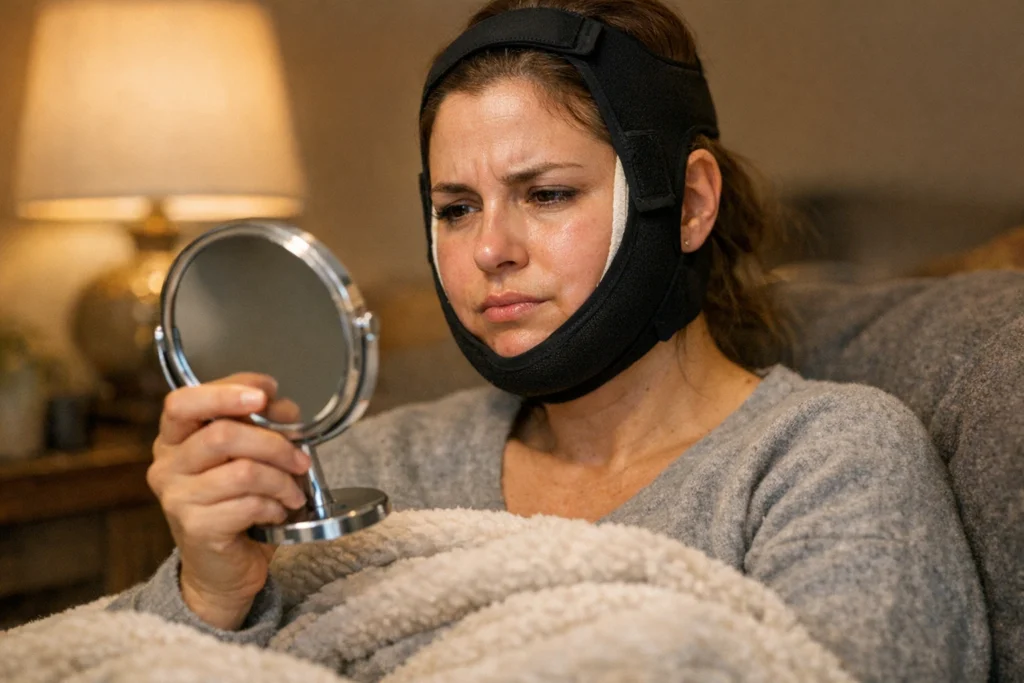
You wake up the morning after chin liposuction and your face is puffy in a way you were not quite prepared for, even though everyone told you to expect swelling. The chin strap is tight, your jaw feels heavy, and you are already second-guessing whether you need to wear the garment to your desk job next week. The answer, before anything else: yes, you do. And here is why it actually matters.
Quick Answer
Chin liposuction recovery moves faster than any body liposuction area. Most patients return to desk work in 3 to 7 days. The chin strap is worn day and night for 7 to 10 days, then nights only for 1 to 3 more weeks. Swelling peaks at 48 to 72 hours and is worse in the mornings. Initial contour improvement is visible at 2 to 3 weeks. Final jawline definition takes 2 to 3 months.
Jump to: Frequently Asked Questions
What Chin Liposuction Actually Does
Chin liposuction targets the submental fat pad, the accumulation of fat directly beneath the chin that creates the appearance commonly called a double chin. Depending on the patient’s anatomy and the surgeon’s plan, the procedure may also address fat in the jowl area and upper neck to create a more defined jawline profile. Incisions are small, typically around 3mm, and placed strategically: under the chin crease where they become nearly invisible, and occasionally at or behind the earlobe crease.
Most chin lipo is performed under local anaesthesia with tumescent technique or with light sedation. You are not under general anaesthesia for this. Recovery, as a result, is significantly faster than body liposuction. The procedure time is relatively short, the incision sites are tiny, and the volume of fat removed is modest compared to abdominal or thigh lipo. This is genuinely a faster recovery. What makes it feel harder than expected is the one piece of aftercare that patients consistently underestimate.
The Chin Strap: What It Is Actually Doing
The chin strap is not there to hold your face together while you heal. It is there because of gravity and fluid physics. The submental area is a natural pooling point for lymphatic fluid and post-surgical swelling. When you lie flat overnight, fluid accumulates under the chin. Without compression to counteract the pooling, patients wake up to significantly more puffiness than they went to sleep with, and that morning swelling slows the overall healing arc.
There is a consistent pattern across accounts from patients who skip the strap or wear it loosely: they report more dramatic morning puffiness, a slower reduction in visible swelling, and less defined early results compared to patients who wear the garment as directed. This is not anecdote. It reflects what the garment is biomechanically doing: counteracting gravity, supporting skin retraction as the tissue adjusts to its new contour, and helping maintain the jawline position the surgeon has created while the body heals.
The protocol is continuous wear, day and night, for the first 7 to 10 days. After that, most surgeons move patients to nights only for another 1 to 3 weeks. The nighttime phase matters because fluid accumulation happens primarily during horizontal sleep, which is exactly when compression is most useful. The general compression logic here is similar to what body lipo patients use with fajas, even though the garment type is entirely different. If you want to understand the broader compression rationale, the faja sizing and switching guide covers the underlying principles well.
Normal
Swelling worse in the morning than afternoon
Bruising that travels into the neck or upper chest in week 1
Numbness or tingling under the chin lasting weeks to months
Incision sites pink or slightly raised for several months
Call Your Provider
Skin that appears mottled, darker, or blistered at any point
Swelling on one side only that is not improving by week 6
A hard or tethered feeling under the chin on one side only
Sudden increase in swelling after the first week, or fever above 38°C / 100.4°F
The Swelling Arc: What to Expect and When
Swelling peaks at 48 to 72 hours post-procedure. This is the worst it will look. It will not keep getting worse after that point, which is useful information to hold onto when day two feels alarming.
From day four, swelling begins reducing noticeably. The morning-versus-afternoon pattern is consistent: mornings are puffier because fluid has pooled overnight, and afternoons are better after gravity and movement have redistributed it. This pattern persists for several weeks. It is one reason the nighttime strap wear continues after the daytime requirement ends.
The dramatic puffiness largely resolves by weeks 2 to 4. Most patients can see the contour change they paid for by the 2 to 3 week mark, even if the result is not fully defined. Final jawline and chin definition typically becomes visible at 2 to 3 months, when residual subtle swelling has cleared and skin retraction is complete. Some patients experience mild residual swelling to the 6-month point, particularly in the morning.
Recovery Timeline
| Timeframe | What to Expect |
|---|---|
| Days 1 to 3 | Peak swelling and bruising. Chin strap on day and night. Head elevated. Rest. |
| Day 4 | Swelling begins reducing noticeably. Still elevated in mornings. |
| Days 3 to 7 | Most patients return to work in this window. Bruising may travel into neck or chest. Normal. |
| Weeks 2 to 4 | Chin strap moves to nights only. Swelling continuing to reduce. Contour emerging. |
| Weeks 4 to 6 | Most bruising and swelling resolved. Light exercise resumed. No strenuous activity yet. |
| Months 2 to 3 | Final chin contour visible. Incision sites fading. Sun protection essential. |
| Up to 6 months | Subtle residual swelling possible. Final skin retraction complete. |
Head Position and the Restriction Nobody Warns You About
Head elevation is non-negotiable for the first two weeks. Sleep at 30 to 45 degrees using a wedge pillow or a recliner. Lying flat allows fluid to pool aggressively in the submental area, counteracting what the chin strap is working to prevent.
The restriction that catches most patients off-guard is the looking-down rule. Spending extended periods with your head bent forward, whether from phone scrolling, reading with the book in your lap, or working on a laptop positioned low, increases swelling and creates downward pressure on healing tissue. Two weeks of conscious head positioning sounds manageable until you realise how much of your daily life involves looking down.
Return to strenuous exercise is 4 to 6 weeks out. The desk work timeline is considerably shorter: most patients return at 3 to 7 days, and some with manageable bruising and a willingness to wear the strap (or conceal it) return as early as day 2 to 3. Bruising is the bigger factor here than pain. Bruising from chin lipo can travel into the neck and upper chest in the first week. This looks dramatic and is entirely expected.
Scars, Incisions, and the Long Game
The incisions for chin liposuction are approximately 3mm and placed in natural skin creases. They typically heal to near-invisibility over 6 to 12 months. There is no lollipop pattern, no anchor scar, nothing that approaches the scar burden of a neck lift or facelift. This is one of the genuine advantages of liposuction over more invasive approaches to submental fullness.
The most important thing patients can do for long-term scar appearance is sun protection. UV exposure causes hyperpigmentation in healing scars, including tiny ones. Applying SPF 50 to the incision sites daily for 6 to 12 months gives the best chance of them becoming truly invisible. This step gets skipped because patients cannot see the problem developing until months later.
For everything you need to know about managing lipo incision scars at any site, lipo incision scars covers the full scar care timeline. Chin incisions are at the minimal end of the spectrum, but the principles apply.
One more consideration patients sometimes ask about: manual lymphatic drainage. MLD is used for body lipo to accelerate fluid clearance and reduce swelling. It is also used for chin liposuction, typically starting in week 2 once the acute swelling has begun to settle. The post-lipo lymphatic massage schedule covers timing and what to expect from MLD sessions in detail.
Frequently Asked Questions
How long does chin liposuction recovery take?
Most patients return to desk work within 3 to 7 days. The acute swelling and bruising phase is largely resolved by weeks 2 to 4. The chin strap transitions to nights only after the first 7 to 10 days and is typically discontinued 1 to 3 weeks after that. Final jawline definition is visible at 2 to 3 months, with subtle swelling possibly persisting to 6 months.
What happens if I skip the chin strap?
Skipping or wearing it loosely consistently results in more significant morning puffiness, slower overall swelling reduction, and less defined early results. The strap is doing real work in preventing overnight fluid pooling and supporting skin retraction. There is no cosmetically neutral version of skipping it. Follow the protocol your surgeon gave you and save the skipping for after you are cleared.
Is the bruising from chin lipo supposed to travel down my neck?
Yes. Bruising that migrates into the neck and upper chest area in the first week is expected and normal. Blood and fluid track downward along tissue planes with gravity. It looks alarming, particularly on a body part that is difficult to conceal, but it resolves on the same timeline as the bruising at the treatment site. If you are seeing skin that looks mottled, darker than surrounding tissue, or blistered at any point, that is a different situation: call your provider.
Patients sometimes compare chin liposuction to Kybella when researching their options. The recovery timelines and swelling profiles differ significantly; the Kybella aftercare guide explains why deoxycholic acid recovery involves considerably more initial swelling than the surgical approach.
Male patients considering chin liposuction should also read our male liposuction recovery guide, which covers the key differences in compression options, pain patterns, and return-to-gym timelines for trunk and body lipo in male patients.
This article is for educational purposes only and is not a substitute for professional medical advice. Always follow your injector’s or surgeon’s specific aftercare instructions.