

The clinic hands you your aftercare sheet and it says “avoid pressure on the treated area for 24-48 hours.” What it does not say is that your chin is a pressure point you touch a hundred times a day without realizing it. Resting your hand on your chin while you read. Pressing your phone against it. Sleeping with your face slightly sideways. These are the things that actually matter after chin filler, and most aftercare sheets never mention them.
Looking for a quick answer? Jump to the FAQ below.
Quick Answer
Chin filler has pressure avoidance rules that matter more than at most other filler sites. No resting your hand on your chin, no sleeping face-down for the first 1-3 nights, no chinstraps or tight bands on the area for at least two weeks. Swelling peaks in 24-48 hours and temporary asymmetry in the first two weeks is almost always swelling, not a placement problem. Do not assess the final result until the two-week mark.
Why Chin Filler Placement Is Different
Chin filler is typically placed at or near the periosteum, which means on or very close to bone. This deep placement is what creates structural projection and definition rather than surface softness. The product used is often denser and more volumizing than what gets used in the lips or under the eyes. You are building structure, not adding softness.
That placement depth is also why pressure avoidance matters more here. In shallower placements, the tissue above the product acts as a natural buffer. At periosteal depth, the filler is sitting directly on a firm surface with the overlying tissue providing less cushion. External pressure applied in the first 48-72 hours can affect positioning before the product has had time to integrate. The first three days are the highest-risk window.
The chin is also a projection point. Unlike the cheeks or temples, it protrudes forward. That geometry means accidental contact happens more often than patients expect. A phone call. A reflexive hand-to-face gesture. The corner of a pillow.
The Pressure Rules, Stated Specifically
These are the rules most aftercare sheets leave vague. Here they are explicitly:
No resting your hand on your chin. This is one of the most common unconscious habits people have, and it becomes relevant the moment chin filler is in place. Set a reminder for the first week if that helps. The habit needs to stop while the filler integrates.
No sleeping face-down for the first 1-3 nights. Back sleeping with your head slightly elevated is best. If you are a confirmed side sleeper, aim for the first night on your back and keep in mind that anything pressing on the chin area while you sleep can affect placement in the early integration window. This applies to the first three days, not indefinitely.
No chinstraps, tight face masks, compression bands, or sports equipment that contacts the chin for at least two weeks. This includes helmets with chin guards, certain kinds of sports headgear, and any tight-fitting garment that covers the lower face. If you have a job or sport that requires this kind of equipment, schedule your appointment to give yourself at least two weeks clearance before needing to use it again.
This connects to the same pressure principles that apply to jawline filler. If you have had jawline filler before, the rules are similar, but the chin’s projection makes accidental contact more likely. See also the cheek filler aftercare guide for comparison on how different facial filler sites carry different post-treatment considerations.
Swelling, Timeline, and the Asymmetry Question
What’s Normal
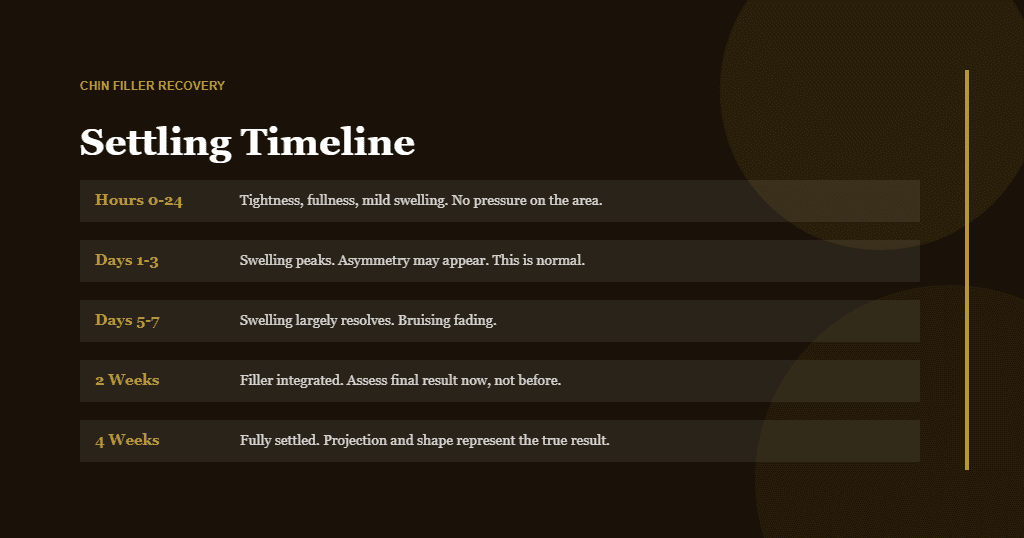
Tightness and fullness immediately post-injection. Swelling that peaks in the first 24-48 hours and may cause the chin to look larger than the final result. Temporary asymmetry in the first 1-2 weeks as one side of the swelling resolves faster than the other. Firmness at the injection site. Minor bruising at the needle entry points that follows the standard bruise timeline, darkening then yellowing and fading over 7-14 days.
When to Call
Pale, white, or bluish skin anywhere near the injection site. Increasing pain after the first day rather than gradual improvement. Hard lumps that persist beyond 3-4 weeks without softening. Skin that looks blanched or has a mottled appearance. Worsening swelling rather than gradual resolution. Any of the vascular compromise signs (pale, dusky, or painful skin) are time-sensitive and require immediate contact with your injector, not a wait-and-see approach.
Swelling peaks in the first 24-48 hours and resolves largely by days 5-7. The final result is visible at 2-4 weeks, as the filler fully integrates and the tissue settles around it. This is the standard timeframe across dermal filler protocols for deep placements.
Temporary Asymmetry Is Not What You Think It Is
Patients consistently raise the asymmetry concern in the first few days. One side of the chin looks fuller, or the projection seems off-center. This is almost always swelling, not a placement problem. Swelling does not resolve at exactly the same rate on both sides of the face. One side clearing faster than the other is normal and says nothing about whether the filler was placed correctly.
The instruction is to wait until the two-week mark before making any assessment of the result. At two weeks, most swelling has resolved and the filler has integrated enough to represent the actual result. If there is a genuine asymmetry at that point, that is the time to discuss it with your injector. Before that point, the information available from looking in the mirror is not reliable enough to act on.
This does not mean you cannot call your injector if something concerns you. It means that asymmetry in the first two weeks, on its own, is not evidence that something went wrong. The timeline matters.
For bruising at the injection site
A topical arnica gel is the standard first line for filler bruising. Boiron Arnicare gel is the one we recommend; apply it around the area, never directly on broken skin.
FAQ
How long does chin filler take to settle?
Initial swelling resolves largely by days 5-7. The final integrated result is visible at 2-4 weeks. Assessing a chin filler result before the two-week mark, especially if you have visible swelling or bruising, will give you misleading information. The 2-week follow-up appointment that many injectors offer exists precisely for this reason: it is when the result is actually readable.
Can I sleep on my side after chin filler?
Ideally not for the first 1-3 nights, if you can help it. Back sleeping with the head slightly elevated is the safest position during the early integration window. If you cannot stay on your back all night, try to minimize the time with your chin pressed into a pillow. After the first three days, the risk from sleeping position decreases significantly as the filler begins to integrate into the tissue.
Is chin filler asymmetry in the first week normal?
Yes. Temporary asymmetry in the first 1-2 weeks is overwhelmingly swelling-related, not a filler placement problem. Swelling resolves unevenly on either side of the face, which can make the chin look off-center even when the filler is placed correctly. Wait until the 2-week mark before evaluating whether any correction is needed. If you are concerned before then, a call to your injector for reassurance is always reasonable, but do not request correction before the swelling has cleared.
This article is for educational purposes only and is not a substitute for professional medical advice. Always follow your injector’s or surgeon’s specific aftercare instructions.