
You booked Radiesse because you wanted results that last. The clinic told you it also stimulates collagen, which sounded appealing. What they may not have mentioned clearly enough is that Radiesse is not like the filler in your lips or cheeks that can be reversed with an injection if something goes wrong. That detail matters. Not because Radiesse is dangerous, but because the decision to use it is a longer commitment than most patients realize going in.
Looking for a quick answer? Jump to the FAQ below.
Quick Answer
Radiesse aftercare is straightforward: avoid touching the area for 24 hours, skip heat exposure for 48 hours, sleep elevated if swollen, and use arnica for bruising. The physical recovery is simple. The more important thing to understand before your appointment is that Radiesse cannot be dissolved if you dislike the result. The body resorbs it naturally over 12-18 months, but there is no fast reversal option. Choose your injector carefully.
What Radiesse Actually Is
Radiesse is composed of calcium hydroxylapatite (CaHA) microspheres suspended in a carboxymethylcellulose gel carrier. That dual structure is what makes it different from hyaluronic acid fillers. The gel provides immediate volume, and the CaHA microspheres act as a scaffold that stimulates the body’s own collagen production over the following months. You are getting two effects: the volume you can see immediately, and the structural improvement that builds over time.
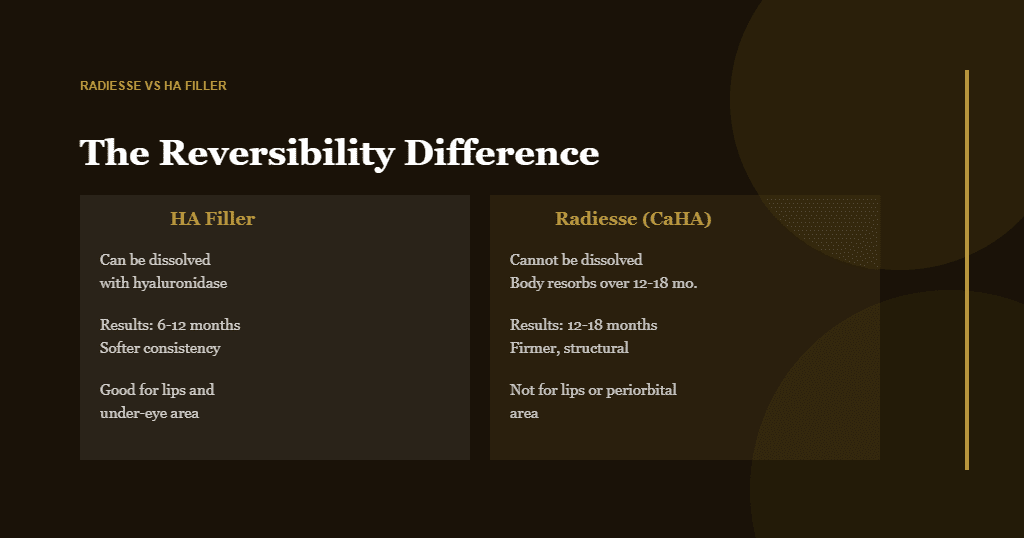
Compare this to hyaluronic acid fillers, which work entirely through hydration. HA draws water to the area, creating volume. There is no collagen stimulation involved. Dissolving HA is fast and predictable: hyaluronidase breaks it down within hours. Radiesse does not have a comparable reversal mechanism. The body resorbs CaHA naturally, but that process takes 12-18 months. Some practitioners use sodium thiosulfate off-label as a partial reversal method, but this is not standard, not widely available, and not reliable in the way hyaluronidase is for HA.
Radiesse received FDA approval for hand rejuvenation in 2015, making it the first dermal filler FDA-approved specifically for that indication. It is also commonly used for structural facial areas: jawline, cheeks, chin, and nasolabial folds. What it is generally not used for: lips and the under-eye area. Its stiffer consistency makes it inappropriate for those locations, where a softer, more pliable product is needed. If a provider suggests Radiesse for your lips, that is a conversation worth pausing on.
The Honest Conversation About Non-Reversibility
Nobody avoids Radiesse because it cannot be dissolved. They should, however, choose their injector more carefully because of it. When a hyaluronic acid result is off, you dissolve it and start over. When a Radiesse result is off, you wait. Possibly a long time.
That is not a reason to avoid the product. Radiesse, placed well by a skilled injector, tends to produce natural-looking structural results that last longer than most HA fillers and improve over time. The issue is that the margin for error is narrower, and the consequences of poor placement are measured in months rather than hours. The question to ask at your consultation is not just “is this the right product for my concern?” but “how experienced is this injector specifically with Radiesse and this placement area?”
The body does fully resorb CaHA over time, so this is not a permanent commitment. But 12-18 months is a meaningful window if you are unhappy with a result. Worth knowing before you book. See also information on dissolving lip filler if you are comparing reversible versus non-reversible options for a filler decision.
Radiesse Aftercare: What to Actually Do
The good news is that the physical aftercare for Radiesse is not complicated. The product is placed deep, typically at or near the periosteum for facial structural work, and the recovery for most patients is milder than they expect.
For the first 24 hours: avoid touching or massaging the treated area. Do not apply pressure to it. No makeup on injection sites. The firmness you feel is normal. The CaHA gel is integrating, and the initial texture under the skin is part of that process. It will soften.
For the first 48 hours: no significant heat exposure. This means no saunas, no steam rooms, no hot yoga, and cooler showers rather than scalding ones. Heat increases blood flow and amplifies swelling. If you have visible swelling, sleeping with your head slightly elevated helps.
Arnica is worth using. Bruising after Radiesse is common because the needles are larger than those used with some HA fillers, and the injection technique often involves more product per site. Arnica gel applied to (not injected into) the surrounding area can reduce bruising duration, and arnica supplements taken in the days before and after the appointment can reduce severity. The evidence on arnica is modest but the risk is minimal.
What Normal Recovery Looks Like and When to Call
What’s Normal
Firmness at the injection site that gradually softens over days. Mild swelling and redness that peaks in 24-48 hours and largely resolves within a week. Bruising that follows the typical bruise arc, darkening on day 2-3 then yellowing and fading. The visible “result” looking slightly larger than expected in the first week due to swelling.
When to Call
Nodules that feel hard and do not soften over several weeks. Any area of skin that appears pale, white, or bluish, or that feels different from the surrounding skin. Increasing pain after the first 24-48 hours, particularly localized pain. Delayed swelling that worsens rather than improving after day 3. Signs of vascular compromise are a medical emergency, contact your injector immediately.
The vascular compromise warning applies to all filler types but is worth repeating here: pale or blanched skin, or skin that turns dusky or bluish near the injection site, is a time-sensitive situation. This is not a “wait and see” scenario. Call immediately.
The Result Timeline
The immediate volume you see after Radiesse is a combination of the filler product and post-injection swelling. The true settled result appears at 1-2 weeks once swelling has resolved. At that point, the product is in its final position and the volume reflects what the Radiesse itself is providing. This is the baseline you should evaluate, not the day-of appearance.
The collagen-stimulating phase is a separate timeline that builds over the following months. Most patients using Radiesse for facial contouring notice progressive improvement at 3, 6, and even 9 months post-treatment. This is the effect that makes Radiesse worth its higher cost compared to some HA fillers: the result gets better before it fades, rather than just slowly diminishing from day one.
For Sculptra aftercare, another collagen biostimulator with a similar gradual improvement trajectory, the protocol and patient expectations are comparable. If you are deciding between biostimulatory options, that article covers the differences worth knowing.
One honest note on where Radiesse works well: it is a structural product, and it performs best where structure is the goal. Cheekbone definition, jawline sharpening, chin projection, nasolabial fold correction, and hand rejuvenation are its strongest indications. If the concern is softness, fine lines, or lip volume, softer HA fillers are typically the better fit.
FAQ
Can Radiesse be dissolved if I don’t like the result?
No. Radiesse is calcium hydroxylapatite, not hyaluronic acid, and hyaluronidase does not break it down. Some practitioners have used sodium thiosulfate off-label as a partial dissolving agent, but this is not a standard technique, is not widely available, and does not work reliably the way hyaluronidase works for HA fillers. The body resorbs Radiesse naturally over 12-18 months. If you are concerned about reversibility, this is the most important conversation to have with your injector before the appointment, not after.
How long does Radiesse last?
Results typically last 12-18 months for most patients and treatment areas. The biostimulatory effect means the results can improve over the first several months before eventually fading. Individual results vary based on the treatment area, the amount of product used, and factors like skin quality, metabolism, and sun exposure over the treatment period.
Is the firmness after Radiesse normal?
Yes. The immediate firmness at the injection site is the CaHA gel integrating into the tissue. It is denser than hyaluronic acid filler and will feel more substantial under the skin, especially in the first few days. This typically softens over one to two weeks as the gel settles and the initial inflammation resolves. If firmness is accompanied by redness, warmth, or increasing discomfort beyond the first couple of days, contact your injector.
This article is for educational purposes only and is not a substitute for professional medical advice. Always follow your injector’s or surgeon’s specific aftercare instructions.