
You booked the appointment. Now you’re reading everything you can find about how to prepare. Most of it will tell you to stay hydrated and get enough sleep and avoid stress. That advice is not wrong, exactly. It’s just not the part that matters. The week before your botox appointment is where the real prep happens, and it mostly comes down to one thing: not showing up with a skin barrier that’s been compromised, and not arriving with anything in your system that makes you bruise more easily.
Quick Answer
The most impactful pre-botox prep happens in the week before your appointment: stop blood-thinning supplements and OTC medications, reduce alcohol, and skip retinoids and harsh exfoliants in the final 48 hours. The 30-day window is mostly about lifestyle, not products. “Botox prep serums” are not a real evidence-based category.
Looking for a quick answer? Jump to the FAQ below.
The 30-Day Window: Lifestyle Over Products
A month is a reasonable amount of lead time. Not because you need 30 days to prepare, but because a month gives you enough runway to address the things that actually matter at a lifestyle level.
Hydration matters modestly. Well-hydrated skin gives the injector a better canvas and tends to show results more clearly than dehydrated skin. This is not about drinking eight specific glasses of water daily; it’s about not being chronically dehydrated going into the appointment. Sleep in the week before makes a difference to skin tone and puffiness. Crash-dieting before a botox appointment is counterproductive for the same reason: skin that is nutritionally depleted doesn’t present as accurately to the injector.
If you smoke, a month is enough time to meaningfully reduce before the appointment. Smoking affects skin healing and bruising, and regular smokers tend to bruise more at injection sites. Stopping entirely for even two to four weeks before the appointment is worth it.
The Week Before: Where Preparation Actually Happens
Seven days out is when the decisions start to matter clinically. This is the section most pre-botox guides bury or skip entirely.
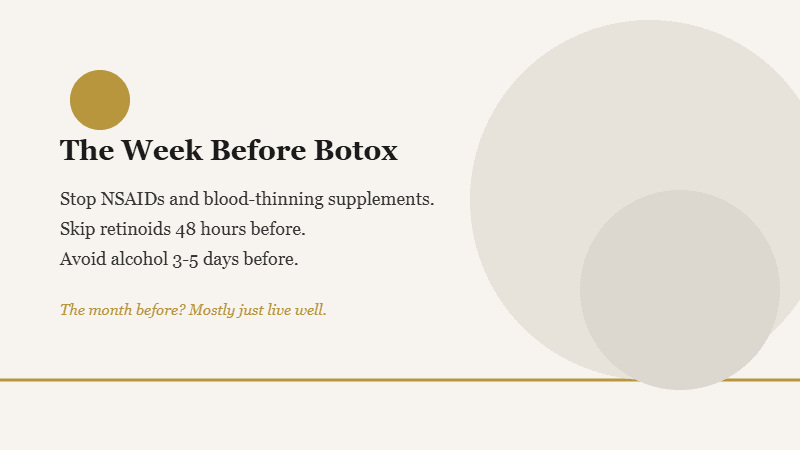
Stop blood-thinning OTC medications. Aspirin, ibuprofen (Advil, Motrin), and naproxen (Aleve) all inhibit platelet aggregation. They increase bruising at injection sites. Standard injector guidance is to stop these 3-7 days before the appointment. If you need pain relief in this window, acetaminophen (Tylenol) is generally acceptable because it doesn’t have the same platelet effect. Confirm with your injector.
Stop blood-thinning supplements. Fish oil, high-dose vitamin E, garlic supplements, ginkgo biloba, and ginseng all appear on most injectors’ pre-appointment stop lists. Stop them a week before. They are the most commonly overlooked items because patients don’t think of supplements as medications. They are pharmacologically active. They have real effects.
Alcohol increases bruising. It is a vasodilator and it thins the blood. Avoiding alcohol for 3-5 days before the appointment is the better version of this instruction. The minimum is 24-48 hours before. Patients who drink heavily the night before a botox appointment consistently report more bruising. This is not coincidence.
What’s Normal
- Some redness or swelling at injection sites for a few hours after treatment
- Small bumps at injection points that resolve within 20-30 minutes
- Minor bruising, especially around the forehead or crow’s feet area
- Botox effects beginning to appear gradually over 3-5 days
When to Call
- Significant swelling or increasing redness beyond the first few hours
- Signs of infection: warmth, pus, fever at injection sites
- Difficulty swallowing or speaking after perioral or neck injections
- Asymmetry at two weeks that seems unexpected given what was injected
Skincare Adjustments in the Final Week
Retinoids, which includes retinol (over the counter) and tretinoin (prescription), do not affect how botox works. Botox is injected into muscle to inhibit acetylcholine release at the neuromuscular junction. What happens at the skin surface doesn’t change that mechanism. The reason injectors ask patients to stop retinoids 1-2 days before the appointment is simpler: retinoids thin the skin barrier slightly and can increase redness and sensitivity at injection sites. A compromised barrier makes the injection experience less comfortable and can slightly increase bruising visibility.
Stop aggressive chemical exfoliants in the week before. AHAs (glycolic, lactic acid), BHAs (salicylic acid), and any chemical peels should be paused for the week before your appointment. They create micro-inflammation and a sensitized barrier that makes bruising more likely.
No waxing, threading, or laser treatments near the treatment area in the week before. These create micro-inflammation in the tissue that can interact with the injection and increase swelling.
| Timeframe Before Botox | What to Do or Stop |
|---|---|
| 30 days out | Stay consistently hydrated; reduce or stop smoking; maintain sleep |
| 1 week out | Stop aspirin, ibuprofen, naproxen; stop fish oil, vitamin E, ginkgo, garlic supplements, ginseng |
| 3-5 days out | Significantly reduce or stop alcohol |
| 1 week out | Stop AHA/BHA exfoliants, chemical peels, waxing, threading, laser near treatment area |
| 48 hours out | Stop retinoids (retinol, tretinoin) |
| Day of | Arrive with clean, makeup-free skin; eat a light meal beforehand; avoid caffeine |
Day of Appointment: The Short List
Arrive with clean, makeup-free skin. Heavy moisturizers, foundation, and active serums all need to be removed before injecting anyway, so save yourself the step at the clinic.
Eat a light meal before you go. Going completely fasted increases the likelihood of lightheadedness during and after the appointment, especially for first-time patients. You don’t need a full meal, just something in your system. Avoiding caffeine on the day is also worth doing: caffeine mildly increases heart rate, which can increase the blood flow that makes bruising more likely at injection sites.
What Skin Prep Doesn’t Do
Here is the honest version that the skin prep content industry would prefer you not read: the “botox prep serum” category is not real. There is no topical product that “primes” your skin for botulinum toxin. Botox works in muscle. It does not care what’s on the surface of your skin. A 30-day routine of expensive serums will not make the toxin diffuse more evenly, help it last longer, or produce a better result.
Hydration matters modestly, as mentioned. But the specific product you use to moisturize before a botox appointment has essentially no effect on the outcome. Save the money.
What does matter: bruising reduction. If you want to prepare your skin specifically for a less visually rough post-botox experience, the most evidence-supported approach is arnica, taken orally in the days before and after the appointment. The arnica for bruising guide covers what the evidence actually supports. For full aftercare post-appointment, see the botox aftercare first 24 hours guide.
The Cold Sore Caveat
If you have a history of oral cold sores (HSV-1) and you are having botox near the lips or perioral area, tell your injector before the appointment. Needle trauma to perioral skin can trigger an HSV-1 outbreak in susceptible patients. This is a recognized phenomenon in aesthetic medicine. Your injector may recommend a brief prophylactic course of antiviral medication before treatment if this is relevant to your history. This does not apply to everyone; it applies specifically to patients with a history of frequent or severe cold sore outbreaks in that area.
For questions about what to expect after the appointment, the companion article on bruising after botox covers the timeline and what actually reduces it.
FAQ
How long before botox should I stop ibuprofen?
Stop ibuprofen, aspirin, and naproxen at least 3-7 days before your appointment. All three inhibit platelet aggregation and increase bruising at injection sites. If you need pain relief in this window, acetaminophen (Tylenol) is the generally accepted alternative, but confirm with your injector. Do not stop any prescription pain medication without talking to the prescribing doctor first.
Can I wear makeup to my botox appointment?
No. Arrive with clean, makeup-free skin. Your injector will need to clean the skin before injecting, so foundation, concealer, and other products need to come off anyway. Heavy moisturizers and active serums should also be skipped on the day of your appointment. Keep your skincare routine minimal on appointment day.
Do I need to do anything special with my skincare routine before botox?
Not special, just restrained. Stop retinoids (retinol, tretinoin) 48 hours before the appointment. Stop AHAs, BHAs, and chemical peels a week before. These don’t affect how botox works, but they sensitize the skin barrier in ways that can increase injection site discomfort and bruising. Your regular cleanser and a basic moisturizer are fine right up to the appointment. Keep it simple.
This article is for educational purposes only and is not a substitute for professional medical advice. Always follow your injector’s or surgeon’s specific aftercare instructions.