

Most people asking about dissolving their lip filler either do not know the option exists, have been told it is risky or extreme, or have quietly googled it at midnight after looking in the mirror and deciding something is wrong. If you are in any of those categories: it is a real procedure, it is widely available, and it works. What it also comes with is a recovery that is often worse in the first week than the original injection, and an outcome that requires patience before it looks normal.
Looking for a quick answer? Jump to the FAQ below.
The short answer
Dissolving lip filler with hyaluronidase is straightforward, fast-acting, and reversible. Most filler dissolves within 24–48 hours of treatment. You can refill after two weeks once swelling has resolved. The decision to dissolve is almost always the right one if you have been unhappy for more than two weeks.
| Timeframe | What to expect |
|---|---|
| Hour 1–4 | Hyaluronidase begins breaking down HA filler, swelling peaks |
| Hour 4–24 | Visible reduction in filler volume, lips may look very deflated |
| Day 1–2 | Most filler dissolved, swelling from the dissolving treatment itself present |
| Day 3–5 | Swelling resolves, baseline lip shape returns |
| Week 1–2 | True baseline visible — assess whether you want to refill |
| Week 2+ | Safe to refill if desired and swelling fully resolved |
What Hyaluronidase Actually Does
Hyaluronidase is an enzyme that breaks down hyaluronic acid. Hyaluronic acid is the base of almost all modern lip fillers, which is why dissolving works on most of them. The enzyme does not discriminate between the filler and your own naturally occurring hyaluronic acid in the tissue, which is why the first week after dissolving often looks more deflated than you might expect. Your lips will typically appear thinner immediately after treatment than they were before you ever had filler. This is not a permanent state. The body produces hyaluronic acid naturally and the tissue rebounds over two to four weeks, but the initial look can be jarring if you are not prepared for it.
The treatment itself is an injection, usually multiple small injections into the areas where filler is present. Mild stinging is common. Swelling after a dissolving treatment tends to be significant, often more pronounced than the swelling from the original filler placement, and bruising can be substantial. This is a real recovery, not a minor procedure.
What to Expect in the First Week
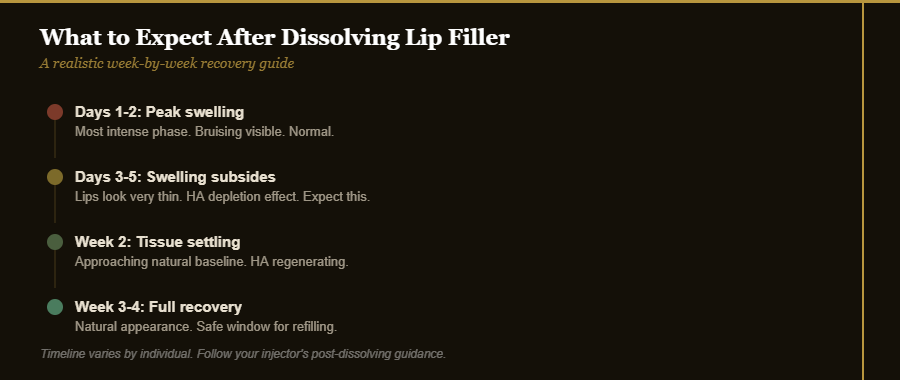
Day one and two are the peak swelling period. Patients consistently describe the first 48 hours as the worst-looking phase: swollen, bruised, and often quite sore. This is normal. It is not a sign that something went wrong.
By day four or five, swelling begins to subside, and you start to see what is actually underneath. This is the phase that surprises most patients: the lips look significantly thinner than pre-filler. For many people, thinner than they remember their natural lips being, even before they started getting filler. This happens partly because of the HA depletion effect described above, and partly because by the time someone dissolves, they have often been getting filler for a while and their natural lip volume has been a background fact rather than something they look at regularly.
Two weeks out, things look different again. The natural HA has begun to regenerate. The tissue has settled. Most patients find at two weeks that their lips look reasonably close to their natural baseline before filler, perhaps slightly thinner or slightly different in shape, but in the normal range. If there are still lumps, asymmetries, or visible irregularities at two weeks, that is worth a follow-up conversation with your injector, not a wait-and-see. For more detail on what the lip filler recovery timeline looks like when you are not dissolving, the 7-day lip filler recovery timeline gives a useful comparison baseline.
This is normal after dissolving
- Significant swelling for 24–48 hours at the injection sites
- Lips looking deflated or uneven immediately after — the filler is dissolving unevenly as it breaks down
- Bruising at the hyaluronidase injection sites
- Lips feeling softer and less defined than before the original filler
Call your injector if
- Swelling is still significant and worsening after 48 hours
- Any signs of allergic reaction: hives, widespread swelling, difficulty breathing — seek emergency care immediately
- A lump or hard area remains completely unchanged at one week
- Cold sore triggered by the treatment — discuss antiviral options
When Dissolving Makes Sense
Migration is one of the clearest cases. If filler has moved beyond the lip border in a way that creates a visible shelf or bump, and it has been there for at least two weeks with no improvement, dissolving is typically the most reliable solution. Waiting it out works for filler irregularities that are new and swelling-related. It does not work for established migration. The filler migration guide goes into more detail on distinguishing the two.
Asymmetry that has not resolved by the two-week mark is another clear case. Asymmetry in the first two weeks is often swelling. Asymmetry at four weeks that was not present before is a different question. If a touch-up cannot address it, dissolving and restarting can give a cleaner result than trying to balance on top of existing placement.
Overfilling, or result that simply does not match what was wanted even after swelling resolves, is a valid reason. Genuine regret, where the result looks correct but you simply do not want filler anymore, is also a valid reason. Neither requires justification. What is not necessarily a reason to dissolve is panic at day three when everything is swollen and bruised. That is a normal recovery, not a result.
If there are lumps that have persisted past two weeks and are bothering you, the lumps after lip filler guide covers what distinguishes a massage-addressable lump from one that warrants dissolving.
What Dissolving Does Not Fix
Hyaluronidase only works on hyaluronic acid filler. If you have received permanent filler, poly-L-lactic acid, calcium hydroxylapatite, or any non-HA product, dissolving will not remove it. These products require different management strategies, and the conversation is best had directly with an experienced injector who can examine the area. This distinction matters, because some patients assume all filler can be dissolved and are surprised to discover otherwise. If you are not certain what product you received, your injector should have records.
How Soon You Can Refill After Dissolving
The general guidance is two to four weeks minimum before placing new filler. This reset period is also a good time to read about what repeated lip filler does to the tissue over time, so you can make a more informed decision about volume and frequency going forward. The reasoning is practical: the hyaluronidase enzyme remains somewhat active in the tissue for a period after treatment, and placing new HA filler too quickly risks partial dissolution of the new product. Two weeks is a common minimum; many injectors prefer four weeks to be confident the enzyme is fully inactive.
This is a conversation to have with your specific injector, not a number to apply universally. They will also be better positioned to assess what your lips actually look like at the two-week point and whether the tissue is ready. Do not book a refill before you have had the dissolving follow-up.
For bruising management
Topical arnica is the standard first line for procedure bruising. Boiron Arnicare gel is the one we recommend; apply around the area, never on broken skin.
The Practical Questions: Cost, Injector Choice, What to Expect
Dissolving is not free. It is a separate procedure with a separate fee, and the range varies significantly by clinic. Some practices include a dissolving session free of charge if they placed the filler and the result was unsatisfactory. Others charge their standard injection fee. In most markets, you are looking at anywhere from $100 to $400 or more. It is worth confirming the fee before booking, and worth clarifying the follow-up policy at that price.
Injector choice matters here as much as anywhere in aesthetics, possibly more. Dissolving requires both technical skill in placing the hyaluronidase accurately and clinical judgment in assessing how much to use and where. An injector who rushes the assessment or applies product aggressively can over-dissolve and produce a result that looks worse than expected at two weeks. Look for someone who discusses the process thoroughly, gives you a realistic picture of the initial recovery, and offers a follow-up appointment included in the process.
Frequently Asked Questions
Does dissolving lip filler hurt more than getting filler?
Many patients describe the dissolving injection as stinging more than a filler placement, partly because the enzyme itself has a mild irritant quality and partly because it is often delivered in multiple small injections across the area. Topical numbing can be applied beforehand and helps. The post-procedure soreness and swelling tends to be more pronounced than post-filler for most patients.
Will my lips go back to exactly how they were before filler?
Not necessarily identically. Most patients find their lips return close to natural baseline by two to four weeks, but the appearance can vary based on how long filler was in place, how much was used over time, and individual tissue response. In some patients who have had significant filler for a long time, there can be a period of the lips looking slightly different from pre-filler normal before fully settling. This typically resolves within a month.
Is it safe to dissolve lip filler?
Yes, hyaluronidase is a well-established treatment used in aesthetics and also in medical settings for other purposes. As with any injection, there are risks including bruising, swelling, and in rare cases, allergic reaction. Injector skill matters. Having the procedure performed by a qualified, experienced practitioner in a clinical setting rather than a discount pop-up significantly reduces procedural risk.
Not all fillers can be dissolved. Calcium hydroxylapatite fillers like Radiesse do not respond to hyaluronidase, which makes the pre-treatment decision more consequential. The Radiesse aftercare guide covers this distinction in detail for patients comparing filler options.
This article is for educational purposes only and is not a substitute for professional medical advice. Always follow your injector’s or surgeon’s specific aftercare instructions.