
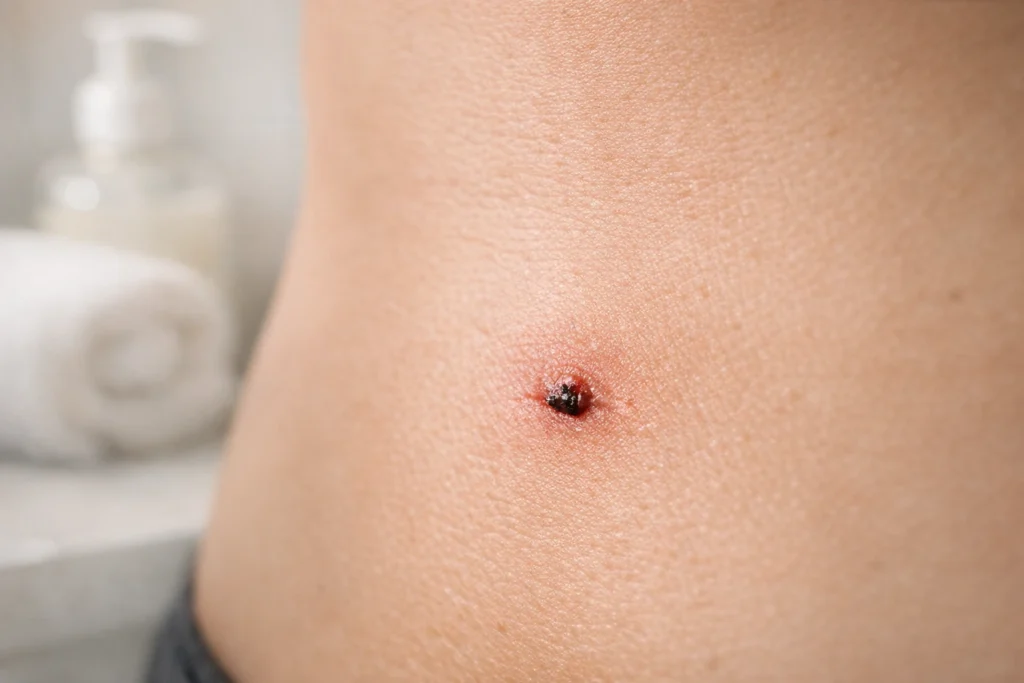
Your surgeon made those incisions small on purpose. Three to five millimeters, sometimes less, hidden in natural creases or contours where the body folds. At the consultation, the word “scarring” probably came up briefly and then moved along. What nobody mentioned is that small and invisible are not the same thing, and the gap between a faint dot at one year and a dark raised mark at one year is decided almost entirely by what happens in the first three months.
What Lipo Incisions Actually Look Like
Surgeons place lipo incisions strategically. On the abdomen, they favor the navel, the natural crease just above the pubic line, or the hip fold. On the thighs, inner thigh folds or the gluteal crease. On the back and flanks, the bra line or lateral hip. The goal is always to tuck the entry point somewhere that clothing or natural shadow will cover it.
Fresh, they look like a small puncture with a dark crust. Closed, around two to three weeks post-op, they look like a small pink or red dot. At month three, they are typically a pink or tan flat mark. At one year, they should be a faint pale dot that you could miss if you did not know where to look. That last outcome is not automatic. It requires two things: keeping the area out of direct sun for the first year, and starting silicone treatment on fully closed skin at the right time.
The Do-Nothing Phase Comes First
Until an incision is fully closed, you are not in scar care territory. You are in wound care territory, and the two are completely different. The first step is keeping the area clean, dry, and covered as directed by your surgeon — for the full guidance on how to safely wash your surgical sites, see showering after lipo. Scar products applied to open or incompletely closed skin can introduce bacteria, cause irritation, or trap moisture in ways that impair healing. Leave it alone.
Full closure typically happens within a few weeks for most patients, though the timeline varies with the size of the incision, how consistently the compression garment stays in place, and individual healing variation. One practical note: the edge of your faja or garment band sits right on or near some of these incision sites, particularly at the hip and lower back. Garment edges that rub repeatedly on a fresh incision slow closure and can cause hyperpigmentation. Getting the right faja fit matters for your incisions as much as it does for your compression results. Your surgeon will tell you when scar treatment can begin; follow that instruction rather than a general timeline.
Silicone Sheets vs. Silicone Gel: The Honest Comparison
Silicone is the established answer for scar management. Not the exotic, the expensive, the peptide-infused, or the “advanced formula” version. Silicone. The mechanism is hydration of the stratum corneum, which signals the body to reduce excess collagen production in the healing scar. It works because of consistent application over time, not because of any active ingredient stacked on top of it.
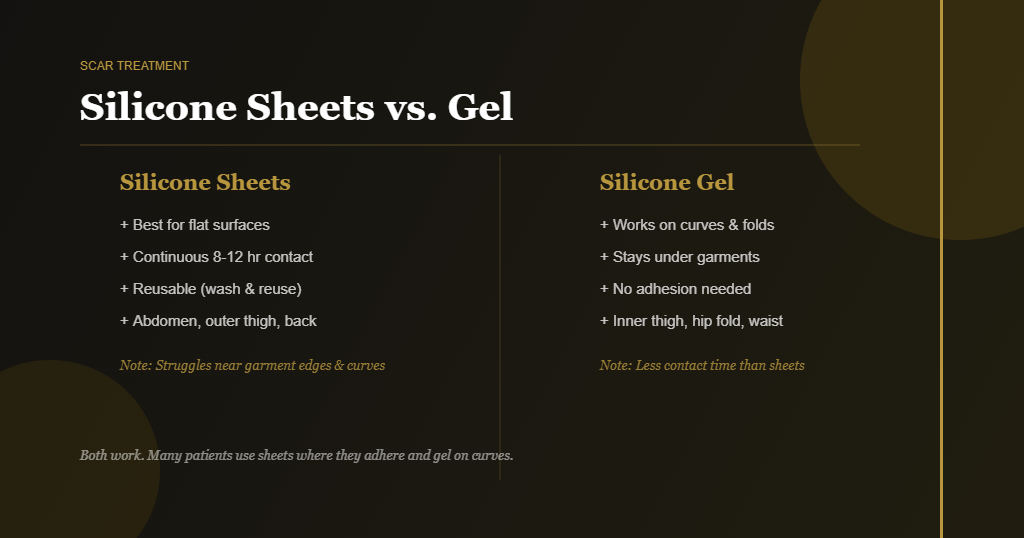
Sheets versus gel is a real question with a practical answer. Silicone sheets adhere to the skin and maintain continuous contact for hours at a time, which is what makes them effective. On flat or gently curved areas like the lower abdomen or outer thigh, sheets stay in place and are the superior option. Near garment edges, waistbands, or curved areas like the inner thigh or hip fold, sheets bunch, peel, and fail to maintain contact. Gel wins in those locations because it conforms to the surface and does not slide off. Some patients use sheets where they can hold and gel everywhere else.
Recommended: Silicone Scar Sheets
Silicone sheeting is the one scar product category with real evidence behind it. ScarAway’s sheets are the widely-stocked version; start them only once the incision is fully closed.
Sun Exposure Is the One You Cannot Take Back
This is the non-negotiable. A healing scar exposed to UV light will hyperpigment. The melanocytes in recovering tissue are hyperactive, responding to any stimulus with increased pigment production. Sun hitting a scar in months one through six can turn what would have been a faint mark into a dark brown spot that takes years to fade, if it fades completely.
Most lipo incisions are under clothing, so the daily wardrobe provides passive protection. The ones that need active management are hip incisions that may sit at a bikini line, lower flank incisions near swimwear edges, and any treated area exposed during exercise. SPF 50 physical sunscreen, applied daily to any incision that might see sun, for the first twelve months. Not “when you remember.” Daily.
What Deeper Skin Tones Need to Know
Post-inflammatory hyperpigmentation is more common and more pronounced in Fitzpatrick types IV through VI. The same incision that fades to near-invisible in lighter skin may leave a lasting dark mark in darker skin if sun protection and silicone use are delayed or inconsistent. This is not a reason to avoid lipo, and it is not a condemnation of the outcome. It is a reason to start the playbook earlier and run it more diligently.
Patients consistently report that nobody warned them about this specifically before surgery, which is one of the more frustrating gaps in pre-op counseling. The protocol is the same: silicone on fully closed skin, SPF daily, no picking or friction on healing sites. The timeline for diligence is simply longer and the stakes for skipping steps are higher.
One more honest note: the “exotic stuff” category of scar products, things that layer in retinol, plant extracts, peptides, or brightening agents on top of a silicone base, is largely marketing stacked on top of the silicone that is doing the actual work. The add-ons will not hurt, and they will not help much either. Fragrance-free, consistent, and correctly timed wins over expensive and sporadic every time.
When a Scar Needs a Professional Conversation
Flat scars that are hyperpigmented but not raised respond well to the silicone plus sun protection protocol over time. Raised, firm, itchy scars that continue to grow beyond the original incision edge are a different situation. Hypertrophic scars stay within the incision boundary and often respond to consistent silicone and steroid injections from your provider. Keloids extend beyond it and require professional intervention.
If your incision site feels firm, raised, or is actively itching at the two-to-three-month mark rather than calming down, that is the moment to mention it at your follow-up. Not to panic, but to open the conversation before a watchful-wait window closes. Your surgeon can tell within a few seconds whether the texture they are seeing is normal remodeling or something that benefits from early treatment. Everything in this article is part of the recovery picture worth planning for before surgery, not just after.
Chin liposuction incisions are at the minimal end of the lipo scar spectrum: approximately 3mm, placed in natural creases, and they typically heal to near-invisibility. The same sun protection principles apply. Full detail on chin liposuction recovery, including the scar timeline, is covered in the chin lipo guide.
FAQ
When can I start using scar products on my lipo incisions?
Only after full closure, which means the skin surface has healed over completely with no scabbing or open areas remaining. Your surgeon should confirm this at a follow-up visit before you begin scar treatment. Starting earlier than that risks trapping bacteria under the product and slowing the healing you are trying to protect.
Are lipo scars permanent?
Technically, yes: any scar represents a change in skin texture and is permanent at the tissue level. Practically, well-managed lipo incisions fade to a degree that most patients find them invisible or undetectable. The difference between a significant mark and a nearly invisible one is mostly how the first year of aftercare goes, not the incision size or technique itself.
Does massaging lipo scars help?
Once the incision is fully mature, meaning closed, flat, and no longer tender to touch (typically two to three months post-op), gentle scar massage can help soften the underlying tissue and improve texture. If you’ve also noticed firm lumps or irregularities beneath the skin nearby, see the guide on managing hard lumps and fibrosis after liposuction — these are a separate issue from the surface scar. During active healing, though, rubbing a fresh incision site creates friction that can trigger more pigmentation and slow closure. Timing matters more than the technique itself.
This article is for educational purposes only and is not a substitute for professional medical advice. Always follow your injector’s or surgeon’s specific aftercare instructions.