
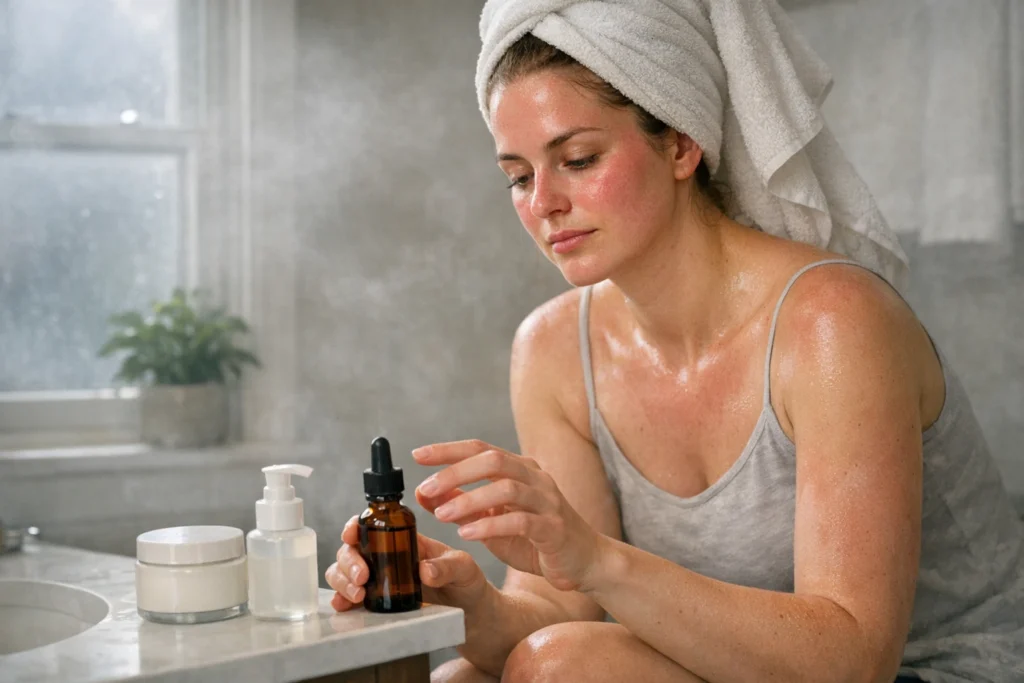
You are home. Your face is red, warm to the touch, and feels like mild sunburn spread evenly across the skin. You grabbed the aftercare sheet from the clinic on the way out, and it says: avoid sun, avoid makeup. That is it. What it does not say is why, which means you are already wondering whether your usual vitamin C serum tonight would be fine, just this once.
It would not be fine. And the reason matters more than the rule. Microneedling aftercare in the first 24 hours is not arbitrary, and understanding what is actually happening in your skin right now is the best reason to follow it precisely.
Looking for a quick answer? Jump to the FAQ below.
The short answer
For the first 6-8 hours: touch nothing except what your provider applied. After that: gentle moisturiser only. No actives (retinol, vitamin C, acids) for 72 hours. SPF the next morning, no exceptions. No exercise or heat for 24-48 hours.
What Is Actually Happening to Your Skin Right Now
Microneedling creates thousands of micro-injuries across the treatment area. Each needle puncture triggers an acute inflammatory healing response: your body sends growth factors, immune cells, and collagen-building fibroblasts to the site. This is the mechanism behind the treatment’s benefits, and it is also why the first hours are the most critical to manage well.
The micro-channels created by the needles remain open and highly permeable for approximately 6-8 hours after treatment. During this window, the skin absorbs topical ingredients at significantly higher rates than normal. This cuts both ways. Anything beneficial absorbs more effectively. Anything harmful absorbs more deeply and causes more damage than it would on intact skin.
Collagen remodeling following microneedling continues for four to six weeks after treatment. What you do in the next 24 hours does not determine that long-term outcome directly, but it does determine how cleanly the initial healing phase proceeds, and a clean initial phase gives the remodeling process the best environment to work in.
The First 6-8 Hours: Touch Nothing You Did Not Get at the Clinic
For the first 6-8 hours, the rule is simple. Whatever your provider applied immediately after treatment, whether a soothing serum, a growth factor product, or a barrier-support formula, leave it on. Do not add anything to it. Do not wash your face. Do not touch the skin unnecessarily.
The enhanced absorption window makes this more important than it sounds. Retinol, vitamin C, AHAs, BHAs, fragranced products, and niacinamide at high concentrations should all be avoided for the first 72 hours after treatment. In the first 6-8 hours, the risk of applying any of these is amplified by the permeability of the micro-channels. Patients who have the worst post-microneedling breakouts or irritation responses are almost always the ones who applied their usual routine the same evening because no one told them not to. The product absorbs into healing channels and causes irritation that looks like purging but is not.
After 6-8 hours, a gentle, fragrance-free moisturiser is appropriate. Once you are past the 24-hour mark, a hyaluronic acid serum is safe and beneficial for supporting the skin barrier through the healing phase. Ingredients like copper peptides, which are specifically supported for post-microneedling use, can be introduced once the skin has calmed, typically from day two or three depending on reactivity.

SPF: The One Thing That Cannot Wait Until Tomorrow
Compromised skin after microneedling is significantly more vulnerable to UV damage and post-inflammatory hyperpigmentation. The micro-channels are closed by the next morning, but the skin barrier remains in a disrupted state for several days. UV exposure over healing skin is one of the most reliable ways to convert normal post-treatment redness into lasting pigmentation changes.
SPF 30 or higher from the morning after treatment, reapplied throughout the day. Mineral SPF formulas using zinc oxide or titanium dioxide are preferred over chemical sunscreens in the first few days. The difference matters: chemical SPF absorbs into the skin to function, which means it is interacting with compromised channels during recovery. Mineral SPF sits on the skin surface and reflects UV physically, without requiring absorption to work.
If you have bruising, which is an uncommon but possible response to microneedling depending on needle depth and treatment area, arnica for bruising can support the resolution process during recovery alongside your SPF and moisturiser routine.
Heat, Sweat, and Exercise: The 24-48 Hour Restriction
No strenuous exercise for 24 to 48 hours, sometimes extended to 72 hours depending on treatment intensity. Sweat contains bacteria and other compounds that can irritate open micro-channels. Beyond the bacterial concern, exercise raises core body temperature and increases blood flow to the skin surface, which amplifies inflammation beyond the therapeutically useful level.
Heat applies more broadly than exercise. Saunas, steam rooms, hot showers, and hot yoga all raise skin surface temperature in ways that extend the inflammatory phase rather than supporting a clean resolution. Lukewarm water only when washing the face or showering. This is the instruction that most patients dismiss as excessive, and it is one of the ones that has a clear mechanistic reason behind it.
Swimming deserves a separate mention. Pool chemicals over healing micro-channels are a meaningful infection risk. Chlorine, in particular, is harsh enough on intact skin. Over freshly treated skin with open or recently closed micro-channels, it is not worth the risk within the first week. Open water introduces its own set of bacterial concerns.
Makeup, Pillowcases, and the Things Nobody Mentions
Skip makeup for the first 24-72 hours at minimum. Foundations, concealers, and setting powders introduce ingredients, bacteria, and application friction onto skin that is in an active healing state. If coverage is genuinely necessary, a tinted mineral SPF is the safest bridge: it provides some coverage and sun protection simultaneously, without the heavier ingredient load of a full foundation formula.
For the full breakdown of timing by treatment depth and formula type, see the guide to when makeup can safely return after microneedling.
If you do apply anything to the face, it should be with clean hands, not a brush or sponge. Brushes and sponges transfer bacteria even when they have been recently washed. Clean fingers with freshly washed hands are the lowest-friction application method in the first 48 hours.
Pillowcases. Change it before bed on the day of treatment. A pillowcase accumulates bacteria, oil, skincare residue, and environmental particulates across multiple nights of use, and the face is pressed against it for hours while healing. This costs nothing and matters more than most of the products people spend money on for post-treatment care. Sleeping on your back where possible reduces the duration of direct fabric contact with the treated skin. When resuming retinol is the right question to ask next, the guidance on retinol after cosmetic procedures covers that decision across treatment types.
This is normal
Redness and warmth for 12-24 hours after treatment. A tight, dry feeling as the skin repairs itself. Mild swelling, particularly around the eyes in the first 24 hours. Small pinpoint marks where the needles penetrated, visible for 24-48 hours. Skin that looks slightly bronzed or uneven in tone on days 2-3 as the micro-injuries resolve. Surface redness typically resolves within 2-3 days.
Call your provider if
Redness that is spreading and getting worse after 48 hours rather than improving. Blistering or open skin that was not present immediately after treatment. Signs of infection: increasing heat, swelling, or any discharge at treated areas. Fever following treatment at any point. These are not expected responses and warrant prompt contact with your provider.
If you are on prescription tretinoin, the stop window for microneedling is 5 to 7 days before the procedure, with resumption at 3 to 5 days after once the microchannels have closed. The full procedure-by-procedure stop and restart guide is at tretinoin after cosmetic procedures.
Frequently Asked Questions
Can I wash my face the night of my microneedling treatment?
Generally, no. The standard guidance is to leave the skin untouched for at least 6-8 hours after treatment, covering the micro-channel open window. If your provider applied a post-treatment product, it should remain on the skin during this period. After 6-8 hours, a very gentle rinse with lukewarm water is typically acceptable. Ask your specific provider what they recommend, as protocols vary by treatment depth and the products used.
When can I use retinol again after microneedling?
The standard recommendation is to avoid retinol for at least 72 hours after microneedling. Many providers extend this to five to seven days for deeper treatments. When resuming, start with a lower concentration than your usual dose and monitor for reactivity. The skin is still in a repair phase for two to three weeks after treatment, and retinol is a potent active that can overstimulate a skin barrier that has not fully restabilised.
Is the redness normal and how long does it last?
Yes, redness is a normal and expected response. Microneedling creates a deliberate inflammatory response, and redness is part of that process. Surface redness typically resolves within two to three days for most patients. Deeper treatments or more sensitive skin types may see redness persist slightly longer. If redness is spreading, worsening after 48 hours, or accompanied by increasing pain or warmth rather than improving, contact your provider, as these are not typical patterns.
For a full picture of what to expect in the days that follow, the day-by-day microneedling recovery guide covers each phase in detail.
Understanding the difference between skin purging vs a true reaction after microneedling helps clarify why the first 24 hours matter so much for what you apply.
Once you are past the first 24 hours and skin is settling, niacinamide is one of the first actives that can safely return to your routine as skin repairs.
If your provider has recommended RF microneedling or you are considering deeper treatments, see the Morpheus8 recovery guide for a full day-by-day breakdown of what RF microneedling recovery looks like compared to standard microneedling.
For patients who have had microneedling, CO2 laser creates a significantly more intense version of the same wound-healing process, with a recovery period that requires considerably more preparation and aftercare.
The mineral SPF requirement after microneedling is covered in detail in the guide on SPF after cosmetic procedures, which explains why chemical sunscreens specifically should be avoided during the healing window.
PRP is one of the most common add-ons to microneedling sessions, and when it is part of your treatment, the aftercare overlaps but with some additional considerations specific to the platelet-rich plasma. The PRP aftercare guide covers the specific 48-hour restrictions, the shedding phase that catches hair PRP patients off guard, and why the “no downtime” description is technically true but practically misleading.
This article is for educational purposes only and is not a substitute for professional medical advice. Always follow your injector’s or surgeon’s specific aftercare instructions.