

Your surgeon said two weeks. Your boss is expecting you back in ten days. And somewhere in between those two numbers, you are trying to figure out whether you are being responsible or just anxious. The honest answer is that “two weeks” is a reasonable estimate for one type of job, a comfortable cushion for another, and dangerously optimistic for a third. The variable that actually matters is not the calendar. It is what your body will be doing for eight hours straight.
The Two Variables That Actually Decide Your Return Date
Most return-to-work timelines after liposuction collapse two separate questions into one number. The first question is your swelling response: how dramatically does your body react, and how long does that reaction last? The second is your job’s physical demand. These two variables interact. A mild sweller with a physically intense job might return at the same time as a significant sweller with a desk job. A significant sweller who stands all day should probably not be back at three weeks regardless of what any general guideline says.
Neither of these variables is fully predictable before surgery. Swelling response has a genetic component, a hydration component, and a correlation with how extensive the lipo was and how many areas were treated. Physical demand is something only you know accurately, not your surgeon, who has never watched you teach a classroom of thirty kids for six hours or lifted a patient in a hospital corridor. Be honest with your surgeon about what your job actually looks like. A vague “I’m on my feet sometimes” is not enough information to work with.
Desk Work and Remote Roles: The 1-2 Week Reality
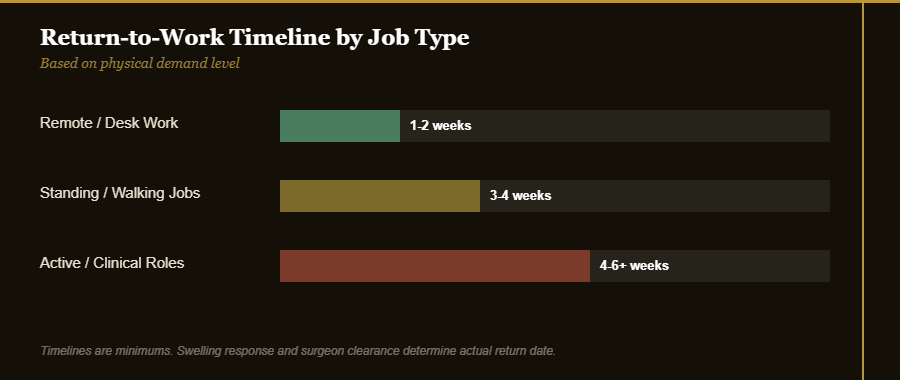
If you sit at a desk or work from home, the two-week guideline is reasonable and most patients manage it. What people consistently underestimate is the fatigue. Surgical fatigue is not the same as being tired. It is a heavy, bone-deep exhaustion that does not respond to coffee and tends to peak around days three through five before slowly lifting. Many patients feel almost normal by day eight and genuinely fine by day twelve. But “almost normal” and “fine to run a full workday” are not identical.
You will be wearing your faja for 23 hours a day, which means wearing it at work. More on that below. You will also be sitting for extended periods while your tissue is still in the early phase of inflammation, which can cause localized swelling to pool. Getting up every 45 to 60 minutes is not optional. If your desk job does not allow for that, factor it in.
Remote workers have an advantage: you can lie down during a call if you need to, and nobody knows you are managing compression logistics between meetings — including keeping abdominal boards or lipo foam properly positioned under your garment throughout the day.
Standing and Walking Jobs: The Swelling Feedback Loop
Teachers, retail workers, restaurant staff, hair stylists, and anyone whose job requires being on their feet for more than a couple of hours need a genuinely different calculation. Upright posture and prolonged standing accelerate lymphatic load on the treated areas. Swelling increases. The tissue that is supposed to be settling is being asked to manage gravity on top of a fresh inflammatory response.
The honest minimum for most standing-heavy jobs is three to four weeks, and even then, the real test is how you feel at the end of the first day back. This is the clearest signal the body gives: if swelling is noticeably more pronounced by the time you get home than it was in the morning, that is not normal fatigue. That is your body telling you it was not ready. Take a rest day. Try again.
Compression is doing more work in these jobs than it does at a desk. A well-fitted stage 1 faja through the first four to six weeks is non-negotiable for patients in physically active roles. Understand what you are buying before you buy it.
A stage 1 faja is the garment you wake up in and live in for the early weeks. The Snatched Body stage 1 faja is the one we recommend; our sizing guide covers how it should fit.
The Driving Question (It Is Separate from the Return-to-Work Question)
Patients consistently conflate two different clearances: the clearance to drive and the clearance to work. They are not the same. Most surgeons clear patients to drive when they are off all narcotic pain medication and can perform an emergency stop without hesitation, which commonly lands somewhere around days five to ten depending on the person and the procedure. Being cleared to drive does not mean you are cleared to work a full shift. It means you can operate a vehicle safely.
If your commute requires 45 minutes of sitting in a car, that counts as physical load on your recovery, not neutral time. Factor the drive into your energy budget for the day, especially in the first two weeks.
Physical Labor, Lifting, and Clinical Roles
Nurses, physical therapists, construction workers, movers, warehouse staff, trainers: this section is for you, and the answer is a real conversation with your surgeon, not a general guideline. Lifting anything above 10 to 15 pounds in the first four to six weeks puts mechanical stress on tissue that is actively remodeling. The lipo results you paid for are being shaped during this period. This is not the moment to rush.
Nursing in particular involves unpredictable physical demand: patient transfers, rapid movement in emergencies, extended standing. Four to six weeks minimum is a reasonable starting expectation for most nursing roles, and some surgeons advise six to eight weeks before unrestricted clinical work. Get the specific clearance in writing if your HR department requires documentation. Returning too early in a physically demanding clinical role is also a liability question, not just a recovery one.
For context on what your body can handle at different recovery milestones, the exercise timeline after liposuction maps the same tissue remodeling logic to physical activity, which is directly relevant to physical job demands.
The Faja at Work: The Practical Reality Nobody Discusses
Your surgeon says 23 hours a day. That is not 23 hours when convenient. That means wearing compression at your desk, at your standing station, on your commute, during your shift. Most patients have not thought through what this means practically until they are three days post-op and trying to figure out which of their work clothes fits over a stage 1 garment.
Stage 1 fajas are thick, structured, and often boned or zippered. They are not designed to be invisible under a fitted blouse. Looser trousers, flowy tops, scrubs, or dresses with some structure work better. The bathroom logistics are real: stage 1 garments with hooks and eyes or zippers take longer to manage than a bra. Add five minutes to every bathroom break. In a busy shift, that adds up.
Heat is the other issue. Compression garments trap body heat, and many patients report feeling significantly warmer than usual, especially in the first two weeks. Climate-controlled environments help. High-heat workplaces (kitchens, outdoor work) add another layer of difficulty to early return.
The transition to a stage 2 faja, which is lighter and easier to manage under clothing, typically happens between weeks three and six depending on your surgeon’s protocol. Understanding that timing in detail makes the work wardrobe question much more manageable. The faja stage guide covers exactly when and how to make that switch, including sizing for both stages.
When your surgeon clears you for stage 2, the Sonryse stage 2 faja is our pick. Size from current measurements, not pre-surgery ones.
The Sign You Went Back Too Early
End-of-day swelling is the feedback signal. Some increase is normal. Noticeable, uncomfortable, visually obvious swelling that is significantly worse than your morning baseline means you did too much. This is not a character flaw or a failure of planning. It is just data. Rest the next day completely. If it happens again on your second attempt, you need more time before returning.
Patients who push through this signal often extend their overall recovery timeline rather than shortening it. The tissue responds to overload by staying inflamed longer. Respect the signal and you will almost always recover faster than if you ignore it. For detailed context on how long compression actually needs to stay in rotation, the guide on how long to wear a faja after lipo explains why the weeks that feel optional usually are not.
Frequently Asked Questions
Can I work from home the first week after liposuction?
For many patients, yes, but light remote work only. Think a few hours of low-demand tasks, not a full day of meetings and problem-solving. Surgical fatigue in the first week is real and significant. Most patients find they can work a partial remote day by days five to seven, and close to a full day by days ten to twelve. Listen to the energy dip rather than the clock.
My surgeon said two weeks but my job is physically demanding. What do I do?
Go back to your surgeon and describe your job in specific physical terms: how much you lift, how long you stand, whether you are doing patient transfers, whether the environment is high-heat. “Two weeks” may have been given without that context. A follow-up conversation with accurate job information will get you a more accurate clearance. Do not assume the number accounts for details your surgeon did not know.
Is it safe to wear my faja all day at work?
Yes, that is the expectation. The 23-hour guideline applies to work hours. The practical challenge is clothing fit, bathroom logistics, and heat management, not safety. If the garment feels like it is cutting off circulation, creating sharp pressure on a specific point, or causing numbness, that is worth flagging with your surgeon. General discomfort from compression is normal. Sharp localized pressure is not.
This article is for educational purposes only and is not a substitute for professional medical advice. Always follow your injector’s or surgeon’s specific aftercare instructions.