
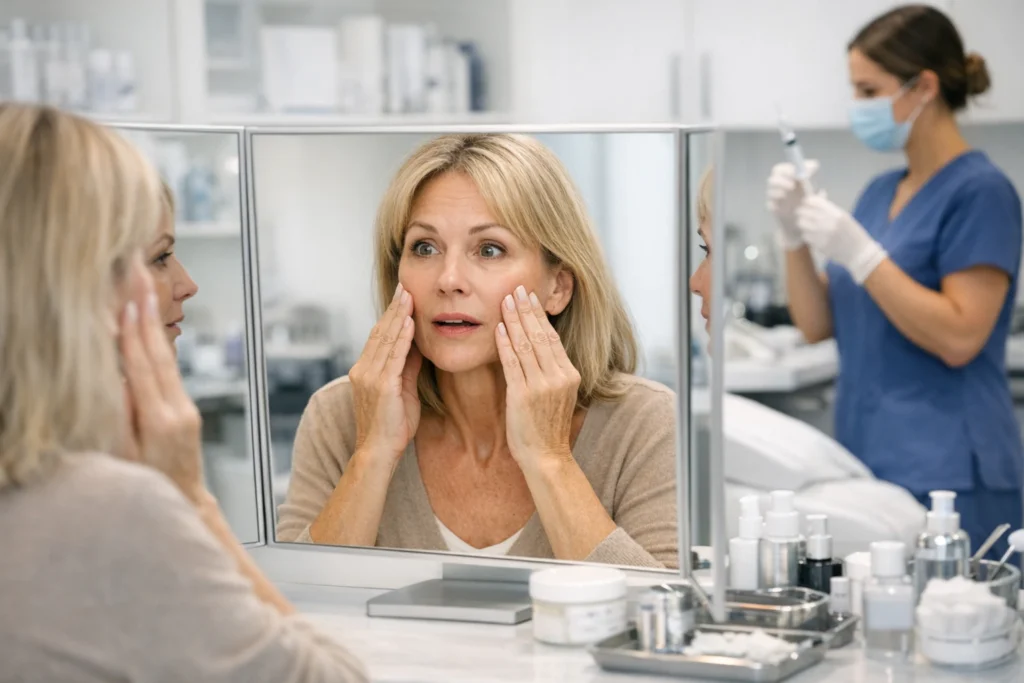
You catch your reflection in a different mirror than usual, maybe a dressing room three-way, and for a second you don’t recognize the hollows under your cheekbones. Forty pounds down and thrilled about it, except your face got the memo before anywhere else on your body did. Type “ozempic face treatment” into a search bar and you’ll find dozens of clinics and skincare brands all claiming to have the fix. Most of them are selling you half an answer.
If you want the short version of what actually helps and what to skip, jump down to the FAQ.
The most effective treatments depend on which problem you actually have: lost volume or loose skin. Filler, Sculptra, and fat transfer restore volume. Radiofrequency, microneedling, and ultrasound tighten skin laxity. Topicals and supplements can support the skin around either treatment, but they won’t reverse hollowing or sagging by themselves.
| Treatment | What It Addresses | The Honest Verdict |
|---|---|---|
| HA fillers | Volume loss (missing facial fat) | Direct, reversible correction; does the real work if hollow cheeks and temples are the main complaint |
| Sculptra and biostimulators | Volume loss, by triggering the skin’s own collagen rather than filling space directly | A mainstream, widely performed option, not a fringe treatment |
| Fat transfer | Volume loss, using the patient’s own fat | Can last longer than filler, but involves a separate donor-site procedure |
| RF and energy-based tightening | Skin laxity, not volume | Helps skin sit better against existing volume; cannot fill a hollow cheek |
| Topicals (retinoids, peptides, HA, SPF) | Skin quality and texture, not structural volume or laxity | Maintenance around the real correction, not a stand-in for it |
What “Ozempic Face” Really Is
Ozempic face isn’t a medical diagnosis. It’s a shorthand for what happens when someone loses fat quickly, whether the cause is a GLP-1 medication, another fast weight-loss method, or illness: the face often shows it before the rest of the body does. Facial fat sits in fairly shallow pads, and those pads shrink along with everything else. Once they shrink, the skin that was stretched over them has to catch up, and it doesn’t always manage that gracefully.
The result is two separate problems wearing one nickname. Sunken cheeks and temples come from volume loss. Fine lines, jawline sagging, and a general crepey texture come from skin laxity. They often show up together, but they don’t share a cause, and that distinction matters more than any product description will tell you.
None of this makes ozempic face a health risk on its own. It’s cosmetic. That said, any facial change that feels sudden, severe, or paired with other symptoms is worth mentioning to your prescriber rather than diagnosing yourself in a mirror.
How We Ranked Every Ozempic Face Treatment
We ranked these by one question: how directly does this address the actual mechanism, volume loss or skin laxity, rather than how often it shows up in a sponsored post. A McKinsey survey of aesthetics providers found that 63 percent of GLP-1 patients seeking aesthetic treatment were entirely new to aesthetics, people who had never sat in an injector’s chair before the weight loss. That’s a lot of first-time patients making decisions in unfamiliar territory, which is exactly why an honest ranking matters here.
Tier One: Restoring Volume
Dermal filler, Sculptra, and fat transfer sit at the top because they address the part of ozempic face that skincare cannot touch: missing fat. Filler adds volume immediately and is reversible. Sculptra works differently. It’s a collagen biostimulator, meaning it triggers your own skin to build collagen gradually rather than filling space directly, so results build over months instead of appearing the same day. Per the American Society of Plastic Surgeons’ 2024 Plastic Surgery Statistics Report, non-hyaluronic-acid fillers such as Sculptra and Radiesse accounted for roughly 932,000 procedures in 2024, up 1 percent year over year, so this is a mainstream, widely performed option rather than a fringe one. If you’re considering it, our Sculptra aftercare guide covers what that recovery actually looks like. Fat transfer moves a patient’s own fat from elsewhere in the body into the face, which can last longer than filler but involves a separate donor-site procedure. If hollow cheeks and temples are your main complaint, this tier does the actual work.
Tier Two: Tightening Skin Laxity
Radiofrequency, radiofrequency microneedling, and ultrasound treatments target the skin itself rather than the space underneath it, which is exactly the job when laxity, not volume, is the main complaint. These tools heat or stimulate the deeper skin layers to encourage new collagen and tighten existing tissue. A small number of clinical reports now describe using targeted radiofrequency specifically for ozempic-face laxity, which suggests device makers are starting to design around this exact complaint instead of treating it as generic anti-aging work. None of this fills a hollow cheek. It helps skin that has lost elasticity sit better against whatever volume is still there, including volume you’ve added with filler or Sculptra.
Tier Three: Topicals and Supplements
Retinoids, peptides, collagen supplements, and daily SPF land last, not because they’re useless, but because they support skin health rather than correct structural loss. Good skincare improves texture and helps protect whatever collagen you have left. It can’t replace fat that isn’t there anymore, and it can’t tighten skin the way an energy-based device can. Treat this tier as maintenance around the real correction, not a stand-in for it.
Why Reversal Is Rarely Complete
Set the expectation early: when weight loss has been large and fast, full reversal of ozempic face is genuinely difficult. How much elasticity comes back on its own depends on age, sun damage, and genetics, and none of those are things a serum can override. Slower, more gradual weight loss tends to give skin more time to adjust, which is one more reason this is worth discussing with whoever is managing your treatment plan, not just your aesthetician.
Timing Treatment Around Your Weight
One detail most of these rankings skip: how long a volume treatment lasts depends partly on whether your weight is still moving. Filler and fat transfer sit in tissue that’s still changing if you’re still losing, which can shift how a result looks over time. That’s a reason to think about timing, not a reason to avoid treatment altogether. It’s worth raising with both your injector and your prescriber before you book anything expensive. The skin laxity that shows up alongside GLP-1 weight loss tends to follow the same rule: bigger, faster loss generally means more visible laxity, and treatment planned around a stable weight tends to hold up better.
Normal Facial Changes vs. When to Call Your Prescriber
Most facial change during GLP-1 treatment is expected. Some of it isn’t. Here’s the difference.
Normal
Gradual facial slimming as you lose weight. Manageable early nausea that eases as your body adjusts. Some temporary hair shedding. Mild dryness or fine lines that respond to good skincare. Cheeks and temples looking less full than they used to.
Call Your Prescriber
Facial swelling, redness, or pain that comes on suddenly. Severe abdominal pain, which can signal pancreatitis or gallbladder problems. Signs of severe dehydration, including dizziness or very dark urine. Any new vision changes. Facial asymmetry or changes that feel dramatic rather than gradual.
Frequently Asked Questions
Will filler or Sculptra stop working if I keep losing weight?
Not exactly stop, but continued weight loss can change how a result looks over time since the tissue underneath is still shifting. Many injectors prefer to wait until weight has stabilized before doing bigger volume work, though smaller touch-ups earlier are common too. Talk timing through with your injector directly.
Can skincare alone fix ozempic face?
For mild cases, good skincare can meaningfully improve texture and tone. For significant volume loss, no topical product replaces missing fat, and no serum tightens skin the way radiofrequency or ultrasound devices can. Skincare supports the correction. It isn’t the correction.
Is ozempic face a sign something is wrong with my medication?
On its own, no. It’s a cosmetic side effect of fat loss, not a safety issue. That said, any facial change that feels sudden, severe, or comes with other symptoms deserves a call to your prescriber rather than a guess.
This article is for educational purposes only and is not a substitute for professional medical advice. Always follow your injector’s or surgeon’s specific aftercare instructions.