
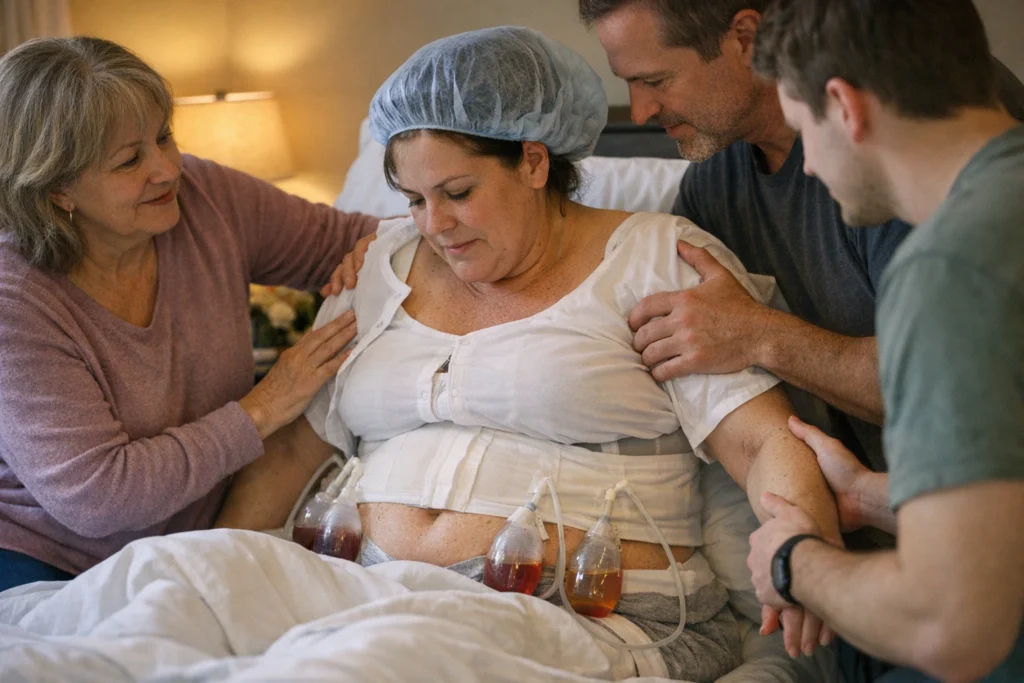
Day two at home after a lower body lift. You have multiple drains. You cannot stand fully upright. Getting to the bathroom requires help. Your surgeon told you recovery takes “4-6 weeks.” Nobody has explained that week one of body lift recovery has essentially nothing in common with what those words suggest to most patients.
Looking for a quick answer? Jump to the FAQ below.
The short answer
Body lift recovery is 4-6 weeks of significant restriction. Week 1: bed rest transitioning to assisted walking, drains in place. Weeks 3-4: desk work possible, but the temptation to do too much is highest and seroma risk peaks here. Full compression for 6 weeks. Weight must be stable for 6-12 months before surgery. This is major surgery — plan the recovery accordingly.
What a Body Lift Actually Is — and Who Has It
A lower body lift (also called a belt lipectomy) removes the circumferential band of loose skin around the lower torso. That means the abdomen, flanks, lower back, outer thighs, and buttocks — all addressed in a single operation via an incision that encircles the entire body, typically at the hip line. It is the procedure most commonly performed after significant weight loss, whether from bariatric surgery or from GLP-1 medications like semaglutide and tirzepatide.
Patients dealing with skin laxity after GLP-1 weight loss often find that the extent of excess skin exceeds what a standalone tummy tuck can address. A lower body lift is the surgical solution when skin removal needs to be circumferential rather than abdominal only. The operation takes four to eight hours under general anaesthesia. This is major surgery, not an extended tummy tuck. The recovery reflects that.
Weight Stability Before Surgery: The Non-Negotiable Prerequisite
Candidates for body lift after GLP-1 weight loss should have achieved a stable weight for at least 6-12 months before surgery. Weight stability is the single most important factor because ongoing weight fluctuation compromises surgical results and increases complication risk. This is not a general recommendation. It is a requirement.
Patients who proceed while still losing weight risk needing revision surgery if additional weight loss continues after the procedure. The skin removal that was calibrated to their current weight becomes insufficient, or their body changes in ways that alter the result. The patience required to wait until weight is genuinely stable is significant. So is the cost of not waiting.
Drain Management: What Week One Actually Looks Like
Most body lift patients leave the operating room with multiple surgical drains. These are silicone tubes placed to remove fluid from the extensive disrupted tissue, preventing seroma and haematoma formation. Managing them — emptying the collection bulbs, measuring and recording output daily — is a central part of week one recovery. This is not something patients are typically prepared for emotionally.
Drains are typically removed after approximately one week when output reduces to acceptable levels, as established by your surgeon’s specific criteria. Drains removed too early significantly increase seroma risk. If output is still elevated and a drain comes out anyway, fluid accumulation is likely to follow. The timeline for drain removal is not arbitrary.
Caregiver assistance is not optional during this phase. You will need someone present at all times for the first week — to help with the drains, with getting to the bathroom, with food preparation, with everything. Planning for help and actually having it available are two different things. Arrange it concretely before the surgery date.

The Body Lift Recovery Timeline
| Timeframe | What to expect |
|---|---|
| Day 1 | Bed rest. Multiple drains. Assistance required for all activities. |
| Day 2 | Walking with assistance. Cannot stand fully upright. Drains being managed. |
| Week 1-2 | Drains removed around day 7. Gradual mobility. Full assistance still needed. |
| Week 3-4 | Desk work possible. Feeling better but seroma risk peaks. Activity must remain controlled. |
| Week 4-6 | Standing fully upright. Walking normally. Compression garments continue. |
| Month 2-3 | Swelling reducing. Scars visible. Scar care beginning. |
| Month 6-12 | Final contour visible. Scars maturing at hip line. |
The period between weeks three and four deserves specific attention. Bed rest has given way to gradual mobility, swelling has started to reduce, and many patients feel significantly better than they did in week one. This creates false confidence. The external improvement does not reflect the internal state of healing. Week 3-4 is when patients consistently attempt too much and when seroma risk peaks — the fluid collection that forms when activity disrupts the healing tissue planes. Controlled activity during this phase is not optional. It is the difference between an uncomplicated recovery and a setback that adds weeks to the timeline.
Compression Garments for Body Lift Recovery
The compression requirement for a body lift is the most extensive of any cosmetic procedure. Coverage of the abdomen, flanks, thighs, and buttocks simultaneously, worn for six weeks. Multiple garments are essential — you need at minimum two to allow for washing rotation. Wearing the same garment continuously without washing is both unhygienic and degrades the compression material.
For guidance on transitioning between compression levels as healing progresses, the stage 1 vs stage 2 compression guide covers the principles of when to move from firmer post-surgical garments to lighter maintenance compression. The same logic applies to body lift compression as it does to abdominal procedures.
Staging Body Lift With Other Procedures
Post-weight-loss patients frequently require arm lift, breast procedures, and body lift. Attempting to combine all of these in a single operation is common only in patients who have not been counselled on the risks of doing so. Most experienced surgeons recommend staging body contouring into upper body and lower body sessions separated by several months. Combining too many procedures increases operative time, anaesthesia exposure, and overall recovery demands significantly.
The conversation about staging is the one that often does not happen at the initial consultation, particularly when a patient is eager to address everything at once. The framing of “get it all done in one recovery” sounds appealing. What it does not communicate is that a combined 10-hour operation carries materially different risk and recovery demands than two five-hour operations separated by an appropriate interval. Ask your surgeon specifically about their staging recommendation and the reasoning behind it.
This is normal
Inability to stand fully upright for the first week as tightened tissue adjusts
Significant swelling and bruising across the entire circumference of the treated area
Feeling significantly worse on day 2 than day 1 as anaesthesia wears off
Seroma development at weeks 2-4 as a known risk that is manageable when identified early
Scars at the hip line that are red and raised for months before beginning to fade
Call your surgeon promptly if
Fever above 38°C / 100.4°F at any point
Drain output that suddenly increases or becomes cloudy, thick, or foul-smelling
A soft, fluctuant swelling developing at the incision line (possible seroma)
Any area of skin that is becoming dark, cold, or losing sensation
Increasing pain rather than gradually improving pain at any point in weeks 1-4
Frequently Asked Questions
How long is body lift recovery?
Most patients are off work for 3-6 weeks depending on their job demands. The most restricted phase — bed rest, drains, full assistance — lasts approximately one to two weeks. Most patients return to desk work around weeks three to four. Full compression garments continue for six weeks. The final contour, with swelling fully resolved, is not visible until 6-12 months post-surgery.
What is seroma and why is it a higher risk after body lift?
Seroma is a collection of fluid under the skin that forms when the dead space created by tissue removal fills with lymphatic fluid. Body lift creates an extensive area of dead space around the entire lower torso, making seroma one of the most common complications. It peaks at weeks 3-4 when patients feel better and increase activity. Signs are a soft, fluctuant swelling along the incision line. Identified early, seroma is managed with aspiration. Left untreated, it can delay healing or become infected.
How long after GLP-1 weight loss should I wait before body lift surgery?
Weight should be stable for at least 6-12 months before body lift surgery. This means not only that active weight loss has stopped, but that your weight has been consistent at its current level for that period. Proceeding while still losing weight, or having recently plateaued on a GLP-1 medication, significantly increases the risk of unsatisfactory results and the need for revision surgery.
Body lift recovery varies significantly based on the extent of tissue removed, the specific techniques used, the patient’s overall health and baseline nutritional status, and adherence to post-operative instructions. This is a major surgical procedure and recovery should not be underestimated.
This article is for educational purposes only and is not a substitute for professional medical advice. Always follow your injector’s or surgeon’s specific aftercare instructions.