
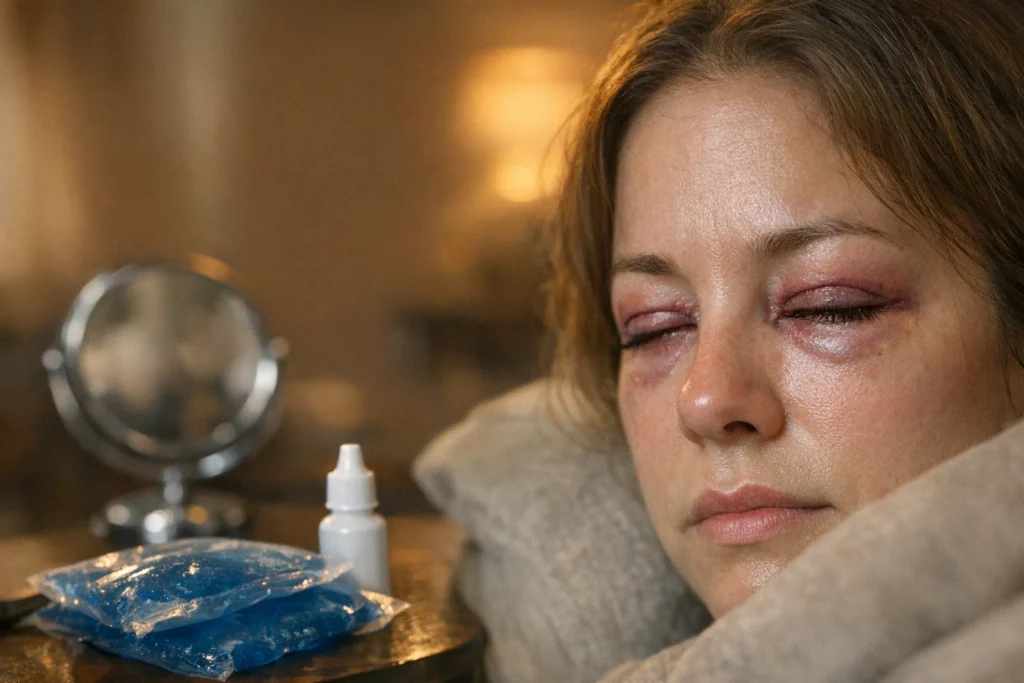
You are home. Your eyelids are swollen almost shut. Vision is blurry. There is a strange foreign sensation around your eyes that the surgeon mentioned but that feels more alarming than the word “discomfort” prepared you for. You were told this surgery would make you look more rested. Right now you cannot fully open your eyes.
This is the first day of blepharoplasty recovery. It is also the most alarming day, and the most misleading one.
Looking for a quick answer? Jump to the FAQ below.
The short answer
Swelling peaks at 48-72 hours and most visible bruising resolves by week two. Sutures come out at days 5-7. Most patients return to light work at 10-14 days. Blurry vision and dry eyes are common and expected. Final results take 3-6 months as scars mature. Upper-only recovery is faster than combined upper and lower.
The Vision Changes: What Is Happening and When It Stops
Blurry vision in the first days after blepharoplasty has two causes, and both are temporary. The first is the lubricating ointment applied during and after the procedure, which blurs vision directly until it is absorbed or washed away. The second is the swelling itself, which physically affects visual acuity by altering how the eyelid rests against the eye.
Both clear as swelling reduces, typically within the first week for most patients. Blurry vision at one month is uncommon and should be evaluated by your surgeon. Rare complications such as double vision or significant pressure changes in the eye occur in fewer than 1% of patients and require prompt contact with the surgeon rather than a wait-and-see approach.
Some patients find it helpful to supplement arnica as a pre-surgical supplement to reduce bruising and associated swelling. It doesn’t eliminate the recovery, but some patients find the bruising arc less severe.
Dry Eye: The Most Common Side Effect Nobody Warns You About
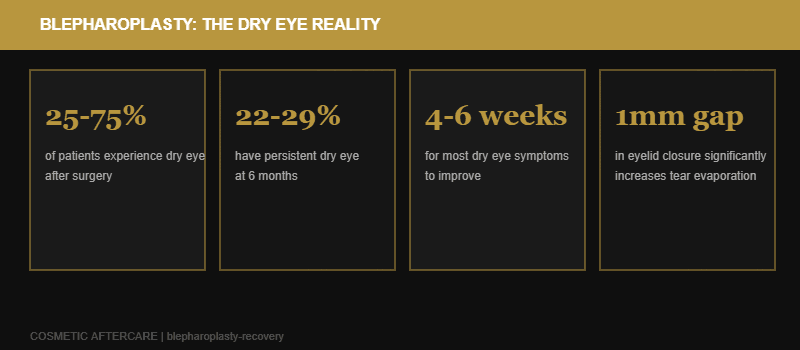
Dry eye symptoms affect between 25-75% of all blepharoplasty patients in the immediate post-operative period. That range is wide because the severity varies substantially between patients, but the frequency is not. This is extremely common and almost never adequately explained at the pre-surgical consultation.
The mechanism matters for understanding what to do about it. Removing skin and sometimes muscle from the eyelid changes how the eyelid closes. A temporary impairment of the blink reflex and a gap in full eyelid closure, even 1mm, significantly increases tear evaporation. The result: gritty sensation, burning, light sensitivity, occasional blurred vision unrelated to swelling. The eye is not damaged. It is dry.
What helps: preservative-free lubricating eye drops throughout the day, lubricating gel ointment at night if the eye is not fully closing. Most dry eye symptoms improve within 4-6 weeks as swelling resolves and lid position normalizes. Some patients have persistent symptoms for up to three months. Persistent dry eye rates at the six-month mark are approximately 22-29%, which means a meaningful minority will need longer-term management.
The Week-by-Week Recovery Timeline
| Stage | What to expect |
|---|---|
| Day 1-2 | Swelling and bruising at their worst. Vision blurry from ointment and swelling. Cold compresses every hour while awake. Head elevated at all times. |
| Day 3-5 | Swelling begins reducing. Bruising deepens in colour before fading. Eyelids may feel very tight. Sutures still in place. |
| Day 5-7 | Suture removal appointment. Significant comfort improvement after removal. Limited social contact possible with sunglasses. |
| Week 2 | Most visible bruising gone. Return to light desk work at days 10-14. Eye makeup cleared with clean hypoallergenic products only. |
| Week 3-4 | Eyelids approaching natural appearance, still slightly swollen. Gentle exercise resumes with surgeon clearance. |
| Month 2-3 | Swelling significantly reduced. Scars maturing and fading. Residual morning swelling is still normal. |
| Month 3-6 | Final results visible as scars fully mature and tissues settle. |
What Not to Do During Recovery
Bending over or lifting anything heavy increases blood pressure to the head and worsens swelling. The mechanism is direct: increased intracranial pressure pushes fluid into the already-inflamed surgical area. Do not lift. Do not bend forward to pick things up. Sleep with the head elevated for at least the first week.
Screen time strains the eyes and should be limited in the first few days. This isn’t about damage, it’s about comfort and avoiding the tension that comes with prolonged eye movement and focus while healing tissue is sensitive. Most patients find they can tolerate increasing amounts of screen time from day 3-4 onward.
Contact lenses cannot be worn until the surgeon clears them, typically not before 2-4 weeks. Sunglasses are non-negotiable outdoors during the entire recovery period: UV protection for healing tissue and physical shielding from wind, dust, and accidental contact. As for skincare, the timing for resuming actives like retinol near the eye area follows general post-procedure guidance with additional caution given the proximity to healing tissue.
Upper vs Lower Blepharoplasty: The Recovery Differs More Than Patients Expect
Upper blepharoplasty alone, the most common procedure, recovers faster than combined upper and lower surgery. The upper eyelid heals with a more defined incision line in the natural crease that becomes inconspicuous relatively quickly. Lower blepharoplasty addresses the under-eye area, which has a longer visible bruising arc and more complex tissue involved.
Combined upper and lower procedures carry the most significant initial downtime. Surgery combined with laser resurfacing extends recovery further again. This matters for realistic expectation-setting: the recovery period described in this article reflects upper-only blepharoplasty as a baseline. Combined procedures will run longer across every stage. If you are uncertain whether what you are seeing is a complication versus a botox-related eye change versus blepharoplasty recovery, the distinction matters because the causes and timelines are different.
Blepharoplasty is the number one cosmetic facial surgery in the United States, with 120,755 procedures performed in 2024. The anxious recovery population it creates is significant, and nearly all of that anxiety is caused by symptoms that are normal and expected but not clearly explained before surgery.
This is normal
- Blurry vision in the first 3-5 days from ointment and swelling
- Eyelids that cannot fully open for 1-3 days
- Eyes that do not fully close during sleep in the first days — use lubricating ointment at night
- Gritty, dry eye sensation for 4-6 weeks
- Bruising that looks worse on day 3 than day 1 before improving
- Swelling that is still present at 4 weeks, especially in the morning
Call your surgeon if
- Blurry vision that is worsening or unchanged at two weeks
- Severe pain rather than manageable discomfort
- Increasing redness, warmth, and swelling at one eye specifically (signs of infection)
- Double vision that is not improving after 48 hours
- Any significant change in vision beyond initial blurring
- Inability to close the eye at all and significant dryness causing eye pain
FAQ
How long does the swelling last after blepharoplasty?
Swelling peaks at 48-72 hours after surgery and reduces gradually from there. Most visible bruising resolves by the end of week two. Residual swelling, particularly in the mornings, can persist for up to two months. Final results including full scar maturation become visible between 3-6 months. Patients who are anxious about persistent swelling at four weeks are usually still within the normal range.
When can I wear eye makeup after blepharoplasty?
Eye makeup is typically cleared at 10-14 days using clean hypoallergenic products only. Standard makeup, especially products with fragrance, preservatives, or glitter particles, should wait until the surgeon confirms the incision lines are fully healed. Mascara application near the lash line requires particular care in the early weeks. When starting back, err toward gentle patting rather than rubbing and remove makeup with a non-irritating micellar water.
What causes the eyelid not to close fully after surgery?
Incomplete eyelid closure after blepharoplasty is caused by swelling and a temporary change in how the eyelid muscle functions after tissue removal. It is one of the most common reasons patients call their surgeon in the first 72 hours, and it is almost always normal and temporary. It typically resolves as swelling decreases over the first week. Using lubricating ointment at night protects the eye surface while closure is impaired. Persistent inability to close the eye after 2-3 weeks should be evaluated.
Recovery experiences after blepharoplasty vary significantly based on surgical technique, whether upper and/or lower lids were treated, individual healing response, and pre-existing conditions including dry eye disease.
Like eyelid surgery, breast lift follows a similar pattern of sensation changes that resolve over months, a detail that rarely gets discussed at the initial consultation for either procedure.
Among facial surgical recoveries, neck lift recovery follows a similar 2-week downtime pattern, with results emerging progressively over 3-6 months in both cases.
Blepharoplasty is frequently performed alongside or as an alternative to a brow lift, and the two procedures address different aspects of upper face ageing. If your surgeon has mentioned combining procedures or if you are considering a brow lift as a next step, the brow lift recovery guide covers the scalp numbness arc and the brow position settling timeline that most patients are not warned about in advance. For patients who have had or are planning a facelift at the same time, the combined facelift and neck lift recovery guide explains how managing two facial healing zones simultaneously differs from either procedure alone.
This article is for educational purposes only and is not a substitute for professional medical advice. Always follow your injector’s or surgeon’s specific aftercare instructions.