

Week two. Maybe week three. You feel completely fine. Not just fine, actually, better than fine — you have energy, the soreness is gone, and your compression garment is starting to feel like a suggestion rather than a necessity. The exercise restriction feels like general post-surgical caution, the kind that obviously can ease off now that you feel ready.
This is the most expensive misunderstanding in BBL recovery.
The restriction has nothing to do with how you feel. It has everything to do with what is happening in the transferred fat right now, under the skin, invisibly.
Looking for a quick answer? Jump to the FAQ below.
The short answer
Walking from day 1. Light cardio from weeks 4-6 with surgeon clearance. Jogging around week 8. No squats, lunges, or direct glute work until week 12 minimum. The restriction exists because premature exercise damages fat grafts that haven’t established blood supply yet, and the consequence shows up months later, not immediately.
Why Exercise Timing Is Specifically About Fat Graft Survival
The fat cells transferred during a BBL are establishing a new blood supply during the first 8-12 weeks. This is not a gentle process. The cells need to integrate into new tissue, grow new capillary connections, and become viable permanent residents rather than foreign material the body reabsorbs.
High-impact exercise disrupts this in several ways at once. Mechanical trauma to the graft site physically disturbs the new connections forming. Elevated cortisol from intense training interferes with healing and fat integration at the cellular level. Raised core temperature increases metabolic demand on cells that don’t yet have adequate blood flow to meet it. And glute-specific movements, the ones patients most want to return to, directly stretch the tissue where the graft is anchoring and pull apart the new vascular network before it’s strong enough to hold.
None of this shows up immediately. That is the critical point. The fat that dies from premature exercise doesn’t announce itself at the gym. It shows up at the six-month appointment as smaller-than-expected results, uneven texture, or asymmetry that can’t be corrected without revision surgery.
The Return Timeline: Week by Week
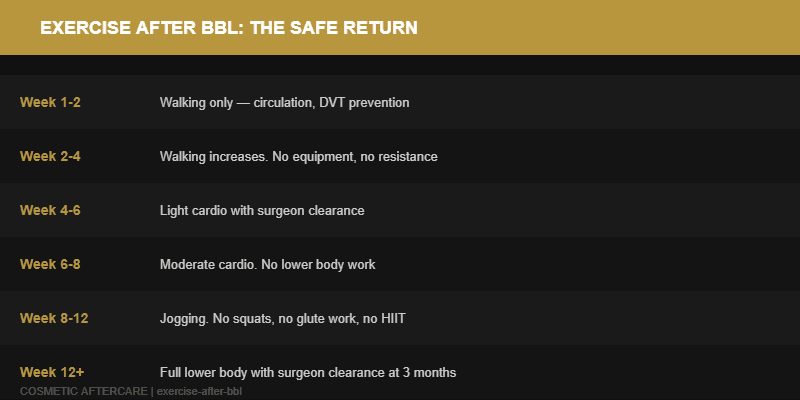
| Week | What’s allowed |
|---|---|
| Week 1-2 | Walking only. Short gentle walks from day 1 for circulation and DVT prevention. No gym, no equipment, no resistance. |
| Week 2-4 | Walking increases in duration. No cardio equipment, no resistance training, nothing that elevates heart rate significantly. |
| Week 4-6 | Light cardio with surgeon clearance. Incline walking, light elliptical with no resistance. No cycling or stairmaster. |
| Week 6-8 | Moderate cardio. Upper body resistance for some patients. No lower body work of any kind. |
| Week 8-12 | Jogging resumes. Most exercise returns except direct glute work, HIIT, and plyometrics. |
| Week 12+ | Full lower body with surgeon clearance. Squats and glute exercises cleared at 3 months minimum. |
The full BBL recovery timeline runs significantly longer than most patients expect going in. Exercise restrictions are one part of a broader recovery protocol, not an isolated rule.
Why Squats Are the Last Thing to Come Back
Squats come up in every BBL recovery conversation because they’re the exercise patients most associate with the results they wanted. The irony is that they are also the exercise most likely to destroy those results if started too soon.
Squats directly load the gluteal muscles and stretch the overlying tissue. Even bodyweight squats place meaningful mechanical stress on the graft site. During the first 12 weeks, this stretch and compression disrupts the new blood supply the fat grafts are building. The 12-week mark is the minimum. Most surgeons recommend waiting for the full three-month clearance appointment rather than assuming 12 weeks is safe without confirmation.
Lunges, deadlifts, and hip thrusts follow the same logic. All of them load or stretch the glute in ways that compromise graft integration when started before vascularization is complete.
What Happens When You Exercise Too Soon
Premature high-impact activity causes mechanical trauma to the graft site. Fat cells that haven’t established blood supply undergo necrosis. Dead fat cells don’t come back. The body reabsorbs them, which means the volume disappears and the surrounding cells that did survive are left in an irregular distribution.
The patient at month six who presents with asymmetric results or volume loss they weren’t expecting usually has a recovery history that includes lower body exercise around weeks 3-5. That’s the pattern. They felt fine. They exercised. The consequence arrived quietly two to four months later.
High cortisol from high-impact exercise adds a second mechanism on top of the mechanical trauma. Cortisol interferes with fat graft integration and increases systemic inflammation during a period when the body needs exactly the opposite. This is why the timing restrictions extend well beyond what patients expect when they first hear them.
Gym Equipment to Avoid Even After General Clearance
Cycling machines create skin shearing against the gluteal area with every pedal rotation. The Stairmaster puts repetitive, rhythmic pressure on the buttocks with every step. Neither is appropriate during early BBL recovery, and both remain lower priority to reintroduce even after general exercise clearance.
This matters for patients who plan to use a gym during the recovery period. Any equipment you sit on creates pressure on the graft site. If you are using a gym bench between sets, this is when a proper BBL pillow becomes relevant outside the home: firm foam, full open-centre design, portable enough for gym and car use.
Recommended: BBL Pillow
If you are using a gym bench between sets, a firm open-centre pillow that keeps pressure off the treated area is what makes sitting there safe again. This BBL pillow is portable enough to bring along and flat enough to use on a bench or car seat.
The compression garment question overlaps here too. Wearing appropriate compression during exercise reintroduction supports the tissue as activity increases. Understanding when to transition between stage 1 and stage 2 compression is directly relevant to when and how exercise can safely resume, since the stage shift typically aligns with the increase in physical activity.
This is normal during recovery
- Feeling physically ready to exercise long before you are cleared to
- Fatigue and reduced fitness during the restriction period
- Swelling that increases temporarily with walking in early weeks — this is normal, keep walking
Do not resume exercise if
- You have not received surgeon clearance for that activity level
- Swelling is still actively increasing rather than reducing week on week
- Any pain at the donor or recipient sites beyond mild expected soreness
- You are within 12 weeks and considering squats, lunges, or direct glute work
FAQ
Can I do upper body exercise after BBL while avoiding lower body?
Upper body resistance training generally becomes an option around weeks 6-8 with surgeon clearance for patients whose recovery is progressing normally. The caveat is core involvement: many upper body exercises involve core engagement that indirectly loads the glute area. Seated exercises also create pressure on the graft site, which requires either modification or use of an offloading cushion. Always confirm specific exercises with your surgeon before reintroducing them.
Why does cycling get singled out even after general clearance?
Cycling creates repetitive skin shearing against the gluteal area that is distinct from the mechanical loading of squats. It also puts sustained pressure on the graft site for the entire duration of the session rather than intermittent loading. Both stationary bikes and outdoor cycling fall under this caution. Most surgeons who are specific about this recommend waiting until four to six months post-surgery before returning to cycling, even when other exercise has been cleared.
If the fat that survives is permanent at three months, why do some patients still lose volume later?
The fat that survives the initial graft period and establishes a blood supply is permanent in the sense that it behaves like native fat. It responds to weight changes. Significant weight loss after a BBL will reduce the volume of the transferred fat along with body fat generally. Patients who maintain stable weight tend to maintain their results. Significant weight fluctuation after a BBL is the most common explanation for volume changes that appear after the established permanent period.
This article is for educational purposes only and is not a substitute for professional medical advice. Always follow your injector’s or surgeon’s specific aftercare instructions.