
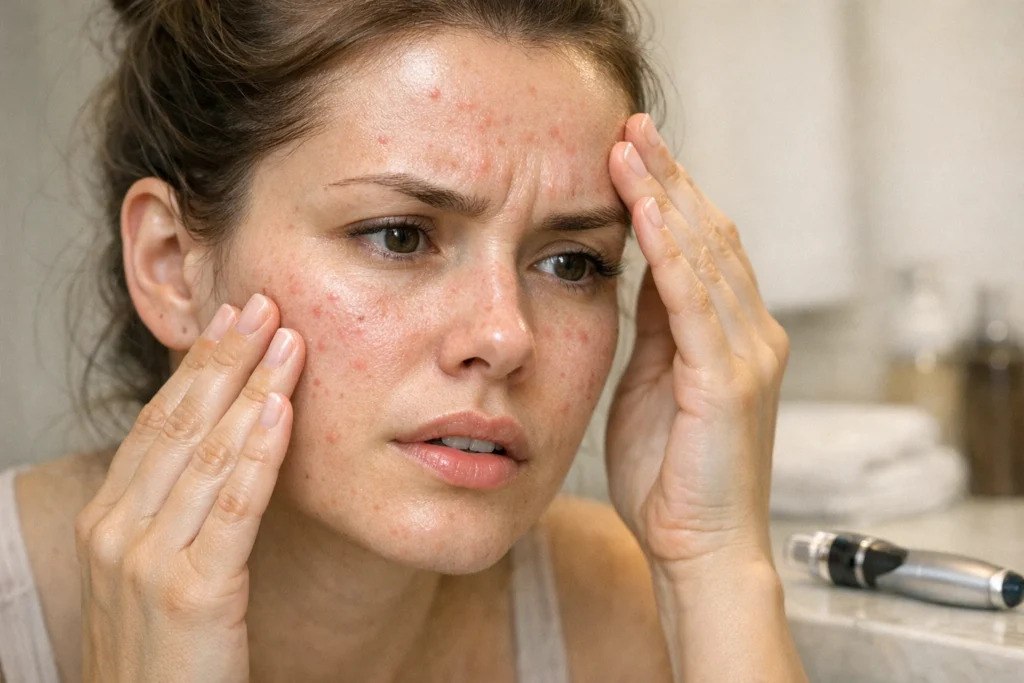
Day three. Maybe day four. You checked your skin this morning and there are spots you didn’t have before the treatment. Small ones, a few of them, right where you usually break out. Your first thought is that the microneedling made things worse. Your second thought is that you paid for this.
Stop. This is almost certainly not what you think it is.
Looking for a quick answer? Jump to the FAQ below.
The short answer
Purging after microneedling is accelerated cell turnover bringing existing congestion to the surface. It appears where you normally break out, involves small spots not cysts, and resolves in 2-4 weeks. A reaction involves spreading redness, heat that worsens after 48 hours, or symptoms in new areas. The 72-hour rule: if symptoms are still getting worse at 72 hours, call your provider.
What Purging Actually Is (And Why Microneedling Triggers It)
Microneedling creates controlled micro-injuries in the skin. This accelerates cell turnover as the skin responds and repairs. The result: congestion and clogged pores that were already forming beneath the surface get pushed up faster than they would have arrived on their own. Those breakouts were coming regardless. Microneedling just moved the timeline forward.
This is purging. It is not a negative response to treatment. It is a sign the treatment is working.
The visual markers are specific. Purging typically appears in the areas where you already break out, not new locations. The spots are small: whiteheads, blackheads, minor congestion. Not cystic nodules. Not inflamed, painful lumps. Small, superficial, and familiar. The timeline also follows a pattern: it tends to start between days 3-7, and it resolves within 2-4 weeks as the accelerated cycle completes itself. If you want to understand the normal day-by-day arc after microneedling, that pattern is your reference point. Purging follows it. A reaction doesn’t.
What a True Reaction Looks Like After Microneedling
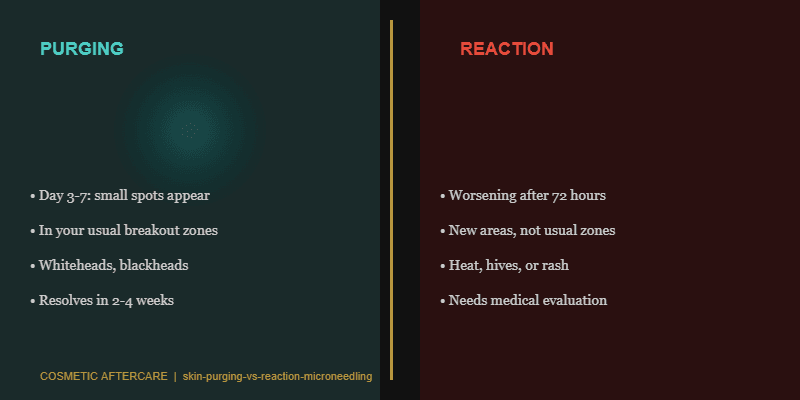
A true reaction is the skin’s immune or inflammatory response to something it didn’t tolerate. It behaves differently from purging in ways that are visible and sensory, not just theoretical.
Redness that is spreading and still worsening rather than plateauing. Heat that increases after 48 hours rather than improving. Hives or a rash pattern across the skin rather than individual spots. Cystic or painful nodules in areas where you never break out. Blistering or weeping skin. Clusters of small vesicles, particularly around the mouth or nose, which may indicate herpes reactivation in patients with a history of cold sores.
The critical distinction is trajectory. Purging follows the normal post-microneedling recovery arc: the sunburn-to-flaking sequence that settles predictably over days. A reaction diverges from that arc. Something that should be calming down is instead intensifying.
The 72-Hour Rule: Your Practical Dividing Line
Most normal post-microneedling inflammation begins improving after 48-72 hours. Redness reduces. Warmth settles. Tightness eases. This is the body completing its acute inflammatory phase and shifting into repair.
Any symptom that is still actively worsening at the 72-hour mark rather than plateauing or improving should be evaluated. That is the clearest practical dividing line between normal healing and something that needs attention. Not “still present” — still worsening. There’s a meaningful difference.
Persistent redness beyond 10-14 days also warrants medical evaluation, as it may indicate infection, an allergic response, or excessive inflammation from the treatment parameters. If it hasn’t meaningfully improved by the two-week mark, call your provider rather than waiting further.
The Real Culprit Most Patients Miss: Product Timing
The most common cause of a true post-microneedling reaction is not the treatment itself. It’s what gets applied afterward.
Retinol, vitamin C, AHAs, BHAs, and fragranced products applied in the first 24-72 hours after microneedling absorb at significantly higher concentrations than normal. The micro-channels are open. The skin barrier is compromised. An ingredient that your skin handles fine in its normal state becomes an irritant when it reaches the deeper dermis at concentrations it wasn’t designed to receive.
The result is irritant contact dermatitis: widespread irritation, burning or stinging rather than simple sensitivity, no predictable day-by-day improvement arc. It looks like a reaction because it is one, but the specific cause is the product-timing mistake rather than anything inherent to the treatment. The pattern is distinctive: broad irritation across the treated area rather than localised spots, and a history that includes applying the usual skincare routine that same evening.
Check the microneedling aftercare rules for the first 24 hours before reaching for anything from your usual lineup. The ingredient avoidance window is not optional.
For the question of what you can safely use during the healing window, copper peptides are among the ingredients genuinely suited to post-microneedling skin and are an example of what the first days should look like rather than your full active routine.
PIH: The Complication That Looks Like Neither
Post-inflammatory hyperpigmentation is not a reaction in the immune sense, but it belongs in this conversation because it gets confused with both purging and reactions. PIH presents as darkening or uneven tone, not as a breakout or a rash. It’s not the skin purging. It’s not the skin reacting. It’s the skin producing excess melanin in response to inflammation combined with UV exposure during the healing window.
Deeper skin tones carry a higher PIH risk after microneedling. The prevention is SPF and sun avoidance during the entire recovery period, consistently applied. If darkening appears weeks after the treatment rather than in the immediate healing phase, PIH is the more likely explanation than purging or reaction. It needs different management: not benign neglect, but targeted pigmentation care and rigorous sun protection.
The Honest Version: What the Pattern Actually Shows
Most of what patients call “purging” after microneedling is genuinely purging. Most of what patients call a “reaction” turns out to be either purging they weren’t warned about or irritation from applying their usual actives too soon. Patients who applied their normal skincare routine the same evening as their microneedling appointment account for the majority of “reaction” reports. The breakouts look alarming. The history reveals the cause immediately.
True allergic reactions exist. They’re less common than the anxiety around them suggests. The 72-hour rule catches them: if things are worsening not improving at that mark, you have your answer.
This is normal (purging)
- Small whiteheads or blackheads in your usual breakout areas starting day 3-7
- Skin looking worse before it looks better in week one
- Breakouts that are resolving on their own by week two
- Dry, flaking skin alongside or instead of breakouts
Call your provider if
- Redness spreading and still worsening after 72 hours
- Cystic or painful nodules in areas you never break out
- Blistering, weeping skin, or a rash pattern
- Clustered small blisters near the mouth or nose
- Fever or feeling unwell following treatment
- Any worsening symptom after day 2 rather than improving
FAQ
How long does skin purging last after microneedling?
Purging after microneedling typically begins between days 3-7 and resolves within 2-4 weeks as the accelerated cell turnover cycle completes. The spots that surface are ones that were already forming under the skin. Once the cycle finishes, skin generally looks clearer than it did before treatment. If breakouts are still multiplying at the four-week mark rather than winding down, that warrants a conversation with your provider.
Can microneedling trigger a real allergic reaction?
Yes, though it’s less common than the anxiety around it suggests. A true allergic or inflammatory reaction presents with spreading redness, heat that worsens after 48 hours, hives, or symptoms appearing in areas where you don’t normally break out. The more common scenario is irritant contact dermatitis from actives applied too soon after treatment, which mimics a reaction but has a specific cause: product timing. Both require provider attention if they meet the 72-hour rule threshold. Makeup applied too early as a trigger for reactions is a specific subcategory of this pattern worth understanding separately.
Should I avoid all skincare products after microneedling to prevent purging?
Avoiding actives is the right call for the first 24-72 hours, but the goal isn’t to prevent purging — purging is a normal response and not something to be suppressed. The goal is to avoid adding an irritant reaction on top of it. After the first 72 hours, gentle fragrance-free products and barrier-supportive ingredients are appropriate. The full active routine resumes when the skin is calm and healed, not immediately after treatment.
This article is for educational purposes only and is not a substitute for professional medical advice. Always follow your injector’s or surgeon’s specific aftercare instructions.