

Every clinic website says six to twelve months. You have seen that answer a hundred times. It is technically not wrong, and it is practically useless, because six months and twelve months are completely different experiences, and the actual range runs wider than that in both directions.
The honest answer is that lip filler longevity is a three-variable equation: the product used, how your individual metabolism works, and where in the lip the filler was placed. Someone with a fast metabolism who got a soft product in the body of the lip may find themselves back at the clinic at four months. Someone with a slower metabolism who got a denser product along the vermilion border may still see meaningful results at eighteen. The consultation where someone tells you exactly how long yours will last without knowing your history is the consultation where you should ask more questions.
Why Lips Metabolize Filler Faster Than Anywhere Else
The lips are exceptionally active tissue. They move constantly, they have a dense vascular supply, and they have little of the structural fat that would slow down filler breakdown in areas like the cheeks or temples.
Hyaluronic acid filler, which is the standard material for lip augmentation, is broken down by hyaluronidase, an enzyme naturally present in body tissue. The more metabolically active the area, the faster that enzyme gets to work. In the lips, repeated daily movement (speaking, eating, expressions) also mechanically accelerates breakdown in ways that do not happen in static areas like the nasolabial folds or under-eye.
This is structural, not a quality issue. The same product that lasts fourteen months in your cheeks may last seven months in your lips. Neither outcome is wrong. They are just different tissue environments.
How Product Type and Density Affects Longevity
Not all hyaluronic acid fillers are equal, and the difference most relevant to longevity is cross-linking density. Cross-linking is what determines how firm a filler is and how resistant it is to enzymatic breakdown. A softer, more fluid filler integrates naturally into the lips and moves with them, which is why it looks natural, but it also metabolizes faster. A denser, more cohesive filler resists breakdown longer but requires more precise placement to avoid looking stiff.
Most lip-appropriate fillers are on the softer end of the spectrum, because the aesthetic goal in lips is almost always movement and softness. This is a considered tradeoff. You are choosing natural movement over maximum longevity when you choose a product designed for lips. A product stiff enough to last two years in your lips would not look or feel like a lip.
Some injectors offer a slightly denser product for specific applications, particularly border definition or cupid’s bow shaping, where more precision and structure are needed. Those placements tend to last longer than body-of-the-lip augmentation. Which brings us to placement.
How Placement Affects How Long Your Filler Lasts
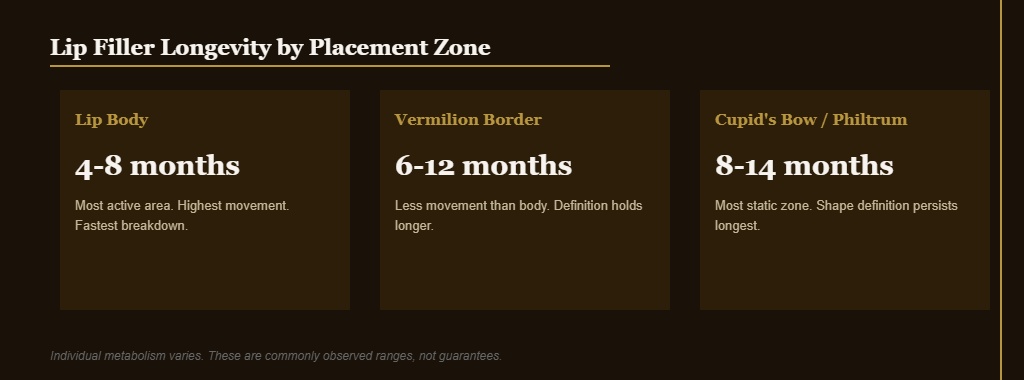
Where in the lip the product is placed has a meaningful effect on how long you will see the result. The lip body, the fleshy pink area, is the most active part. Movement-driven breakdown here is highest. Filler in the body of the lip tends to metabolize fastest.
The vermilion border, the defined edge between your lip and skin, has less movement than the body and slightly more structure. Filler here lasts longer, which is why patients who primarily want definition (rather than volume) often notice their results persisting longer than patients who primarily wanted fullness.
The cupid’s bow area and philtrum columns are relatively static by comparison to the rest of the lip, and filler placed here for shape definition tends to hold the longest of the three zones. This is worth understanding if you have noticed your results fading unevenly: the body softens first, then the border, then the definition. That pattern is not something going wrong. It is the predictable sequence of breakdown by tissue activity level.
The Metabolism Variable Nobody Can Predict at Your First Appointment
Individual metabolism genuinely varies. Some people break down HA filler consistently faster than average, regardless of product or placement. Some break it down more slowly. First-time filler patients have no established baseline, which is why any specific longevity promise on a first appointment is an educated guess.
After your first treatment and first follow-up, you will have useful data. You will know roughly when you started noticing the filler softening, whether you were disappointed at month four or still happy at month ten. That information makes subsequent consultations more precise. Your injector can note your metabolism rate and adjust product selection or placement for the next session accordingly.
Some factors that may accelerate breakdown anecdotally include high-intensity exercise (increased metabolic rate and circulation), significant weight change, and sun exposure over the lip area without SPF protection. None of these are dramatic enough to make a three-month difference on their own, but they are worth considering if you are trying to understand why your results did not match someone else’s timeline.
The Top-Up vs. Let-It-Dissolve Debate
This is a genuine point of disagreement among injectors, and worth having explicitly with yours. One school of thought holds that topping up before the previous filler is fully gone maintains a foundation and may require less product per visit over time. The other holds that layering filler repeatedly without allowing full dissolution can alter tissue texture over time, and that returning to a true baseline periodically allows for more accurate assessment of what your face actually needs.
Both positions have reasonable clinical rationale. What matters practically: if you are noticing asymmetry, if filler looks like it has shifted or hardened rather than simply faded, or if you are not sure what is your own lip and what is filler anymore, letting it fully dissolve before retreating is worth discussing — see the guide on dissolving lip filler for what that process actually involves. For more context on how repeated filler affects lip tissue over time, the long-term effects of repeated lip filler is a useful read before your next appointment.
Reading Your Own Results More Accurately Than the Calendar
The most reliable indicator of when you need a top-up is not a calendar date. It is your own baseline comparison. Most patients have a sense of what their lips looked like before filler, and whether current photos look meaningfully different from that baseline. The question to ask is not “is my filler gone?” but “do my lips look the way I want them to look?” Those are different questions with different answers at different time points for different people.
The 7-day lip filler recovery timeline is useful context if you are trying to sort out what is swelling from what is the actual result in the early days, since many patients misread the initial swelling as the final result and then feel confused when it settles.
One thing worth monitoring: if filler is lasting unusually briefly and looking uneven or lumpy as it fades rather than simply softening uniformly, it may be worth discussing migration with your injector. Filler migration can look like rapid fading in some spots and unexplained puffiness in others, and distinguishing that from normal breakdown is not always obvious without a trained eye.
FAQ
Why did my filler seem to last longer last time?
Product choice, placement, and even the injector’s technique can vary between appointments. If you specifically noted a longer-lasting result, ask your injector whether anything about the product or placement changed. If it was the same product and placement, individual variation from session to session is real. Stress, illness, and metabolic fluctuations can affect breakdown rates in the short term.
My friend says her filler lasted two years. Is that possible?
Yes, for some individuals and some placements, particularly less mobile areas or denser products. It is less common in the lips than in other areas. It is also possible that what is being described as lasting filler is a combination of actual remaining HA and the collagen stimulation and tissue changes that can accompany repeated filler over time. This is worth understanding rather than using as a benchmark for your own result.
Should I take something to make my filler last longer?
There are no supplements with strong clinical evidence for extending HA filler longevity. Consistent SPF protection over the lip area, avoiding intense heat exposure (saunas, hot tubs) in the first weeks, and staying well-hydrated are sensible general practices. They will not dramatically extend your timeline, but they remove controllable factors that may accelerate breakdown.
This article is for educational purposes only and is not a substitute for professional medical advice. Always follow your injector’s or surgeon’s specific aftercare instructions.