

You are three days out from your lip filler appointment and you just found a lump. You did what anyone does: you pressed on it, poked at it, pressed again, and now you are Googling. Almost every person who gets lip filler finds something they were not expecting in the first week. Almost none of those findings are a problem. The hard part is knowing which category yours falls into, and resisting the urge to fix it yourself.
Why Fresh Filler Feels Lumpy
Filler is not a liquid that settles instantly and evenly. It is a gel substance injected into tissue that is already reacting to being injected. In the first days, what you feel under your lips is a combination of: the filler itself in its initial placement, swelling around each injection site, small areas of bruising that feel different from surrounding tissue, and the firmness that naturally comes from your body’s inflammatory response to anything new.
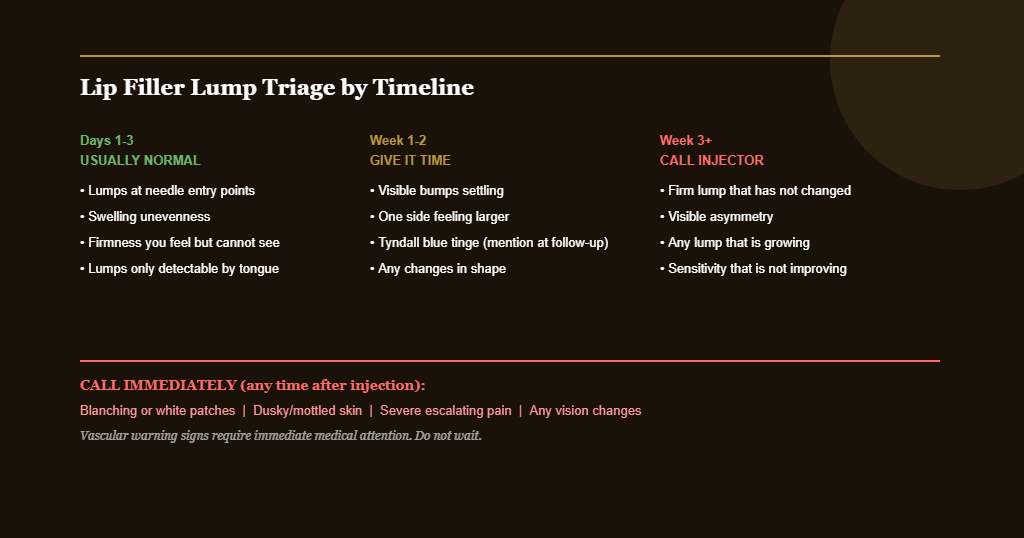
Needle entry points can feel like tiny hard dots. Zones of slightly uneven swelling can make one area feel fuller than the other even if the same amount was placed bilaterally. All of this resolves as swelling comes down and the filler integrates into surrounding tissue. The two-week mark is the standard waiting period before you or your injector make any judgment about the result. Lumps that feel alarming at day five often feel like nothing by day fourteen.
Lumps Only You Can Feel vs Lumps That Are Visible
Lumps you can only detect by pressing your tongue against your lip from the inside are nearly always fine. This is the most common kind of lump report, and it reflects normal filler texture in early healing. The product has not yet fully integrated, and lips have a lot of nerve endings, which means you will feel things that are not visible and will not bother anyone looking at you.
Visible lumps, bumps that are apparent without poking, deserve more attention. A visible lump at day one or two is often swelling concentrated at an injection site. A visible lump that is still present at week three or four is worth a conversation with your injector. That timeline distinction matters a great deal: early lumps are usually swelling, late lumps are usually hyaluronic acid that has not integrated evenly, or occasionally a small granuloma that forms around the product.
Patients consistently report that they notice lumps most in certain lighting situations, particularly in direct light from above or harsh bathroom lighting. If you can only see it in very specific conditions, give it the full two weeks before you conclude anything.
Do Not Self-Massage
This is the rule that gets broken most often because it feels counterintuitive. You have a bump. Massage resolves bumps. Why not? Because filler is a placed product. A bump in the first week may be a concentration of product that your injector deliberately placed in a specific location. Massaging it moves that product. You can displace something that was intentionally positioned, turning a lump that was going to resolve into an asymmetry that now needs correction.
There is an exception: some injectors specifically instruct patients to massage a particular area after treatment. If your injector told you to massage, massage exactly the area and in the manner they described. If your injector said nothing about massage, that is the answer. Do not start.
The Tyndall Effect: When a Lump Has a Blue Tinge
If you notice a faint bluish or grayish discoloration under the skin at or near your lips, this is called the Tyndall effect and it is caused by filler placed too superficially. The product itself is clear, but when it sits close to the surface, light scatters through it in a way that creates a blue-gray appearance. It is not dangerous, it is not a sign of infection, and it is correctable. Your injector can dissolve the superficial product with hyaluronidase — for what that process involves, see the guide on dissolving lip filler. The 7-day recovery timeline in the lip filler recovery guide covers what normal color changes look like in the first week so you can compare.
Hyaluronidase is worth mentioning here because it is the reassuring bottom line for most lip filler concerns. Lumps, uneven lip filler, Tyndall effect, and overfilled appearance are all correctable with an enzyme that dissolves hyaluronic acid. The stakes with HA filler are lower than many patients realize. If something does not resolve on its own, there is a solution. Filler migration and how it differs from normal lumps is covered in the article on filler migration signs and causes.
When You Need to Call Immediately
This section is not about lumps. Normal lumps, even alarming-looking ones, do not produce these symptoms. Call your injector immediately, not in a few days, if you experience: blanching or a white patch on or near the lips that appeared suddenly after injection; skin that looks dusky, mottled, or grayish in color; severe escalating pain that is getting worse rather than better; or any change in vision, even mild. These are vascular warning signs. They indicate the possibility that filler has entered or compressed a blood vessel. This is rare but it is a medical emergency. Vascular complications have a narrow treatment window. Do not wait to see how it develops.
A bruising article on the lip filler bruising page shows what normal bruising looks like and how it progresses, which can help you distinguish bruising from the vascular warning signs above. Bruising changes color over days. Vascular compromise looks different from bruising and the timeline is different.
What to Send Your Injector
If you are unsure whether your lump warrants a call, take well-lit photos in natural light, both straight-on and at an angle. Note when the lump appeared, whether it is getting larger or smaller, and whether it is tender to touch. Send this to your injector’s office with those details. A good injector can usually triage from photos and give you a meaningful answer. Knowing how to document what you are seeing is more useful than trying to describe it in words.
FAQ
Is it normal to feel lumps with my tongue a week after filler?
Yes, this is one of the most common post-filler concerns and almost always resolves on its own. Your tongue is extremely sensitive and can detect subtle variations in tissue texture that are not visible from the outside and will not be present at the two-week mark. Stop pressing on it, give it two weeks, and reassess then. If it is still prominent at week two, contact your injector.
I found a hard lump three weeks after filler. Is that different from early lumps?
Yes. A firm, distinct lump at three or four weeks is not the same as early swelling. It could be product that has not integrated, a small granuloma (a rare but known complication), or in some cases a cyst. This is worth a call and possibly an in-person visit with your injector. Hyaluronidase can dissolve HA filler, so if the product is the issue, there is a straightforward correction. Do not assume it will resolve on its own at this stage.
My injector said I could massage if I felt lumps. How do I do it?
Follow exactly what your injector told you: the area, the pressure, and the timing. If they said “gently massage the upper lip for 30 seconds,” do exactly that. Do not extend the massage to other areas, do not apply more pressure than instructed, and do not massage more frequently than advised. If you cannot remember the specific instructions, call the office and ask rather than guessing.
This article is for educational purposes only and is not a substitute for professional medical advice. Always follow your injector’s or surgeon’s specific aftercare instructions.