
You are standing in your bathroom on day five, faja back on after a shower, and you cannot decide whether the pressure you feel in your outer thigh is the garment doing its job or something going wrong. “Compression should feel snug” is the advice you got, which is roughly as useful as “you will feel some discomfort.” The honest answer is that too tight and too loose look different from each other, and the stakes are not equal. A loose faja underperforms. A too-tight one can actively damage your results and your skin.
The Signs Your Faja Is Too Tight
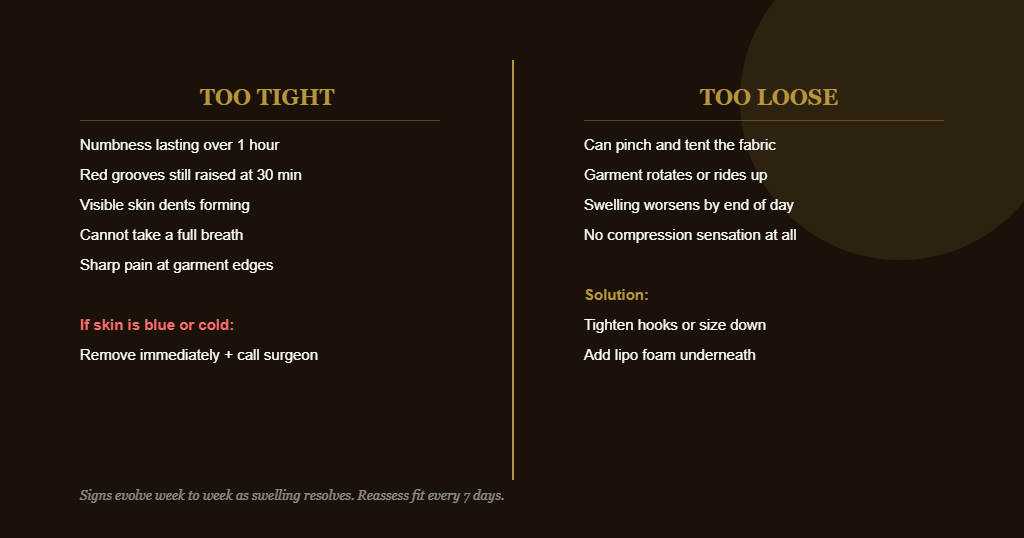
The most important signal is numbness or tingling that does not go away when you shift the garment. Some temporary pressure sensation when you first put the faja on is normal. What is not normal is persistent pins-and-needles down a limb or across your abdomen an hour after dressing. That pattern suggests the garment is compressing nerve pathways or restricting circulation, not just hugging tissue.
Deep red grooves that are still visible and raised thirty minutes after removing the garment are another flag. Skin indent marks that fade within ten minutes are typical. Marks that linger, especially if they are accompanied by a raised ridge or a line that feels different to the touch than surrounding skin, mean the edge of the garment is cutting in with too much force.
Visible dents forming in your skin over days (not just the temporary compression impression when you take it off) indicate the garment is deforming tissue rather than uniformly shaping it. This is particularly common at garment edges: the thigh band on a bodysuit, or the waist edge of a shorter faja. The dent forms because pressure is concentrated at a border instead of distributed across a surface.
Trouble taking a full breath, or the feeling that your rib expansion is blocked, means the garment is too small in the torso. Mild restriction is part of early recovery. Feeling like you cannot complete a slow deep breath is not.
Pain specifically at garment edges, the kind that is sharp rather than the background ache of surgery, is the clearest mechanical sign that the seams or boning are pressing where they should not.
The Signs Your Faja Is Too Loose
A too-loose faja is easier to dismiss because it does not hurt. It just does not work. The simplest test: can you pinch and tent the fabric away from your skin at the abdomen or flank? On a properly fitted garment, you should not have more than a fingertip-width of slack. If you can gather a fold, the garment is not generating meaningful compression at that point.
Rotation is the second sign. A well-fitted faja stays put. If yours rides up at the waist, twists to one side, or slides down at the thigh throughout the day, the garment is not anchored to your body contour. Loose fajas shift with movement, which means the compression pressure is inconsistent and the seams end up in wrong positions.
Swelling pattern changes at end of day are subtler but worth tracking. If your swelling looks significantly worse in the late afternoon or evening in a particular area, and that area happens to correspond to a region where the faja is loose, the garment is not holding fluid management in that zone.
No compression sensation at all is the simplest version of this problem. You should be aware of the garment. If you genuinely cannot feel it doing anything, it is not.
Why Fit Changes Week to Week (This Is Normal)
Swelling resolution is not linear and it is not uniform across your body. You may find that a faja that felt nearly too tight at day four feels loose at day fourteen, without you doing anything wrong. This is the process working. As fluid redistributes and initial swelling drops, the garment has less volume to compress against.
This is why the hooks-and-eyes system matters so much. Most fajas give you three or more columns of hooks, and you start on the loosest column in early recovery when swelling is at its peak. As swelling reduces, you tighten to the next column. When you genuinely run out of columns because the garment is now too large on its loosest setting, the garment is done. Not you. The garment has served its purpose for that stage, and you need a replacement or a stage transition.
Patients consistently describe week three as the week they panic about sizing, because swelling drops enough that the stage 1 faja suddenly feels enormous, but they are not sure whether they are ready to switch. If you are on the tightest hook column and still have significant slack, that is your answer. For the full decision framework on when to move from stage 1 to stage 2, the faja sizing and switching guide covers the timing in detail.
Recommended: Stage 2 Faja
When your surgeon clears the switch, look for hook-and-eye rows plus a zipper so the faja tightens as swelling drops. The Sonryse stage 2 is our standing pick for exactly that closure system.
How Foam Changes the Fit Equation
Lipo foam placed inside a faja changes the compression mathematics. The foam redistributes pressure across a larger surface area, which is exactly what it is supposed to do. What it also does is take up space. A faja that fits correctly without foam may feel genuinely too tight with foam underneath, especially in the first week when swelling is highest.
If you are wearing foam and feeling like the garment is too tight, try removing the foam and assessing: does the tightness resolve? If yes, the garment fits correctly and you may need to reduce foam thickness, adjust placement, or temporarily skip the foam for a few days. For specific guidance on how and where foam goes, the article on lipo foam placement is worth reading before you adjust anything.
If the tightness persists without foam, the garment itself is too small.
Recommended: Lipo Foam
Foam goes between skin and faja to keep compression even and stop a too-tight garment from digging into one spot. Buy a multi-pack since single sheets wear out mid-recovery. This lipo foam set fits under any garment.
When to Size Down Versus When to Switch Stages
Sizing down within the same stage makes sense when your current garment has become genuinely too loose but you still need the open-busk or wider coverage of a stage 1. Switching stages makes sense when the garment style itself is no longer serving your recovery phase, not just when the size is wrong.
Stage 2 fajas are firmer, often shorter, and designed for the period when your tissue is more stable and you need shaping rather than post-surgical support. Moving to a stage 2 too early means wearing a garment that does not accommodate drain sites, maximum swelling, or the mobility limitations of early recovery. Moving too late means missing the shaping window. The faja wear timeline explains the staging milestones by week so you can orient yourself.
The Circulation Red Flags That Mean Take It Off Now
Everything above is about fit optimization. This section is different. Call your surgeon immediately if you notice skin that is cold to the touch below the garment, skin that looks bluish, purple, or mottled (not bruising, which is patchy and browns over days, but active discoloration that is spreading or new), or severe pain that is escalating rather than stable. These are signs of compromised circulation that require medical attention, not garment adjustment.
When in doubt between two sizes in early recovery, the marginally looser garment with foam underneath almost always beats the tighter one. You can add foam. You cannot un-damage tissue that has been cut off from blood flow.
FAQ
My faja leaves marks on my skin. Is that normal?
Temporary marks that fade within ten to fifteen minutes of removing the garment are normal and expected. Marks that take longer than thirty minutes to fade, or marks that feel raised, hardened, or are accompanied by a lasting dent in the skin, suggest the garment is too tight or that a seam or boning is pressing in the wrong place. Reposition the garment, check that all hooks are evenly fastened, and if the marks persist, size up or consult your surgeon.
Can wearing a faja that is too loose actually hurt my results?
Yes, though the harm is different from wearing one that is too tight. A loose faja does not provide enough pressure to help your body manage swelling, support lymphatic drainage, or shape tissue during the period when it is still pliable. Fibrosis and irregular contour are more likely when compression is inconsistent. A loose garment that shifts and rotates also places seams and boning in unintended positions. If you find yourself rotating between garments of different fits, see the full guide on how many fajas you actually need to plan your recovery properly.
I am between sizes. Should I size up or size down?
In the first three weeks, size up. Early recovery swelling means your body is at or near its maximum volume, and a garment that fits correctly at week one will loosen appropriately as swelling resolves. Buying a garment that fits at week one’s smallest measurement usually means it is already too tight. If you are past the peak swelling phase and genuinely between sizes, try both with foam and without, and prioritize whichever gives you even, all-over compression without marks or numbness.
This article is for educational purposes only and is not a substitute for professional medical advice. Always follow your injector’s or surgeon’s specific aftercare instructions.