
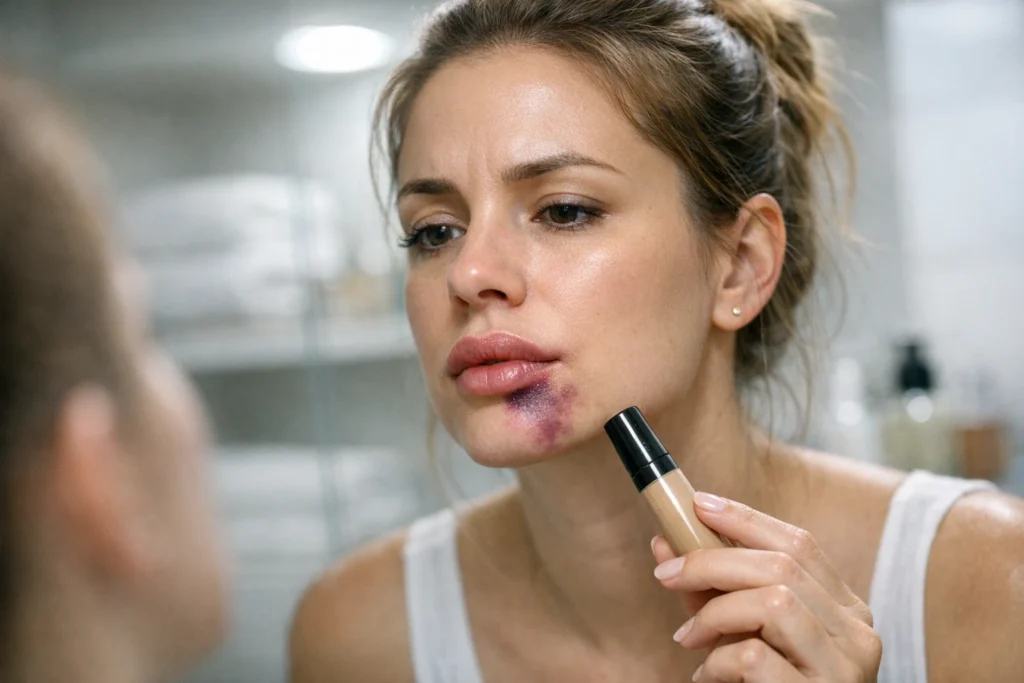
You went in on a Thursday because you had the weekend to recover. By Saturday you are looking at a bruise that has turned a spectacular shade of purple and extending toward your chin, and you are calculating whether it will be visible at Monday’s meeting. This is bruising after lip filler. It is not a complication. It is a probability that nobody communicates clearly enough in the consultation room.
The people who walk out looking untouched two days later mostly got lucky with anatomy, or timed their appointment strategically. Bruising after lip filler is the norm, not the exception. Knowing what color it will turn next week is more useful than panicking about what it looks like today.
Why Lips Bruise So Easily
The lips are extremely vascular tissue. The superior and inferior labial arteries run through the lip tissue, accompanied by a dense network of smaller vessels. There is very little distance between the surface and these structures. Any needle passing through the lip area has a high likelihood of clipping a small vessel, causing blood to escape into the surrounding tissue. That is bruising, and it has nothing to do with the skill of your injector in most cases.
Some people have more prominent vessels in the perioral area than others. Some have naturally thinner skin. Some have tissue that does not tamponade (compress back around a puncture) as efficiently. None of this is visible in advance. Your injector cannot predict with certainty whether you will bruise, only that the area is bruise-prone by nature.
The Bruise Color Timeline
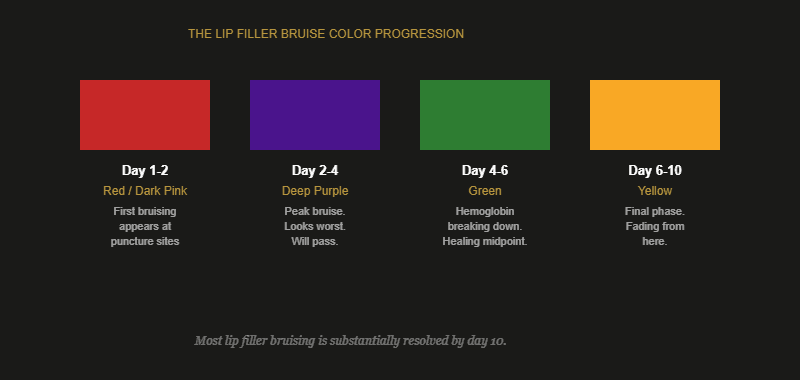
This is the single most reassuring piece of information available to a lip filler patient in the first week, and it almost never gets communicated. Bruising is not static. It changes color in a predictable progression as the body breaks down the blood that has pooled in the tissue.
Day one and two: if bruising appears, it typically starts as red or dark pink at the puncture site, sometimes extending outward. The swelling from the filler itself tends to dominate on day one, which can obscure or distort how much bruising is present.
Days two through four: the bruise deepens to purple, sometimes nearly black in concentrated areas. This is peak bruise and also peak panic for most patients. It looks severe. It is not.
Days four through six: the purple begins shifting to green. This is hemoglobin breaking down into biliverdin. It is normal and marks the middle phase of healing. Green bruising under concealer is actually easier to cover than purple because the color is less saturated.
Days six through ten: green transitions to yellow and light brown. The bruise is in its final phase and will fade from here. Most bruising from lip filler is substantially resolved by day ten, though some people carry a faint yellow tinge for a few days beyond that.
Patients consistently describe day four as the day they almost cancel their follow-up appointment convinced something is wrong. Knowing the timeline exists, and that purple means midway through rather than getting worse, changes the experience significantly.
What Reduces Bruising Before the Appointment
Timing matters. Alcohol thins the blood and increases bruising risk. Avoiding alcohol for 24 to 48 hours before your appointment is one of the most consistently recommended steps and one of the most consistently ignored ones. It does not guarantee no bruising, but it removes a controllable variable.
Some supplements and over-the-counter medications, including aspirin, ibuprofen, fish oil, vitamin E, and several others, can affect platelet function and increase bruising. Your injector should give you a full list of what to avoid before lip filler, and if they do not, ask. Do not stop any prescribed medication based on this article or any other non-medical source. The decision to pause a prescribed medication always goes through the prescribing doctor, not the injector.
Some injectors recommend starting arnica supplements a few days before the appointment — see the dedicated guide on arnica for bruising for a full breakdown of forms, timing, and what the evidence actually shows. Arnica is widely used and widely recommended in aesthetic recovery circles. The evidence base for it is genuinely mixed: some small studies suggest a modest effect, others show minimal benefit over placebo. It is unlikely to cause harm and many patients find it useful. It is probably not the variable making the biggest difference in whether you bruise.
Cold Compress Done Right
In the first 24 to 48 hours after your appointment, cold compress application can reduce swelling and may modestly limit how much bruising develops by constricting blood vessels near the puncture sites. After 48 hours, the window for cold to meaningfully affect bruising has largely passed. Cold at that point provides comfort but is not doing much to change the bruise.
Technique matters. A clean cold compress, a gel pack wrapped in a thin cloth, held gently against the lips for ten minutes at a time. Do not press hard. The goal is cooling the tissue, not compressing it. Do not apply ice directly to the skin or lips. Do not use frozen food products that are harder to control for pressure and temperature.
Some patients find that the cold compress creates discomfort around the fresh injection sites. Light contact is fine. If it hurts, ease up. The benefit is modest enough that if it is uncomfortable, it is not worth forcing.
The Makeup Window: When and How to Cover
Most injectors recommend waiting at least 24 hours before applying makeup over the injection sites themselves. Some recommend 48 hours for lips specifically, because the lip area is a moist environment that takes slightly longer for puncture sites to close fully. This is not the injector being overcautious. An open puncture site is a direct route into recently injected tissue, and applying product over it carries infection risk that is simply not worth taking for cosmetic reasons.
When you do start covering: a peach or orange-toned color corrector applied before concealer is more effective than going straight to concealer for purple and green bruising. The color wheel logic works: orange neutralizes blue-purple, peach neutralizes green-yellow. Apply the corrector, then layer a concealer that matches your skin tone over it, then set with a light powder. Avoid heavy product accumulation in the fine lines around the lip border, which tends to look worse than the bruise itself.
Lip products can resume once the injection sites have closed. At that point, applying lipstick or gloss directly on the lip is fine. The concern is about the puncture sites specifically, not the lip surface generally. Ask your injector when they consider the sites sufficiently closed if you are not sure.
The honest take on concealing lip bruising: it is harder to fully conceal than body bruising because the face is well-lit and closely examined in daily interaction. Accept that some level of visibility may persist through the purple and green phases regardless of technique. Schedule important events for at least ten days after your appointment, not three.
When the Bruising Is Not Bruising: Vascular Warning Signs
Ordinary bruising develops gradually, changes color through the progression described above, and responds to time. There are warning signs that are not ordinary bruising and require immediate contact with your injector or a medical provider.
Blanching: a white or pale patch appearing during or immediately after the injection. This can indicate that filler has entered a blood vessel and is blocking blood flow. A good injector will catch this during treatment. If you notice white patches developing in the hours after your appointment, contact your injector immediately.
Dusky or dark gray-purple discoloration that appears in a defined pattern, particularly around the nose or in areas not directly injected, and does not look like ordinary bruise spreading. This can also indicate vascular compromise. Do not wait to see if it resolves. Call your injector same day.
Severe pain that is worsening rather than improving in the hours after your appointment. Soreness and tenderness are expected. Pain that is escalating over time is not.
Ordinary bruising, even large purple bruising, does not come with these features. It progresses slowly through color changes, it does not create a cold or numb sensation, and it does not concentrate in defined vascular patterns. The full lip filler recovery timeline covers what normal looks like day by day, which is the best calibration tool for knowing when something has moved outside that range.
One final note: timing your appointment is not about vanity alone. The natural question of how the body handles swelling relates to diet choices some people make before procedures. Whether pineapple actually reduces lip filler swelling is worth reading if you are in the pre-appointment research phase, because that claim gets a lot more confidence than the evidence warrants.
FAQ
How long does lip filler bruising usually last?
Most lip filler bruising resolves between seven and ten days. The purple peak at days three to four is the worst it gets in most cases, and it transitions through green and yellow before fading. Some people clear faster, particularly lighter bruising in people with faster healing. Some carry a faint yellow tinge past the ten-day mark. Booking anything with close scrutiny of your appearance should have a ten-day minimum buffer from your appointment.
Does lip filler bruising mean something went wrong?
No. Bruising is a predictable outcome of injecting into highly vascular lip tissue, not a sign of technique error. Even experienced injectors with the best technique have patients who bruise significantly, because the anatomy of the individual patient determines bruising risk more than the injection approach does. A bruise that progresses through the expected color changes and resolves within two weeks is part of normal recovery, not an adverse event.
Can I get lip filler dissolved to remove the bruising?
Dissolving filler with hyaluronidase does not remove bruising. The bruise is blood in the tissue, not filler. It will resolve on its own timeline regardless of whether the filler is present or dissolved. Dissolving filler in the bruising phase also carries additional procedural risks and should not be done as a response to bruising unless there is a specific clinical reason for it.
This article is for educational purposes only and is not a substitute for professional medical advice. Always follow your injector’s or surgeon’s specific aftercare instructions.