
The compression fibers in your faja don’t fail from wearing. They fail from washing wrong. Specifically, they fail in the dryer, usually on the first or second cycle, and the damage is invisible until you realize your garment feels snug but isn’t actually doing anything.
This matters because a faja that has lost its compression still feels like a faja. It’s warm, it’s fitted, it covers your surgical sites. It just isn’t generating the pressure your body needs right now. You’ve paid for compression and you’re getting a tube of fabric. Learning how to wash a faja correctly is the difference between a garment that works for eight weeks and one that quietly retires after week two.
Why Heat Is the Enemy of Compression
The compression in your faja comes from elastane (sometimes called spandex) woven into a powernet or similar technical fabric. Elastane is highly heat-sensitive. At the temperatures a standard clothes dryer reaches, typically 125 to 135 degrees Fahrenheit, the fiber begins to break down at a structural level. It loses elasticity. It cannot recover.
This is not a gradual process. One dryer cycle at high heat can degrade a faja’s compression meaningfully. Two cycles and you’re wearing very expensive shapewear. The fibers also break down with hot water washing, so “skip the dryer, hot wash is fine” does not save you. Cold water only. Always.
Direct sunlight is a slower version of the same problem. Hang your faja to dry in shade or indoors. A faja draped over a sunny windowsill for a few hours is not as bad as the dryer, but it’s not neutral either. Cool, indirect airflow is what you want.
Hand Wash vs Machine Wash: What Actually Works
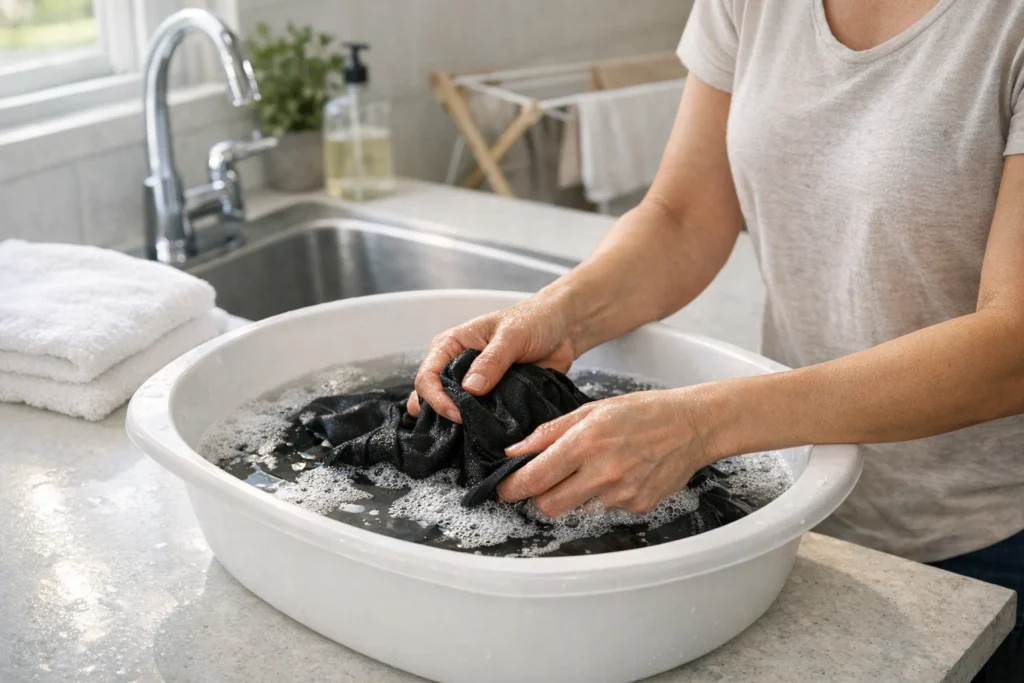
Hand washing in cold water is the gold standard. Fill a basin or your sink, add a small amount of gentle detergent (more on that below), submerge the faja, work it gently for two to three minutes, then rinse thoroughly. The goal is to flush out sweat, drainage residue, and skin oils without stressing the fibers. This takes about five minutes and costs you nothing in garment longevity.
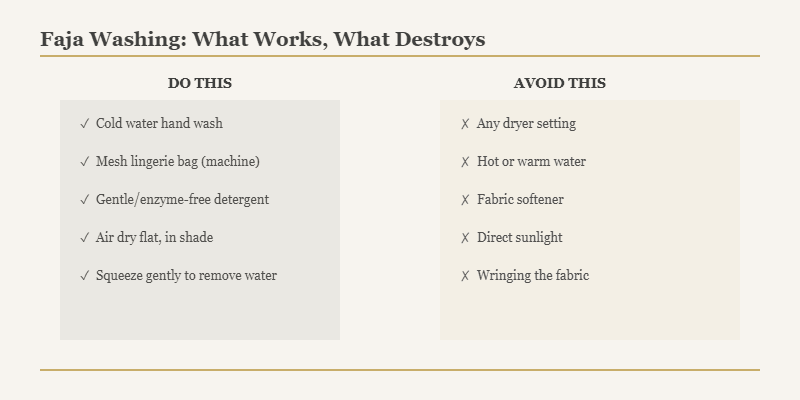
Machine washing is workable if you’re disciplined about it. Cold water cycle, delicate or gentle setting, and the faja must go inside a mesh lingerie bag. Without the bag, agitation from the machine will pull and distort the fabric in ways that don’t show immediately but accumulate over multiple washes. With the bag, machine washing is a reasonable compromise when hand washing isn’t practical. Never machine wash without the bag. That’s not a preference, it’s the difference between the garment lasting three weeks or eight.
What you should not do is throw the faja in with your regular laundry on a warm cycle. That’s how most fajas are ruined. It feels efficient until you’re two weeks into recovery and your compression garment is functionally decorative.
Detergents to Avoid (and What to Use Instead)
Fabric softener is the worst thing you can put on a compression garment. It works by coating fibers with a thin lubricant layer to make them feel softer. That coating is exactly what you don’t want in a garment whose purpose is to grip and compress. Fabric softener doesn’t permanently destroy elastane the way heat does, but regular use degrades the surface texture that helps the garment hold its position against your skin and reduces the friction that keeps foam boards and liners in place.
Avoid standard laundry detergents with enzymes (the ones marketed for “deep cleaning” or “tough stains”). Enzymatic cleaners are aggressive on protein fibers, and while elastane is synthetic, the repeated exposure wears on the material. Bleach is obvious, but worth stating: never.
What works: a small amount of gentle lingerie wash or any fragrance-free, dye-free, enzyme-free detergent. Some patients use a small amount of mild dish soap in a pinch. The goal is to clean without introducing chemistry that degrades the fiber. You need very little product. The faja isn’t dirty in the way a gym shirt is dirty. Rinsing is actually more important than the washing.
How Often to Wash During Active Recovery
In the first week post-op, you’re washing daily. Surgical drainage soaks into the fabric quickly, and leaving it overnight creates both hygiene and odor problems. After the drainage slows, usually around day five to ten for most patients, you can move to washing every one to two days.
This is exactly why owning two fajas per stage is non-negotiable, not a luxury. When you wash in the evening, the faja needs to air dry fully before you put it back on. Putting on a damp faja is uncomfortable and defeats part of the compression purpose since wet fabric compresses differently than dry fabric. Full air drying takes 12 to 24 hours depending on the garment’s weight and your environment’s humidity. That gap is covered by your second garment. There is no other practical solution.
If you’re unsure how to time the transition between your stage 1 and stage 2 garments, the stage 1 vs stage 2 faja switching and sizing guide covers the specific signals to look for. The washing care routine is the same across both stages, but the garments themselves are different enough that they shouldn’t be cross-used as backups.
Recommended: Stage 2 Faja
A faja takes hours to air dry and you are supposed to be in compression the whole time, so washing one really just means going without. The realistic answer is a second garment. This stage 2 Colombian faja is the one we point sizing questions to. If you’re weighing brands rather than just sizing, choosing between Sonryse and Salome comes down to closure and fit more than anything else.
How to Air Dry Correctly
Flat drying is better than hanging. When you hang a wet compression garment, the weight of the water pulls the lower portion of the fabric, stretching it unevenly. Over multiple washes, this creates a garment that fits differently at the hip than it did when it was new. Lay it flat on a clean, dry towel or a mesh drying rack. Reshape it gently to its original form before leaving it.
If you must hang it, use a drying rack and hang it by the widest part of the waistband, not by a strap or narrow edge. Avoid hanging in a closed bathroom where humidity stays high. Garments dry faster in a room with some air movement.
Do not wring the faja to remove water. Squeeze gently, then roll it in a dry towel to absorb excess moisture, then lay flat. Wringing distorts the same elastic fibers that heat destroys.
How to Tell When Your Faja Has Lost Compression and Needs Replacing
The test is simple: put on your faja and sit down, then stand and move. A compression garment with intact elasticity will grip and follow your movement. It will feel like it’s actively holding you. A garment that has lost compression will feel present but passive. It won’t roll at the edges, but it also won’t resist the way it should.
Other signs: the garment no longer leaves any temporary skin indentation when removed, the fabric has a looser, more pilled texture than when new, or you notice swelling that responds to removing the garment but returns faster than it used to. Any of these means the garment has passed its functional end of life. It’s still a piece of clothing. It is no longer a medical-grade compression tool.
For stage 1, this typically becomes relevant around the four to six week mark. Stage 2 garments tend to last longer because they’re worn in a lower-swelling phase and typically take less daily abuse. Either way, the signs are the same. Trust what you’re feeling, not what the garment looks like.
If you’re building out your full recovery garment plan and aren’t sure yet how many pieces you actually need across both stages, the complete breakdown lives in how many fajas you need after lipo, including the budget math for the full wardrobe.
Compression check: Washing keeps your faja’s elastane intact, but fit still matters day to day. Not sure if yours is too tight, too loose, or working exactly right? See the warning signs to look for — and if you’re layering foam or a board underneath, learn how they stack under your garment for even compression.
FAQ
Can I put my faja in the dryer on a low or no-heat setting?
The no-heat or air-fluff setting is technically safer than high heat, but it still introduces tumbling action that stresses the fibers over time. It also takes almost as long as air drying. There’s no real upside to the dryer when flat drying is available, so it’s a risk with no practical benefit. Air dry flat and skip the machine entirely.
My faja smells even after washing. What’s going on?
Drainage, sweat, and the oils from healing skin can bond to synthetic fibers and require more than a quick cold rinse to clear. Try soaking the garment for 15 to 20 minutes in cold water with a small amount of white vinegar before washing, then rinse thoroughly. Persistent odor in a new garment is almost always a rinsing issue: the detergent or body residue didn’t fully clear. Don’t use more detergent, use less and rinse more.
Is it okay to wear my faja slightly damp if I’m in a rush?
Slightly damp is uncomfortable and compresses differently than dry fabric, so you won’t get the full benefit. More practically, a warm, damp faja worn against surgical skin during the healing phase creates conditions that aren’t ideal for the incision sites. If you’re in this situation regularly, it’s a signal that you need a second garment in rotation. That’s the real fix, not tolerating a damp one. If your garment also feels uncomfortably restrictive when you put it back on, see the guide on what to do if your faja is too tight — sometimes what feels like tightness is actually compression working correctly, and sometimes it’s a sign the fit needs adjusting.
This article is for educational purposes only and is not a substitute for professional medical advice. Always follow your injector’s or surgeon’s specific aftercare instructions.