
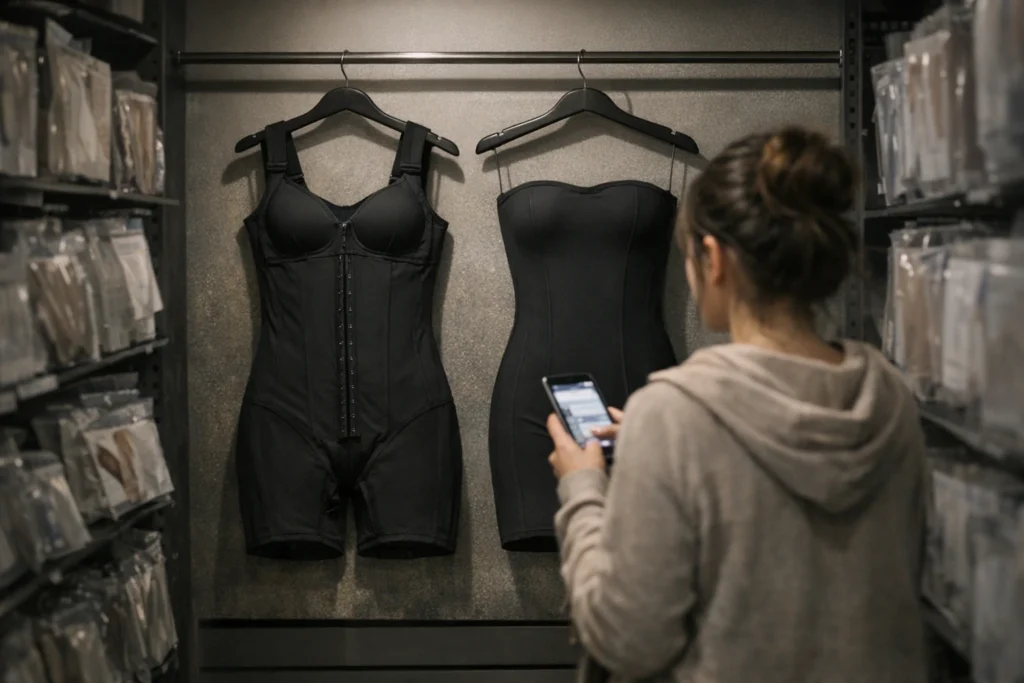
You’re standing in the post-op supply aisle at 1am, or scrolling on your phone three days before surgery, staring at two nearly identical black compression garments. Both say stage 2. Both promise real recovery support. Both listings use the phrase “surgeon trusted” like it settles the argument. It doesn’t, and here’s the one-sentence version before the details: the sonryse vs salome faja decision comes down to design differences you can actually check, not brand loyalty. Neither one is a scam, and neither is a miracle garment. They are two different engineering answers to the same recovery problem.
Both are legitimate Colombian post-surgical garments. Neither is a wrong choice. But they’re built differently enough that the right one for you depends on what your torso and your recovery actually need, not which brand shows up first in search. Every difference below comes from what each brand states on its own current listing, not from marketing copy on the box or claims you’ll find repeated across forums.
Quick Verdict: Sonryse’s built-in bra and wider size range (up to 4XL) make it the safer default for most torsos. Salome’s strapless cut is the better call if you already have chest support handled and want a garment that disappears under strapless or off-shoulder clothing.
| Feature | Sonryse Stage 2 | Salome Stage 2 |
|---|---|---|
| Bra / straps | Built-in bra with wide straps | Strapless design, no built-in bra |
| Closure (as stated on listing) | 2 levels of hook and eye | Not specified in the listing copy |
| Crotch design | Open crotch | Not specified in the listing copy |
| Fabric | Powernet | Powernet |
| Size range offered | XS to 4XL (8 sizes) | XS to 3XL (7 sizes) |
| Care instructions | Hand wash only | Hand wash only |
The Bra Question Decides More Than People Expect
If you had any procedure that touches the chest or torso alongside your lipo or BBL, or you simply don’t want to manage a separate post-surgical bra on top of everything else, Sonryse’s built-in bra earns its keep. It’s one less garment to buy, wash, and coordinate. Salome’s strapless cut solves a different problem: it disappears under strapless dresses, tube tops, and off-shoulder pieces in a way a built-in bra never will.
Neither design is objectively better. The honest question is what you’re already wearing underneath and what your surgeon told you about chest support during your specific recovery.
If your procedure list includes anything above the waist, breast augmentation, lipo of the bra line, an arm lift, ask your surgeon directly whether a separate compression bra is part of your plan. If it is, Salome’s strapless design stops being a comfort question and becomes the simpler setup, since you won’t be stacking two separate bust-support pieces on top of each other.
What the Closure Systems Actually Tell You
Sonryse’s own listing states its closure plainly: two levels of hook and eye. That detail matters more than it sounds. Multiple hook levels mean you can tighten the garment incrementally as swelling shifts week to week, instead of being stuck between one setting that’s too loose and the next that’s too tight.
That incremental adjustment isn’t a minor convenience either. Swelling after lipo doesn’t drop in a straight line. It moves in waves, worse some mornings than others, and a garment that only offers one fixed setting forces you to choose between too tight on a good day or too loose on a bad one.
Salome’s listing doesn’t spell out its closure hardware at all, which is a gap in the product copy, not necessarily a flaw in the garment. Customer photos and reviews describe a hook-and-zip combination, but that’s reviewer testimony, not manufacturer specification, so treat it as a lead to verify rather than a fact to rely on.
Sizing Range: The Extra Size Isn’t Just Marketing
Sonryse’s listing runs X-Small through 4X-Large. Salome tops out at 3X-Large. One size sounds trivial until you’re the person just outside a brand’s top listed size, hunting for a garment that will actually close. If you’re near either end of the size chart, check both brands’ size charts against your own measurements before you decide anything else in this article.
For a deeper look at how compression needs change as your body does, our sizing guide walks through sizing at each stage in more detail than either Amazon listing will.
The Open Crotch Detail Nobody Talks About
Sonryse’s listing states an open crotch design plainly. That detail sounds small until you are three days post-op and every bathroom trip involves peeling off a full-body garment. An open crotch means you unhook a smaller panel instead of wrestling the whole compression layer down and back up, which matters more at 2am than any spec sheet suggests.
Salome’s listing does not mention crotch design at all, positive or negative. That is a real gap in the product copy, not evidence the garment lacks the feature. If bathroom convenience is high on your list during early recovery, this is worth asking a customer service rep before you buy rather than assuming either way.
Who Should Buy Which
Choose the Sonryse Stage 2 if built-in bust support and room to size up to 4XL matter more to you than a strapless silhouette. It is the safer default for most torsos and most post-lipo timelines.
Choose the Salome Stage 2 if you already have chest support handled elsewhere and want a strapless cut that disappears under fitted or off-shoulder clothing. Its top size caps at 3XL, so check the chart first.
One garment is rarely the whole story. Most patients rotate at least two so a clean one is always ready while the other is being hand washed, which is worth planning for before your first fitting.
Garment discomfort is normal in the first few weeks: tightness, warm skin, pinching at a fold when you sit down. Pain that is sharp, one-sided, or paired with a change in skin color is not something to solve with a tighter hook setting. That combination means calling your surgeon, not reordering a smaller size.
Frequently Asked Questions
Can I switch between Sonryse and Salome mid-recovery?
Yes, as long as both are rated for your current recovery stage. Compression level matters more than brand loyalty here. Just confirm the closure style and size chart match what your surgeon cleared for this point in recovery.
What if I’m between two sizes on the chart?
Most patients in that spot do better sizing up rather than down, especially in early recovery when swelling is highest. A garment that is too tight can restrict circulation and cause the exact skin changes that warrant a call to your surgeon.
How long do I wear a Stage 2 faja before moving on?
Timelines vary by procedure and surgeon, but Stage 2 typically runs several weeks past Stage 1. Your surgeon’s specific schedule overrides any general timeline you read online, including this one. Swelling patterns, activity level, and the specific procedure all shift that window, which is exactly why the schedule your surgeon gives you should carry more weight than any general timeline, including the stage breakdown in our sizing guide above.
Does the fabric feel different between the two brands?
Both listings describe a Powernet-type compression fabric, so the base material is the same category. Fit, not fabric, is what actually separates the day-to-day feel of these two garments, since the same fabric behaves differently depending on how the panels are cut and where the seams sit against your body.
DOES THE OPEN-BUST DESIGN MEAN LESS COMPRESSION OVERALL?
No. Open bust changes where compression starts and stops relative to the bustline, not how firm the compression is across the torso and abdomen. If your procedure needs bust compression specifically, that’s a built-in-bra question, not a firmness question.
This article is for educational purposes only and is not a substitute for professional medical advice. Always follow your injector’s or surgeon’s specific aftercare instructions.