
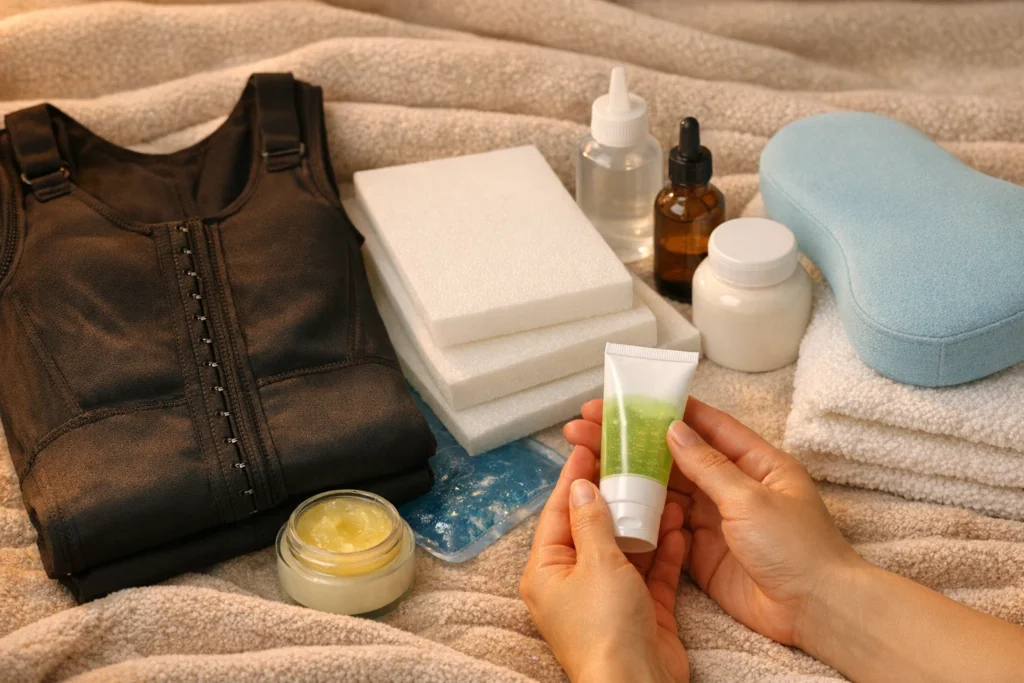
Your surgery date is set, and now you’re staring at a TikTok video promising the “25 things you NEED for lipo recovery,” followed by a blog post from a compression garment brand that conveniently recommends four of its own products. Somewhere between the influencers and the retailers, nobody is telling you the plain truth: most of that list is padding.
This is the honest version of a lipo recovery kit. Four things are genuinely essential. Three more depend entirely on which procedure you had. Everything else getting pushed on pre-op patients right now is either premature, redundant, or padding sold to anxiety. Below is which is which, and when to actually buy each one.
Want the shopping list without the reasoning? Jump to the FAQ or the summary table near the bottom.
Quick verdict: A stage 1 faja, lipo foam sheets, and arnica gel are needed from day one. A stage 2 faja is essential too, but you buy it later, once swelling has resolved enough to size it correctly. An ab board, BBL pillow, and fibrosis roller depend entirely on your specific procedure. The 30-piece “recovery kits” flooding shopping carts right now are mostly gauze, tape, and markup.
What You Actually Need
These four items are not optional. Every lipo patient needs some version of each one, regardless of treatment area, and three of the four need to be in the house before surgery day, not ordered afterward while you’re too sore to sit at a computer.
A Stage 1 Faja You Buy Before Surgery
This is the garment you wear home from the surgery center, so it needs to be purchased and in your bag ahead of time, not ordered the week after. Look for a full-body stage 1 design, since compression needs to extend beyond just the treated area in the first weeks. A full-body stage 1 faja built for post-surgical wear is the standard starting point that most surgeons describe at pre-op.
If you haven’t finished building your full pre-op bag yet, our checklist for what to pack for lipo surgery day covers everything else you’ll want within reach.
Lipo Foam Sheets (Buy More Than One Set)
Foam goes under the compression garment starting day one, cushioning and evening out pressure over treated areas. It compresses and loses shape with wear and washing, so a single sheet will not last your whole recovery. A multi-pack of lipo foam sheets is the more practical purchase than buying one sheet at a time.
Arnica Gel, With Modest Expectations
Arnica will not erase bruising. What it may do, applied to fully closed skin only, is take the edge off the worst of it for some patients. Treat it as a minor assist, not a miracle. A fragrance-free arnica gel is the simplest version of this to keep on hand, applied only once skin is closed and your surgeon has cleared topical products.
A Stage 2 Faja (Essential, But Not Yet)
Here is the part almost nobody selling you a “complete kit” will say out loud: do not buy your stage 2 faja before surgery. Sizing depends entirely on how your swelling resolves over the following weeks, and buying ahead of that is how patients end up with a stage 2 garment that no longer fits by the time they’re cleared to wear it. Wait until your surgeon tells you it’s time to switch, then size against your body as it actually is that week. Our guide to switching from stage 1 to stage 2 walks through timing and sizing in detail. When you’re ready, a stage 2 faja is the general style to look for.
Depends on Your Procedure
These three are not universal. Whether you need them comes down to what was actually done, not what an algorithm decided to show you.
Ab Board (Lipo 360 and Tummy Tuck Patients)
An ab board sits between the garment and your abdomen, spreading compression evenly and helping prevent the rippling and uneven swelling that can otherwise show up over the treated area. It matters most for lipo 360 and tummy tuck patients, less so for isolated areas like arms or thighs. A front and back ab board and foam set covers the standard need here. Our full comparison of abdominal boards versus lipo foam goes deeper into when you need one, the other, or both.
BBL Pillow (BBL Patients Only)
This one is a BBL-specific add-on, not a general lipo item. If you had fat transferred to the buttocks, a cutout pillow that keeps pressure off the grafted area while sitting is part of protecting your results, not a comfort item. A BBL-specific support cushion is built for exactly this. If you did not have fat grafting, skip this one entirely.
Fibrosis Massage Roller (If Hard Spots Develop)
Fibrosis, the hard, uneven tissue that can form as swelling resolves, is common enough that many surgeons recommend early attention to it, either through professional lymphatic massage or at-home tools. A massage roller designed for fibrosis and lymphatic work is a reasonable option if hard spots show up and professional massage isn’t in the budget, or as a supplement between sessions.
One distinction matters here. Ordinary firmness that responds to gentle rolling is normal tissue healing. Hard lumps that are warm to the touch, red, or noticeably worse on one side only are not a massage project. That’s a call to your surgeon, not a home remedy.
Buy Later, Not Now
Silicone Scar Sheets
Scar treatment is a real thing to plan for. It is also useless, and occasionally irritating, if you start before your incisions are fully closed. Add this to your cart mentally, then actually buy it once your surgeon confirms you’re closed and cleared for topical scar products. Clear silicone scar sheets are the standard option once you get there.
Skip These
The 30-piece “BBL and lipo recovery kits” sold as one bundle are mostly gauze, medical tape, and markup dressed up as a complete solution. You already have most of what’s in those boxes in a bathroom cabinet somewhere, and the parts you don’t have are cheaper bought individually.
Brand-labeled “lipo recovery” versions of generic items, ice packs, body wash, sleep pillows, sold at triple the price of the identical unbranded product with the word “lipo” printed on the label, are marketing, not medicine.
Duplicate stage 2 garments bought before your sizing is knowable belong on this list too, for the same reason your stage 1 to stage 2 timing matters above. And compression “accessories” marketed as extra tools that just duplicate what foam sheets already do are money spent twice on one job.
The Full List at a Glance
| Item | What It Does | When to Buy |
|---|---|---|
| Stage 1 faja | Full-body compression worn from day one | Before surgery |
| Lipo foam sheets | Even pressure under the garment, protects skin | Before surgery, buy a multi-pack |
| Arnica gel | Modest bruising support on closed skin | Before surgery, use once closed |
| Stage 2 faja | Lighter, longer-term compression | Only once your surgeon clears the switch |
| Ab board | Even compression over the abdomen | Before surgery, lipo 360 and tummy tuck patients |
| BBL pillow | Keeps pressure off grafted fat while sitting | Before surgery, BBL patients only |
| Fibrosis massage roller | Helps with hard, uneven tissue as swelling resolves | If firm spots develop, or budget is tight for professional massage |
| Silicone scar sheets | Supports scar maturation | Only after incisions are fully closed |
FAQ
How many stage 1 fajas do I actually need?
Enough that one can be washing while you wear the other, since these garments typically need to stay on nearly around the clock in the early weeks. Follow your surgeon’s specific compression schedule rather than a generic number, but plan for a backup so wash day doesn’t leave you without coverage.
When should I switch from stage 1 to stage 2?
By fit and your surgeon’s clearance, not by a date on a calendar. Swelling resolves at different speeds for different patients, and switching too early into a garment sized for a smaller, less swollen body defeats the purpose of staged compression.
Is a fibrosis roller a substitute for professional lymphatic massage?
Not exactly, but it can be a reasonable supplement or a lighter-budget option between sessions. It isn’t a substitute for medical attention if you notice lumps that are warm, red, or dramatically worse on one side. That pattern calls for a conversation with your surgeon, not more rolling.
This article is for educational purposes only and is not a substitute for professional medical advice. Always follow your injector’s or surgeon’s specific aftercare instructions.