
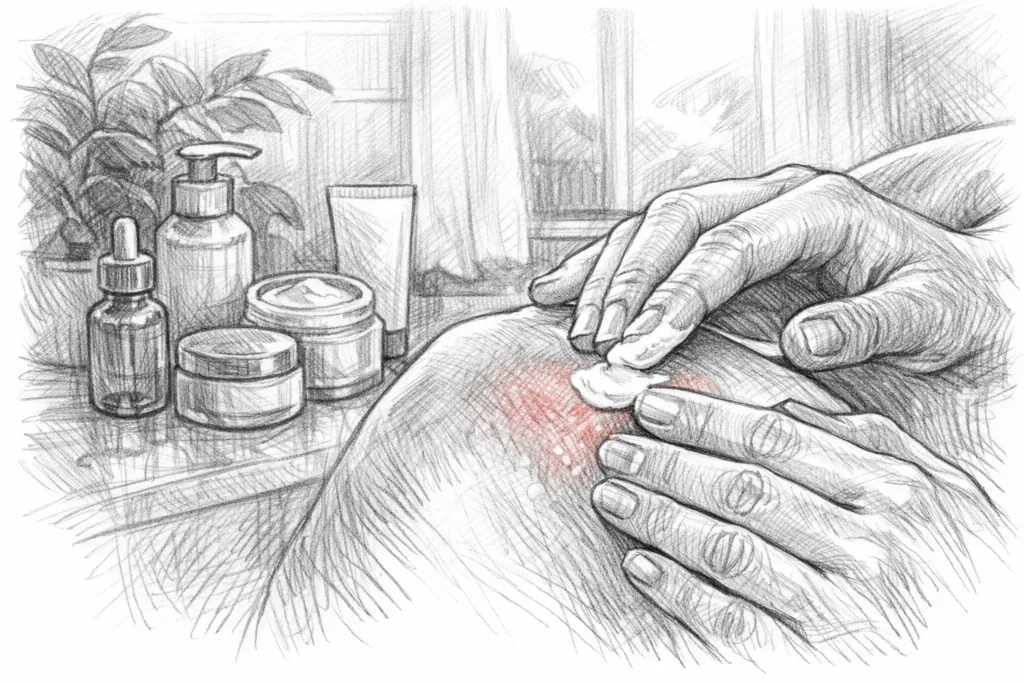
The day after your peel or laser session, you reach for your usual vitamin C serum out of habit. Redness, stinging, and a burning sensation you probably charitably describe as “my skin is just sensitive right now.” It is not sensitivity. It is your skin telling you that you have applied an acid to an open wound. Your barrier is not a vague metaphor. It is a specific structure, and right now it is compromised. The serum goes back on the shelf.
Have a specific question? Jump to the FAQ section.
Quick Answer
Every procedure that touches the skin disrupts the stratum corneum, the lipid matrix that controls moisture retention and keeps environmental aggressors out. The immediate goal after any ablative, puncturing, or chemical procedure is restoring that structure, not treating other concerns. Ceramides, panthenol, niacinamide at lower concentrations, and centella asiatica have the strongest evidence base for barrier support. Retinoids, AHAs, BHAs, and high-concentration vitamin C need to wait until your skin has recovered.
What Your Skin Barrier Actually Is
The stratum corneum is the outermost layer of the epidermis, and it functions as a lipid matrix made primarily of ceramides, cholesterol, and free fatty acids in roughly a 3:1:1 ratio. Ceramides make up approximately 50% of that lipid mass. This ratio is not arbitrary. Clinical evidence supports that barrier repair formulations mimicking this ratio perform better than single-component approaches. A product that contains ceramides but no cholesterol or fatty acids is replacing part of the structure. The ratio matters.
When a cosmetic procedure disrupts this matrix, whether through the micro-channels created by microneedling, the chemical exfoliation of a peel, or the thermal injury of laser resurfacing, the barrier’s ability to retain moisture and exclude environmental irritants is reduced proportionally to the degree of disruption. A superficial chemical peel compromises a different level of the stratum corneum than a fractional CO2 laser. Both require barrier repair. The intensity and duration of that repair period differ.
What’s Normal During Barrier Recovery
Tightness and mild sensitivity in the first 24-72 hours after most procedures
Dryness and slight flaking as old skin cells shed (especially after peels)
Mild redness that gradually diminishes over several days
Sensitivity to products that would not normally cause irritation
Skin feeling “different” or reactive even to water temperature
When to Call Your Provider
Redness that is intensifying rather than gradually fading
Oozing, weeping, or crusting beyond what the provider described as expected
Signs of infection: warmth, swelling, yellow discharge, fever
Blistering that was not anticipated for your procedure type
Burning or stinging that persists even with barrier-only products
Ingredients That Actually Support Skin Barrier Repair After Cosmetic Procedures
Ceramides are the most direct structural support available in topical form. Look for formulations that contain ceramides alongside cholesterol and fatty acids, not ceramides alone. The ratio matters because the stratum corneum lipid ratio is what determines barrier function, and a ceramide-only product replaces only part of the architecture. Products that list ceramides, cholesterol, and fatty acids in the first half of the ingredient list are doing something meaningful. Products that list ceramides as the twelfth ingredient after fragrance are marketing ceramides.
Panthenol, also listed as Pro-vitamin B5, converts to pantothenic acid in the skin and supports tissue repair and barrier function. It is anti-inflammatory, well-tolerated even on very compromised skin, and has a solid documentation base for wound healing support. If your post-procedure skin can tolerate one non-ceramide ingredient early in recovery, panthenol is the candidate.
Centella asiatica, frequently appearing on labels as cica, has anti-inflammatory properties and supports collagen synthesis. It has a reasonable evidence base for post-procedure skincare, is widely used in Asian skincare traditions for wound healing, and tolerates well on compromised skin. It is not magic, but it is genuinely useful in this context.
Niacinamide supports ceramide production and is anti-inflammatory, but the concentration matters after a procedure. At 10% or above, niacinamide can cause irritation on very compromised skin. In the two to five percent range, it is well-tolerated and genuinely supportive. If you are reaching for a niacinamide product during recovery, check the concentration. Most clinical skincare products list the percentage. Mass-market products often do not. When in doubt, choose a lower-concentration option during the acute recovery phase. The article on niacinamide after cosmetic procedures covers this timing question in more detail.
Hyaluronic acid is useful for hydration but works only when sealed in with an occlusive. Applied to open or compromised skin without a barrier layer on top, humectants draw moisture from the dermis rather than from the environment, which is the opposite of what you want. Apply hyaluronic acid to slightly damp skin and follow immediately with a ceramide-rich cream or an occlusive like petrolatum.
[IN-BODY IMAGE PLACEHOLDER]What to Avoid and Why
Retinoids should be paused during active recovery. Retinol and tretinoin increase cell turnover, which is exactly the wrong mechanism when the goal is stabilizing and repairing an already-compromised barrier. This applies even if you are a long-term tretinoin user with established tolerance. Pause it. Most providers give a specific timeline for reintroduction, and that timeline exists for a reason. The article on retinol after cosmetic procedures gives specifics by procedure type.
AHAs and BHAs (glycolic acid, lactic acid, salicylic acid) are exfoliants. The stratum corneum has already been exfoliated or disrupted by your procedure. Adding more exfoliation delays barrier repair and increases the risk of hyperpigmentation, particularly in darker skin tones where post-inflammatory hyperpigmentation is already a meaningful concern after procedures. These go in the drawer until your provider clears them.
High-concentration vitamin C in the ascorbic acid form is acidic and will sting and irritate on compromised skin. Some patients tolerate vitamin C derivatives (ascorbyl glucoside, sodium ascorbyl phosphate) better during recovery, but most providers recommend waiting until barrier function is restored before reintroducing any vitamin C formulation. Fragrance and essential oils belong in the same category: common irritants even on intact skin, and a reliable source of contact dermatitis on compromised skin. Not the time.
How to Reintroduce Products After Recovery
The general sequence that makes sense clinically starts with barrier-only products for the first one to two weeks post-procedure, depending on the intensity of what was done. This means ceramides, panthenol, and gentle moisturizers. Nothing that has a “treatment” purpose.
Once the barrier is restored and the provider has cleared you, antioxidants come next: low-concentration vitamin C derivatives, niacinamide in the two to five percent range, or products containing vitamin E. Then gentle actives, meaning niacinamide at slightly higher concentrations, azelaic acid for those who use it. Retinoids and strong acids come last. The natural instinct is to rush back to the routine that was working before the procedure. That instinct works against your recovery.
| Recovery Phase | What’s Appropriate | What to Avoid |
|---|---|---|
| Days 1-7 (early) | Ceramides, panthenol, centella, plain SPF, gentle cleanser | Everything else |
| Weeks 1-2 | Add hyaluronic acid (sealed with occlusive), low-percentage niacinamide | Actives, retinoids, acids, fragrance |
| Weeks 2-4 (provider-cleared) | Antioxidants, niacinamide 5-10%, azelaic acid | Retinoids, glycolic, salicylic |
| Month 1+ (provider-cleared) | Gradual return of stronger actives, vitamin C | Strong acids without tolerance check |
| Final clearance | Tretinoin and prescription-strength actives | Anything causing irritation |
The Honest Moment on “Barrier Repair” Marketing
“Barrier repair” has become a marketing phrase applied broadly to products that do not contain meaningful quantities of the lipids that actually repair the barrier. This is not a minor quibble. It is the difference between a product that does something and a product with label copy. Look at where ceramides appear in the ingredient list. Ingredients are listed in descending order of concentration. If ceramides appear after fragrance, after multiple alcohols, or after a list of ten other ingredients, they are present as a label ingredient, not as a functional barrier repair component. Read the ingredient list before you buy anything for post-procedure use, and do not let the word “barrier” on the front of the package substitute for that check.
Frequently Asked Questions
Can I use my regular moisturizer after a cosmetic procedure?
It depends on what is in it. If your regular moisturizer is fragrance-free, contains ceramides or panthenol, and has no active acids or retinoids, it is likely appropriate. If it contains fragrance, essential oils, AHAs, BHAs, retinol, or vitamin C, it is not appropriate during active recovery. The safest default is a plain, unfragranced ceramide moisturizer until your provider clears you back to your regular routine. Most patients find that at two to four weeks post-procedure they can return to most products, with retinoids and strong acids typically being the last to reintroduce.
How do I know when my barrier is repaired?
Clinically, barrier restoration correlates with resolution of visible symptoms: redness gone, tightness resolved, normal sensitivity to water temperature and products. Practically, most patients can use their pre-procedure products without irritation as a rough self-test. Your provider can also assess barrier function at a follow-up appointment. The timeline varies significantly by procedure: microneedling micro-channels close within 24 to 48 hours, while a deep CO2 laser can require weeks of active barrier repair. Do not use the timeline from a milder procedure to calibrate when to reintroduce actives after a more intensive one. The chemical peel recovery article gives more procedure-specific context if you want to calibrate to your specific treatment.
Does SPF matter during barrier recovery?
Yes, and more than usual. Post-procedure skin is significantly more photosensitive than intact skin, and UV exposure during recovery increases hyperpigmentation risk, particularly in skin tones prone to post-inflammatory hyperpigmentation. A mineral SPF (zinc oxide or titanium dioxide) is typically better tolerated during recovery than chemical SPF filters, which can cause irritation on compromised skin. Broad-spectrum SPF 30 minimum, reapplied, for as long as your provider recommends. Most providers extend sun protection guidelines post-procedure to six to twelve weeks depending on the treatment depth. This is one aftercare instruction worth following precisely.
Sunscreen choice during the recovery window works in tandem with barrier repair. Our guide to SPF after cosmetic procedures explains why mineral-only sunscreen is the appropriate choice during active healing, with specific timing rules for microneedling, chemical peels, laser, and surgical procedures.
This article is for educational purposes only and is not a substitute for professional medical advice. Always follow your injector’s or surgeon’s specific aftercare instructions.