
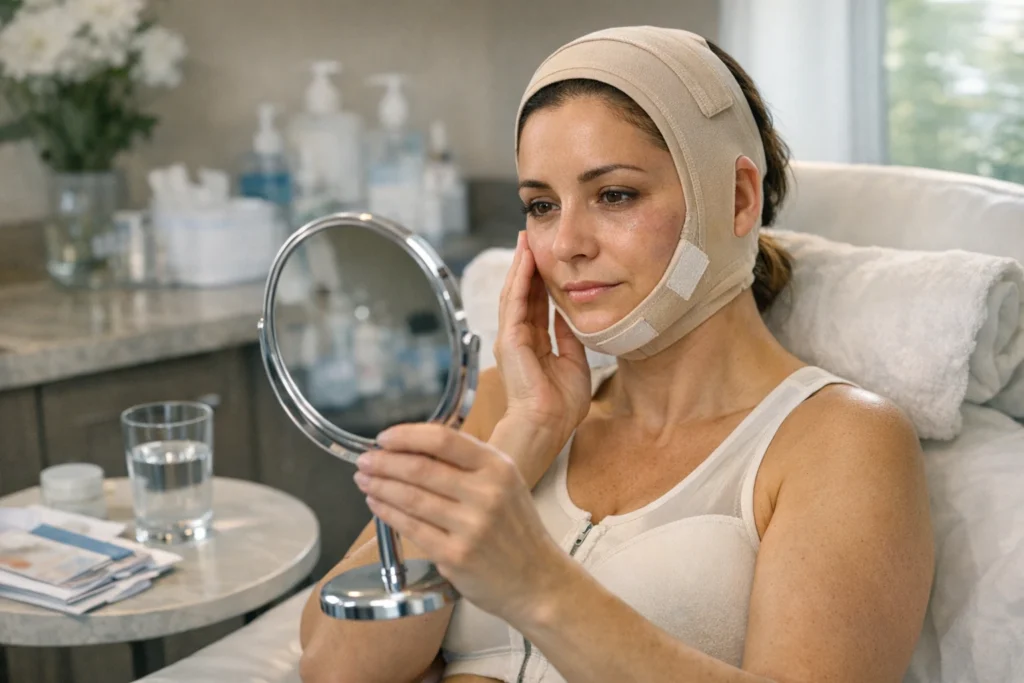
Every consultation ends with some version of the same promise: “Most of our patients are back to their normal routine within a week or two.” Sometimes that is true. Often it is not. The number quoted at booking tends to reflect the best-case patient, not the median one, and it almost never accounts for the social dimension of recovery: the bruising that shows up in Zoom calls, the compression garment you will be sleeping in, the swelling that makes you look worse at ten days than you did at two.
No clinic is going to publish a side-by-side ranking of how disruptive their procedures actually are. That comparison discourages bookings. So here it is, built from a five-tier framework and placed against the optimistic numbers you typically hear in consultation, because you deserve the honest version before you schedule time off work.
For patients also wanting to understand pain levels, not just downtime, the most painful cosmetic procedures ranking covers procedural and recovery pain across the same procedures.
Quick Answer
Cosmetic procedure recovery time ranked across five tiers: Tier 1 (same day, like Botox and filler) through Tier 5 (six-plus weeks to final result, like body lift and rhinoplasty’s swelling tail). The most commonly undersold procedures at consultation are liposuction on large areas, rhinoplasty, and tummy tuck. The ranking below uses actual time off work, compression requirements, visible bruising windows, and activity restrictions, not the optimistic number from your pre-op paperwork.
Jump to the FAQ section for specific questions about comparing recovery times before you book.
How the Ranking Criteria Work
Five factors determine each tier placement. Pain level matters less than people expect; most procedures are manageable with prescribed medication in the first few days. What actually disrupts your life is the combination of the other four.
Visible bruising and swelling duration means the window until you could appear in public, at work, or on a video call without it being immediately obvious you had a procedure. This is different from when you “feel fine.” You can feel fine and still look alarming at day nine.
Activity restriction window covers when you can exercise, lift, bend, or return to physically demanding work. For many patients this is more disruptive than the initial recovery because it extends weeks past the point where they feel recovered.
Compression garment requirement is underappreciated as a downtime factor. A patient who needs to wear a Stage 1 faja around the clock for six weeks is not living normally, even if she is technically back at work.
Time off work is estimated for a desk job unless otherwise noted. Physical work adds a week or more across every tier.
The Five-Tier Cosmetic Procedure Recovery Time Ranking
General published recovery data frames abdominoplasty as requiring roughly six to eight weeks for full recovery, while Botox and dermal filler patients typically resume normal activity the same day or within a few days. Most patients across procedure types return to work or light exercise within one to four weeks. For the full procedure volume and recovery data behind these baselines, see our full cosmetic recovery data page. Those baselines are accurate as far as they go. The tiers below add the granular layer that published summaries leave out: compression windows, social downtime, and where the marketing version diverges from the real one.
| Tier | Procedure | Actual Downtime | Compression? | Honest Note |
|---|---|---|---|---|
| Tier 1 – Back Same Day | Botox, Lip filler, Most dermal fillers, Dysport/Xeomin | 0-2 days | No | Realistic. Minor swelling and pinpoint bruising possible with filler; rarely visible to others by the next day. |
| Tier 2 – Socially Invisible in 5-7 Days | Microneedling, Light chemical peel, Kybella (early rounds), PRF/PRP injections | 3-7 days | No (chin strap for Kybella optional) | Kybella swelling can be dramatic in the first 72 hours. Microneedling redness resolves faster than patients fear but slower than the clinic says. |
| Tier 3 – About 2 Weeks | Blepharoplasty, Buccal fat removal, BBL (compression stage), Medium chemical peel, Lip lift | 10-14 days visible; 4-6 weeks activity restriction | Compression for BBL (4+ weeks) | BBL patients are often told “two weeks” but compression and sitting restrictions run much longer. Blepharoplasty bruising can extend past two weeks in some patients. |
| Tier 4 – 4-6 Weeks | Facelift, Breast augmentation (drop-and-fluff phase), Liposuction (large areas), Tummy tuck, Mini tummy tuck | 2-4 weeks off work; 6-8 weeks full recovery | Yes: binder or faja 4-8 weeks | The most undersold tier. “Minimally invasive” liposuction on the abdomen, flanks, and thighs still carries a Tier 4 burden. Breast augmentation patients are often surprised by the drop-and-fluff timeline stretching 3-4 months for final shape. |
| Tier 5 – 6+ Weeks to Final Result | Body lift, Mommy makeover, Rhinoplasty, Arm lift (brachioplasty), Thigh lift | 4-6 weeks off work; final result 6-12 months | Yes: extended compression | Rhinoplasty’s subtle swelling tail genuinely runs months to a year. Body lift and mommy makeover patients are managing multiple recovery zones simultaneously, which amplifies fatigue and complication risk. |
The Three Procedures Most Consistently Undersold at Consultation
The tier system above shows where procedures actually land. What it cannot show is the gap between that placement and what patients are told beforehand. Three procedures come up repeatedly, and the pattern is consistent enough to be worth naming directly.
Liposuction: “Minimally Invasive” Is Doing a Lot of Work
Liposuction is technically minimally invasive in the sense that there is no large incision. But large-volume lipo, or lipo across multiple zones (abdomen, flanks, back, thighs in the same session), is a real surgery with real recovery. Patients told to expect “a few days off” for a full torso case frequently contact their surgeons around day five wondering why they cannot stand upright comfortably. Bruising in lipo patients can track downward from the treatment area by gravity and appear in places the patient did not expect. Compression garment requirements routinely run six to eight weeks for full cases.
The “minimally invasive” framing is not wrong, exactly, but it sets the wrong expectation. A useful comparison: liposuction on the abdomen and flanks is roughly as disruptive to daily life as a tummy tuck in weeks two through six, even though the initial recovery looks shorter. Check the full tummy tuck recovery guide if you are deciding between procedures and want to compare the real timelines side by side.
Rhinoplasty: “Two Weeks” Is When the Cast Comes Off, Not When You Are Done
The two-week rhinoplasty recovery claim refers to when the cast or splint comes off and when patients are typically presentable for daily life. It does not refer to final result. Subtle swelling, particularly in the nasal tip, can persist for up to a year. Patients who had rhinoplasty expecting a sharp final result at six weeks are often anxious and frustrated by month three when the tip still looks thicker than expected.
This is not a complication. It is a known feature of nasal healing that is frequently underemphasized because “your nose will continue changing for twelve months” is not a sentence that closes bookings. The rhinoplasty recovery timeline covers what to expect at each stage, including why the swelling behaves so differently from other facial procedures.
Tummy Tuck: The Marketing Timeline and the Medical Timeline Are Different Documents
Published guidance, including data referenced from ASPS, places abdominoplasty recovery at roughly six to eight weeks for full recovery. Marketing materials for many practices compress this. Patients see “return to desk work in two weeks” and read it as “two week recovery.” Those are not the same statement. Two weeks off work still means six more weeks of compression, activity restriction, swell management, and incision care before the result is stable.
The patients who handle tummy tuck recovery best are the ones who planned for eight weeks of modified living, not two. The ones who struggle consistently are the ones who cleared two weeks on their calendar and nothing more.
Notable Placements Worth Unpacking
Blepharoplasty is Tier 3, which surprises some patients who heard it described as a quick outpatient procedure. It is quick, and it is outpatient, but the bruising and swelling around the eyes is highly visible and the area heals slowly because the skin is thin. Facelift patients are sometimes quoted two weeks, which aligns with when many return to daily routines, but sustained swelling and tightness persist for months. Facelift belongs in Tier 4 on a realistic timeline.
BBL sits in Tier 3 for the visible swelling window but has a Tier 4-equivalent burden when compression and positioning restrictions are factored in. Patients cannot sit or sleep on their back for weeks, which affects sleep quality, work logistics, and daily comfort in ways that a tier number cannot fully capture. The BBL recovery timeline breaks down what each week actually looks like on the positioning restriction schedule.
Kybella is placed in Tier 2 because the swelling resolves within the week for most patients, but it deserves an asterisk: the first and second sessions often produce dramatic, sausage-neck-level swelling that patients are not emotionally prepared for even when they are technically informed. Knowing swelling is coming and seeing it in the mirror are two different experiences.
How to Get an Honest Timeline at Your Consultation
Standard consultation questions yield optimistic answers because they are phrased to invite optimistic answers. “How long is recovery?” invites the best-case response. These questions surface the real number.
Ask for the median patient, not the best case. “What does recovery look like for the typical patient at your practice for this procedure, not the fastest recovery you have seen?” This signals that you want accuracy and usually gets it.
Ask separately about social downtime and activity restriction. “When would I be comfortable appearing in public or on a video call?” and “When could I return to exercise or physically demanding activity?” are different questions with different answers. Treat them that way.
Ask about compression requirements in weeks, not just “yes or no.” “How many weeks will I need to wear a compression garment, and for how many hours per day?” A six-week garment requirement at twenty-three hours a day is a different life than a two-week binder requirement after hours only.
Ask what week three looks like. Week one and two tend to be covered in consultation because that is when patients have follow-up appointments. Week three, when many patients are back to work but still uncomfortable, is often not discussed. “What should I expect in weeks three through six?” opens that conversation.
Ask your surgeon what they would tell their own family member to plan for. This is not a trick question. It consistently produces a more candid answer than any of the procedural questions above.
Frequently Asked Questions
Which cosmetic procedure has the longest real recovery time?
Body lift, mommy makeover, and rhinoplasty have the longest time to final result. Body lift and mommy makeover require four to six weeks off work and months of healing across multiple zones. Rhinoplasty tip swelling can persist for up to a year, making it the procedure with the longest gap between “feeling fine” and “seeing the actual result.”
Why do clinics quote shorter recovery times than patients actually experience?
A few reasons. First, the quoted number often reflects return to light desk work, not full recovery. Second, best-case patients are more memorable than median ones. Third, the number quoted at consultation tends to cover the acute phase (bruising, swelling, limited mobility) but not the ongoing management phase (compression, swelling fluctuation, activity restriction). The two phases together are the actual recovery.
Does a “minimally invasive” label mean shorter recovery?
Not reliably. The label refers to incision size and technique, not recovery burden. Large-volume liposuction is technically minimally invasive and carries a Tier 4 recovery. Kybella requires no incision at all and produces dramatic visible swelling for several days. The tier a procedure falls into depends on the tissue disruption, the compression requirements, and the social downtime, not on whether an incision was made.
For the full out-of-pocket breakdown that shows what you spend beyond the procedure quote, including compression garments, lymphatic massage, and the hidden costs that never make it onto the clinic handout, see our cosmetic procedure recovery cost ranking.
This article is for educational purposes only and is not a substitute for professional medical advice. Always follow your injector’s or surgeon’s specific aftercare instructions.