
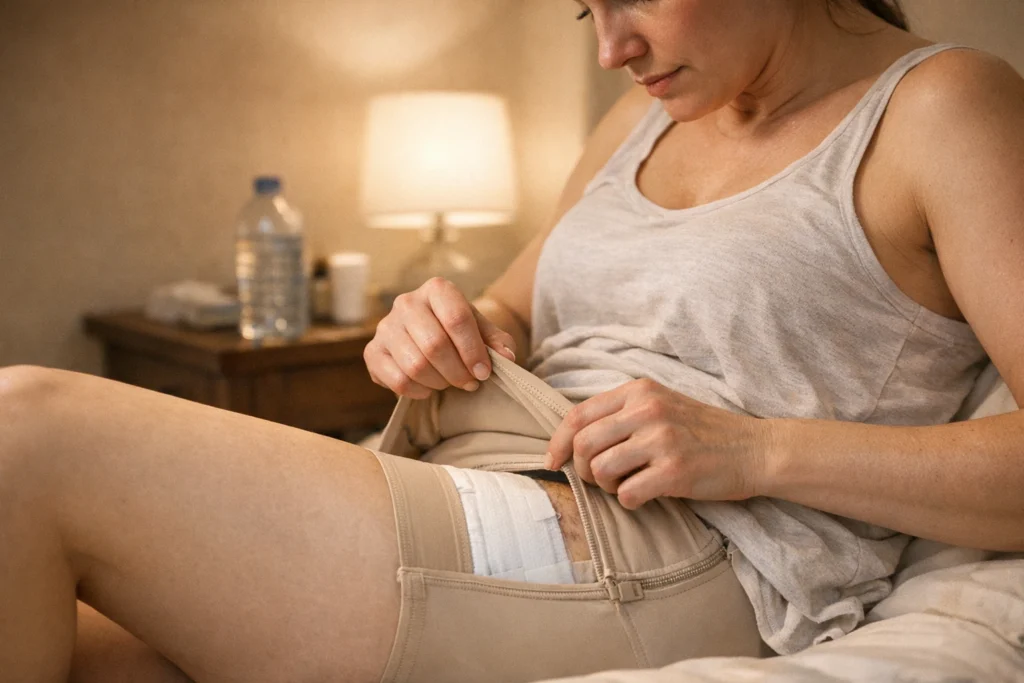
A thigh lift gets described as a “body contouring procedure” in the same breath as a tummy tuck, but the recovery comparison stops being useful around day three. Your abdomen, inconvenient as it is post-tummy-tuck, stays relatively still during daily life. Your inner thighs do not. Every step you take, every time you sit down or stand up, every time you use stairs, you are moving the exact tissue that was operated on. Most patients are not fully prepared for what that means in the first two weeks.
Thigh lift recovery is also getting a new patient population. A significant share of thigh lift patients today come to surgery after major weight loss, whether from GLP-1 medications, bariatric procedures, or other means. Excess skin is the primary concern, not fat volume, and those patients have different healing considerations than the traditional candidate. If that describes you, there is a section below specifically for you.
Quick Answer
Thigh lift recovery takes two to four weeks before you walk normally, with four to six weeks until you can return to most activities. Scar lines run through a high-friction, high-flexion zone, which makes them more prone to stretching and irritation than scars in lower-movement areas. Compression garment wear typically runs six to eight weeks. Final scar appearance takes twelve to eighteen months to fully mature.
Jump to the FAQ section for specific questions about thigh lift scars, mobility, and return to exercise.
Incision Pattern Determines Your Recovery Experience More Than Procedure Name Does
Three incision patterns are used for thigh lifts, and which one applies to you shapes almost everything about your recovery: where the scars land, how much mobility you lose temporarily, and what the long-term scar management challenge looks like.
A medial thigh lift uses an incision in the groin crease. This is the most common pattern and addresses loose skin on the upper inner thigh. The scar is hidden in the groin fold, which sounds ideal, but it sits in a high-friction zone where skin meets skin and where movement constantly stresses the incision line. Walking normally puts tension on this scar with every step.
A vertical thigh lift adds an incision running down the inner thigh. This addresses more extensive laxity and allows the surgeon to remove more skin, but it places scar tissue along the inner thigh where it will be visible in shorts and swimwear. Recovery is typically more painful and mobility-restricted than a standard medial lift, and scar management becomes a long-term commitment.
A spiral thigh lift combines the groin crease incision with extensions that wrap around the thigh. It addresses circumferential laxity and is most commonly performed on post-weight-loss patients with skin excess on multiple surfaces. Recovery is the most complex of the three: more tissue disruption, longer scar lines, and a longer restriction window. If your surgeon recommended a spiral lift, plan for a recovery that is meaningfully longer than what standard thigh lift articles describe.
Walking After Thigh Lift: The First Two Weeks Look Nothing Like Normal
Walking in the first week after a medial or vertical thigh lift looks like a wide-legged shuffle. The goal is to avoid tension on the incision lines, which means keeping the thighs slightly apart and stepping carefully rather than with a normal stride length. Short, frequent walks are encouraged for circulation and lymphatic drainage, but trying to walk normally before the tissue is ready puts direct stress on incisions that are still fragile.
Most patients achieve something approaching a normal gait by week two, but it does not feel completely normal for three to four weeks. Stairs are particularly challenging because the hip flexion involved in stepping up stretches the groin incision. Patients are often surprised to find that walking is harder than they expected not because of pain, but because the body instinctively protects the incision area in ways that make normal movement feel awkward and effortful.
Swelling management during this phase matters for mobility, not just comfort. Keeping legs elevated when at rest, using compression as directed, and staying hydrated all reduce the fluid accumulation that makes movement more painful. The principles around returning to exercise after soft tissue surgery apply here, and the exercise return guide covers when it is safe to progress activity in soft tissue recovery cases.
Compression Garment Requirements and the Mobility Tradeoff
Thigh lift patients are typically in compression garments continuously for the first four to six weeks, then transition to graduated compression for another two to four weeks. The garment requirement extends longer than many patients expect, partly because the inner thigh is a high-fluid-accumulation zone and partly because compression supports the skin envelope while tissues are still reorganizing.
The compression-mobility tradeoff is real. A properly fitted compression garment does restrict range of motion. Patients who try to abbreviate the compression phase because they feel recovered often regret it at the scar maturation stage, when the scar tissue that formed without adequate compression shows more spreading or hypertrophy than it otherwise would.
Getting properly fitted garments and knowing when to transition sizes matters for outcomes. When compression begins to feel loose rather than supportive (usually around weeks two to three as initial swelling subsides), it is time to discuss a new sizing with your surgeon or surgical team.
Sitting Restrictions and Hard Surfaces
Sitting cross-legged is typically off the table for six to eight weeks, and sitting on hard surfaces (wooden chairs, hard floors, stone benches) is uncomfortable before that point. The compression garment helps, but the pressure on the inner thigh incision from hard surfaces is something patients consistently underestimate until they encounter it.
Most patients can sit comfortably in a padded office chair with normal posture around weeks two to three. Hard seating may still be uncomfortable at week four, and sitting cross-legged or in deep hip-flexion positions typically does not become comfortable until week six to eight. Patients who plan to return to desk work should check in with their surgeon about what modified sitting accommodations they may need in the early return-to-work period.
Thigh Lift Scars: Setting Realistic Expectations Before Surgery
Thigh lift scars are visible in shorts and swimwear. This is a fact that deserves direct pre-operative discussion rather than softening. The trade is excess skin and laxity for permanent scar lines, and for most patients who pursue a thigh lift it is a worthwhile trade. But patients who see only the initial nice-looking closure photos and not the twelve-month scar photos are not making a fully informed decision.
Thigh scar maturation takes twelve to eighteen months. In the first three months, scars are typically red or purple, raised, and firm. Around months four to six they begin flattening. By twelve months they have usually reached close to their final appearance, which in most patients is a pale, flat line, but in some is a more visible raised or widened scar. Skin type, genetics, and how well compression and scar therapy protocols are followed all influence final appearance.
The inner thigh scar specifically is prone to widening because of the constant friction and movement in that area. Silicone scar therapy (sheets or gel) started after the wound is fully closed and maintained consistently for six to twelve months is the intervention with the most evidence behind it. The incision scar care guide covers the post-closure scar management timeline in detail.
Post-Weight-Loss Patients: GLP-1 and Bariatric Thigh Lift Recovery
Patients who have lost significant weight before a thigh lift, whether through GLP-1 medications like semaglutide and tirzepatide or through bariatric surgery, are now a substantial share of thigh lift candidates. The reason they pursue a thigh lift is different from the classic candidate: the goal is to remove loose, excess skin rather than to address fat volume. The recovery experience is also different in ways that are not always discussed.
Skin that has been stretched significantly and then lost volume has different properties than skin that was never stretched. It is often thinner, less elastic, and can have compromised wound-healing capacity depending on the patient’s overall nutrition status at the time of surgery. Patients who are still losing weight rapidly on GLP-1 medications at the time of surgery, or who had surgery relatively recently, may have healing considerations that typical thigh lift recovery timelines do not account for.
This population also has a higher likelihood of being referred for a spiral thigh lift or extended vertical lift because skin laxity is often more extensive and circumferential. The recovery for these procedures, as noted above, is more demanding than a standard medial lift. For a broader look at how GLP-1-driven weight loss affects skin quality and healing, the GLP-1 skin laxity guide covers the specific considerations for this patient group.
Normal vs. Not Normal After Thigh Lift
Call Your Provider
Fever above 101.5 F
Wound separation more than a few millimeters, or separation with discharge
Increasing rather than decreasing pain after day five
A firm, tender, defined lump that appeared suddenly (could indicate seroma or hematoma)
Numbness that is spreading rather than resolving
Skin color changes (blue, purple, dusky) around the incision site
Normal in Thigh Lift Recovery
Wide-legged, shuffling gait in the first week
Significant bruising extending down toward the knee by gravity
Itching along incision lines as healing progresses
Red, raised, firm scar appearance for the first three to four months
Temporary numbness or altered sensation on the inner thigh
Discomfort sitting on hard surfaces through week six
Frequently Asked Questions
How long until thigh lift scars are not noticeable in shorts?
Medial thigh lift scars sit in the groin crease and may be relatively hidden in loose shorts, but they can be visible in fitted shorts or swimwear. Vertical thigh lift scars along the inner thigh are visible in most shorts and swimwear until they fade. Full scar maturation takes twelve to eighteen months, and consistent silicone scar therapy throughout that window gives the best chance of a flat, pale final appearance. Some patients have excellent cosmetic outcomes; others have more visible scars. Genetics and compliance with scar care protocols are the main variables you can partially control.
Can I return to exercise after thigh lift recovery?
Light walking is typically encouraged from day one to two, but actual exercise, including walking at pace, cycling, or any lower body resistance work, is typically cleared at four to six weeks depending on your healing. High-impact and inner thigh-specific movements (sumo squats, wide-stance exercises, lateral lunges) are often held off the longest because they directly stress the incision area. Always get clearance from your surgeon before returning to specific activities.
Does the thigh lift recovery differ for patients who had significant weight loss?
Yes, it can. Patients with a history of major weight loss may have thinner skin with different healing properties, a higher likelihood of being recommended for a more extensive incision pattern (spiral or vertical), and in some cases slower wound healing if their nutritional status or protein intake is suboptimal at time of surgery. The emotional dimension is also different: many weight-loss patients have complex relationships with their bodies after significant transformation, and the temporary appearance of swelling and bruising during recovery can be challenging. Working with a surgeon experienced in post-weight-loss body contouring matters for both technical and supportive care reasons.
This article is for educational purposes only and is not a substitute for professional medical advice. Always follow your injector’s or surgeon’s specific aftercare instructions.