
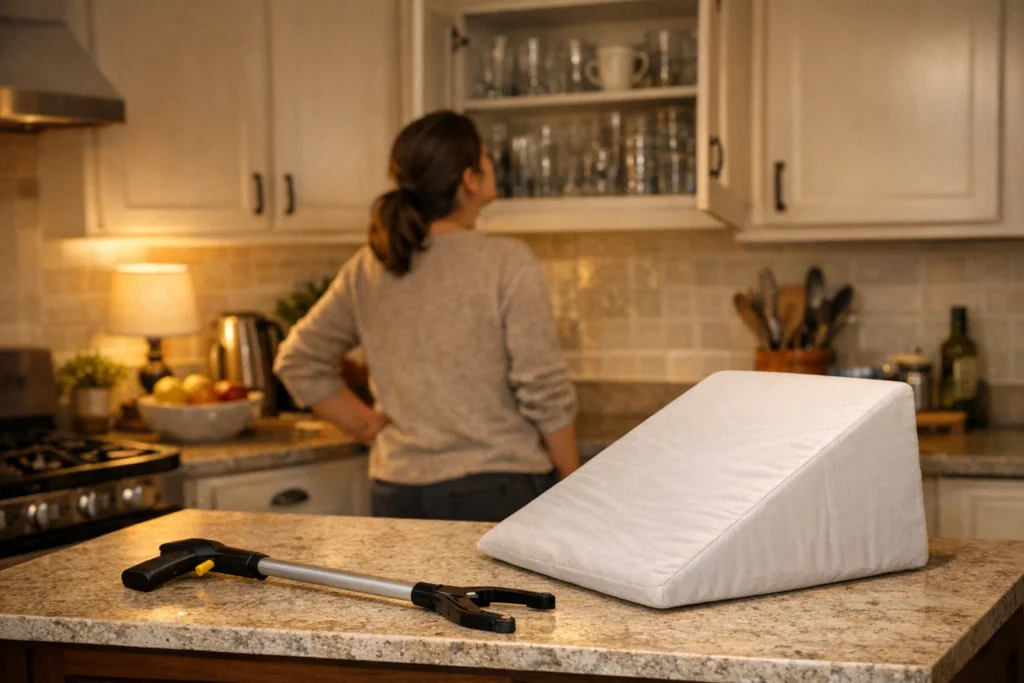
You are home from surgery. You have what your surgical practice gave you: discharge instructions, prescriptions, an appointment date. And you realize, standing in your kitchen, that getting a glass of water requires bending to reach the lower cabinet where you keep the glasses, and you cannot bend. You did not think about this before surgery. You are thinking about it now.
Looking for a quick answer? Jump to the FAQ below.
The short answer
Buy the grabber tool, the wedge pillow, and the raised toilet seat before surgery, not on day two when you realize you need them. Prep meals and freeze them. Arrange childcare and pet care for the full restriction period. Fill prescriptions before the procedure. Have button-front clothing and slip-on shoes ready. Practice the required sleep position before surgery day.
Why Your Surgeon’s Pre-Op List Misses the Most Important Part
Pre-operative instructions from surgical practices are almost entirely focused on the body: what to stop eating, what medications to avoid, when to shower with the provided wash. They are rarely focused on the environment the patient returns to after surgery. The home environment has a measurable effect on recovery outcomes. Patients who fall in the bathroom in week one, who sleep in a wrong position because their pillow setup fails, or who skip lymphatic massage because getting out of the house is too physically demanding, these outcomes are avoidable with preparation. The surgeon’s job is the procedure. Preparing the environment is the patient’s job, and most practices do not give a list for it.
This is especially true for tummy tuck recovery, BBL recovery, and other body contouring procedures. For a detailed look at the post-surgical demands of tummy tuck recovery, the home setup considerations are a significant part of the first week experience.
Pre-surgery nutrition preparation is the companion to home preparation: pre-surgery nutrition planning covers the body preparation side of this same pre-care period.
The Bedroom: Your Recovery Headquarters

The bed is where most of the recovery happens. Getting this right before surgery day makes weeks one and two dramatically more manageable.
Head and body elevation is non-negotiable for facial surgery, breast surgery, and tummy tuck patients. Sleeping flat is not possible in the first weeks and attempts to do it cause discomfort and can worsen swelling. A wedge pillow system that maintains 30-45 degree elevation without requiring constant pillow restacking is the single most useful bedroom purchase for most surgical recoveries.
Practice the sleep position before surgery. This is genuinely underutilized advice. If the procedure requires back sleeping (most breast and facial surgery), or stomach sleeping (BBL), establishing the position before surgery day, when you have full mobility to adjust, leads to significantly better rest during recovery. BBL sleep positioning requirements in particular are specific enough that BBL recovery preparation should include a full practice night before surgery.
Bedside supplies for the first 24-48 hours need to be within arm’s reach without requiring stretching or bending: a water bottle with a straw (no lifting a glass), medications already organized with timing labels, phone charger, the remote. Ice packs in rotation from the freezer. The surgeon’s contact number written down somewhere physical, because clarity of thought is reduced on pain medication and “I will look it up if I need it” does not work at 2am on night two.
Clothing for the recovery period needs to be thought through before surgery. Button-front tops and elastic-waist bottoms for the first weeks. For lipo, tummy tuck, and BBL patients, clothing must go over the compression garment and be easy to remove without significant lifting or straining. Slip-on shoes from surgery day. No bending to tie laces.
The Bathroom: The Highest-Risk Room in Recovery
Most patients significantly underestimate how challenging the bathroom is in the first days after surgery. Pain, reduced stability, and fatigue combine in an environment that requires balance and mobility.
A shower chair or bath bench makes the first shower safe rather than risky for any patient with significant mobility restriction. Standing for a full shower on post-surgical day 3-5 is more difficult than most patients anticipate. A chair eliminates that risk entirely.
The raised toilet seat is one of the two items (along with the grabber tool) that patients most commonly buy after surgery rather than before. For tummy tuck, liposuction, and BBL patients, lowering to a standard toilet height requires core engagement that is more painful and difficult than expected. A toilet riser of 3-5 inches removes this problem entirely. Both items cost under $25 and take minutes to install. The pattern is consistent: patients who buy these after day two always say they should have bought them before surgery day.
A temporary suction-mount grab bar near the shower entry provides a safety anchor for the first week. A long-handled sponge or back brush addresses body areas that cannot be reached without bending, which is relevant for every tummy tuck and liposuction patient who needs to shower around incision sites.
The Kitchen and the Grabber Tool
Meal prep before surgery is one of the highest-value preparations. Preparing and freezing meals before the procedure eliminates the need to cook or stand at a counter during the first week. High protein, easy to eat, in containers that open without significant grip strength. A small bedside cooler stocked with drinks and light snacks before surgery day reduces how often the kitchen needs to be visited.
The grabber tool is the most frequently mentioned item by patients who wish they had prepared better. A 32-36 inch reacher prevents the need to bend to pick things up from the floor, reach low shelves, or retrieve items that fall. It also picks up items from high shelves without raising the arms overhead, which matters for breast surgery patients. One tool. Two applications. Both highly relevant.
Straws matter for facial surgery, rhinoplasty, buccal fat, and any procedure limiting jaw movement or head tilting. Note that BBL patients in the first days should confirm with their surgeon whether suction pressure is contraindicated for their specific procedure.
Childcare, Pet Care, and the Things That Cannot Be Improvised
This is the single most important non-product preparation for any surgical recovery.
No lifting children for the restriction period specific to the procedure. Most post-surgical patients cannot pick up a child or pet for 2-6 weeks depending on what was done. Children who jump onto a healing tummy tuck patient are a medical emergency risk. Dogs who jump in greeting are the same. This must be arranged specifically before surgery, not managed around day-to-day during recovery. Filling all prescriptions beforehand and arranging support for children and pets allows the patient’s sole responsibility during recovery to be healing.
The caregiver also needs preparation. A patient recovering from major body contouring who needs help with drains, compression garment changes, and meals for the first week is a significant caregiving role. A clear agreement with whoever is helping, and possibly more than one person across the recovery period, prevents both abandonment and resentment. The first-time surgical recovery caregiver is frequently unprepared for the commitment involved.
No driving while taking prescription pain medication, typically the first 7-10 days for most procedures. This is not a suggestion. Arrange someone for all errands, follow-up appointments, and prescription collection for this period.
Entertainment and mental preparation are underrated. A curated list of shows, podcasts, and audiobooks ready before surgery helps pass the time and supports the mental rest that is part of healing. The boredom of being restricted to a position and unable to be productive is underestimated by almost every first-time surgical patient. The patient who goes into recovery with a mental plan for occupying their time has a significantly better emotional experience than the patient who discovers on day two that they can do nothing but stare at the ceiling.
Signs your home setup is working
- You can reach everything you need without bending, stretching, or straining
- Meals and medications are accessible without significant effort
- Your sleep position maintains the required elevation without constant adjustment
- Your caregiver has a clear understanding of what they need to do and when
Address immediately if
- You are bending to pick things up from the floor against surgical restrictions
- Shower access requires standing unsupported for longer than you safely can
- You do not have someone available for driving to follow-up appointments while on pain medication
- Children or pets have unrestricted access to the recovery space
Frequently Asked Questions
What should I buy before cosmetic surgery?
The highest-priority items for most surgical recoveries: a wedge pillow (firm foam, 30-45 degrees), a grabber tool (32-36 inch), a raised toilet seat (3-5 inch riser), a shower chair, button-front clothing, slip-on shoes, and a water bottle with a straw. Fill all prescriptions before surgery day. Stock a bedside table with medications, phone charger, and the surgeon’s contact number. Freeze meals before the procedure date.
How long do I need someone to help me after surgery?
For most cosmetic surgical procedures, plan for at least 7-10 days of support for daily tasks including driving, meal preparation, and assistance with drains or dressing changes. Major body contouring procedures like tummy tuck may require support for 2 weeks or more. Plan for more support than you think you will need, not less. Most patients overestimate their independence in the first week and are grateful for arrangements they thought they might not use.
Can I set up my recovery space the day of surgery?
No. The setup needs to be complete before you leave for the procedure. You will return home in pain, potentially groggy from anesthesia, and without the physical ability to move furniture or stock a bedside table. Everything should be in place, tested, and easily accessible from surgery morning. Practice the sleep position. Know where every item is before you need it in the dark at 3am on night one.
On the supplement side, the evidence supports collagen supplementation as part of the broader pre-surgical preparation plan — hydrolyzed collagen peptides at 10-15g daily starting one to two weeks before surgery have the strongest clinical backing of any peri-surgical supplement.
This article is for educational purposes only and is not a substitute for professional medical advice. Always follow your injector’s or surgeon’s specific aftercare instructions.